 Skip to content

Have you ever been at a crowded concert or a bustling stadium and your phone’s data slows to a crawl? It’s a frustratingly common experience. As more and more devices connect to the network, the old way of broadcasting signals becomes inefficient. This is where some fascinating new technologies come into play. I’m talking about beamforming and phased array antennas, and they’re not just improving 5G; they’re completely changing the game for wireless coverage. The global Massive MIMO and beamforming market is projected to grow exponentially in the coming years, a testament to its transformative impact.
Beamforming and phased array antennas work together to focus 5G signals directly on your device, rather than broadcasting them in all directions. This targeted approach, made possible by using multiple antennas to create a steerable beam of radio waves, results in a stronger, more reliable connection with less interference. This technology is particularly crucial for the high-frequency millimeter-wave (mmWave) bands that give 5G its incredible speed but have a shorter range.

But here’s an interesting twist: while some advanced techniques, like DPBF (Digitally Processed Beamforming), can create broad beams with a spatially flat array factor, most real-world antenna systems aren’t designed for true omnidirectional coverage. Instead, antennas are engineered to serve a specific angular sector—think of the classic three-sector deployment model you see on cell towers. Each sector typically covers about 120°, meaning that the array factor needs to be more focused (or narrower) than a truly omnidirectional setup. This sector-focused design ensures that energy is concentrated where it’s needed most, maximizing coverage and minimizing wasted signal.
Think you need to know more? Read on to discover how this technology, once the domain of military applications, is now in your hands, making your 5G experience faster and more dependable.
The Challenge with 5G and High-Frequency Signals
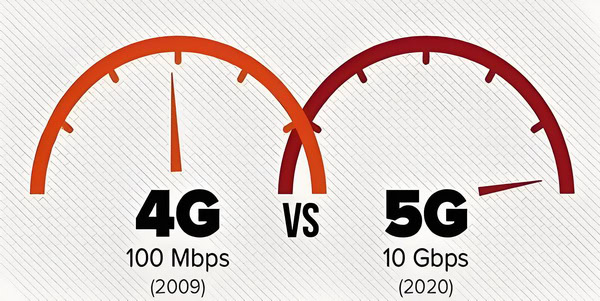
Let’s get one thing straight: 5G is a massive leap forward. It promises speeds that can be up to 100 times faster than 4G, which opens the door for incredible innovations like autonomous vehicles, remote surgery, and immersive virtual reality experiences. To achieve these lightning-fast speeds, 5G utilizes a wider range of frequencies, including the high-band millimeter-wave (mmWave) spectrum.
But here’s the catch. While mmWave signals are super-fast, they’re also a bit delicate. They have a much shorter range and are easily blocked by obstacles like buildings, trees, and even rain. This is a huge hurdle for providing widespread, reliable 5G coverage, especially indoors. If we relied on traditional antennas that broadcast signals in all directions, a lot of that precious mmWave signal would be wasted and easily obstructed.
This is the fundamental problem that beamforming and phased array antennas are so brilliantly solving.
What Makes 5G NR Different: Decoupling Data and Synchronization Beams
Here’s where 5G New Radio (NR) throws a curveball compared to 4G LTE: it separates the transmission of data from the synchronization signals, which completely changes the performance playbook.
In 4G LTE, your phone’s connection quality—the kind measured by metrics like RSRP (Reference Signal Received Power) and SINR (Signal-to-Interference-plus-Noise Ratio)—is tightly tied to the signals beaming out from every cell tower. Basically, if you had a strong reference signal from your cell, you could count on fast, reliable data speeds.
But in 5G NR, things are more nuanced. The initial synchronization and cell selection—handled by the Synchronization Signal Block (SSB)—are kept apart from the high-speed data delivery, which uses their own precisely targeted “traffic beams.” This means improving the metrics (RSRP/SINR) for the SSB doesn’t always deliver better data performance, since your phone’s actual data flows down a totally different channel.
The Practical Impact for Users
- Robust Initial Access: The PBCH (Physical Broadcast Channel) within the SSB is designed to be super rugged. Even in challenging environments (like deep inside buildings or during bad weather), it can usually be picked up by your phone, preventing coverage blackouts during the connection handshake.
- Mobility and Handover: When your phone decides which cell to latch onto, it compares the relative signal strength between SSBs from different towers. A higher SSB signal doesn’t necessarily mean a faster or more reliable connection, just a clearer “You are here” ping for navigation.
- No One-Size-Fits-All Boost: Simply ramping up the SSB signal or sweeping it with additional beams doesn’t guarantee a better experience. Sometimes it can even muddy the handover process between cells, because interference and real-world congestion aren’t captured in those synchronization measurements.
In short, while 4G LTE was a single-lane road where your reference signal said it all, 5G’s dual-path approach lets it fine-tune and target data delivery—making the connection smarter, not just stronger. This is one of the big reasons 5G networks can balance blistering speeds with reliable coverage in our modern, device-packed world.
Meet the Dynamic Duo: Beamforming and Phased Array Antennas
To understand how 5G overcomes these hurdles, we need to look at two key technologies that work hand-in-hand: phased array antennas and beamforming.
Phased Array Antennas: The Foundation
Imagine instead of one big antenna, you have a group of many small antennas working together. That’s the basic idea behind a phased array antenna. This technology has actually been around for decades, primarily used in military radar systems. Now, it’s a cornerstone of 5G.
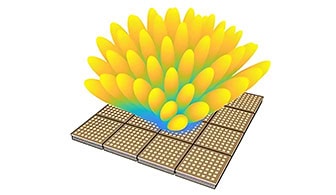
These arrays can consist of a handful to thousands of tiny antenna elements. By slightly delaying the signal sent to each individual antenna, we can control the direction of the overall signal beam. This is all done electronically, meaning there are no moving parts, which makes the system incredibly fast and reliable.
Taming the Complexity: 2D Broad-Beam Design in Practice
So, what happens when you need to direct your signal not just side-to-side, but also up-and-down? Enter the 2D broad-beam design. With antennas made of many branches (think: huge arrays of tiny transmitters all working together), designing beams that can sweep both horizontally and vertically sounds great in theory—but it can be a real computational bear in practice. Optimizing these complex patterns across two dimensions often means tackling large, time-intensive math problems.
Here’s the bright side: many real-world beamforming scenarios allow us to break that complex 2D puzzle into two much simpler ones—one for each direction. Instead of wrestling with a massive task all at once, engineers can optimize the horizontal and vertical beams separately, using powerful algorithms from the likes of MIT and Stanford. This clever shortcut slashes the time it takes to find the best beam shapes, making quick, efficient design possible for even the largest antenna arrays.
Broad-Beam Designs: Casting a Wide (But Not Always Perfect) Net
Let’s break down what actually happens when cell towers use broad-beam designs—like the classic Gaussian 65° half-power beamwidth (HPBW)—to provide coverage. These “wide angle” beams are the telecom equivalent of throwing a big party invitation across a whole neighborhood. In other words, their main job is to blanket a large area with signal, making sure devices in every corner of a sector (often up to 120° wide!) have a fighting chance of connecting.
But, as with most things in life, there’s a trade-off. While these Gaussian broad-beam patterns do a decent job of spanning a big area, they often paint with too broad a brush. The actual way a data beam behaves within that sector can be wider than the original 65°, and this means the broad-beam doesn’t always capture the antenna’s real strengths—especially when it comes to locking onto traffic-heavy hotspots.
Now, some advanced designs try to mitigate this by cleverly optimizing the beam’s shape to better match where devices actually cluster, or by slicing the coverage into several smaller beams. For example:
- Optimized single beams can be tailored to track devices more precisely within wide sectors, aligning the overall coverage with real-world usage patterns.
- Multi-beam approaches divide a sector into multiple focused beams, which improves directivity (think of it like swapping a lantern for a series of flashlights) and reduces signal fluctuations in the main direction.
In short: broad-beam designs are great for quick, wide coverage, making them ideal for general broadcast signaling. However, when precise performance and efficient data delivery are needed—especially in high-traffic zones—optimized or multi-beam strategies step in, focusing energy where it matters most for a stronger, more stable connection.
Polarization Diversity: Unlocking More Reliable Connections
So, how do we tackle the challenge of polarization diversity in modern antenna systems? Enter dual-polarized beamforming (DPBF)—a cleverly engineered approach that allows antennas to transmit and receive signals in multiple polarizations at the same time. Think of it as having two sets of spotlights, each shining in a different direction, but working together to fully illuminate the stage.
By generating beams with orthogonal (meaning, at right angles) polarizations, DPBF provides several advantages:
- Enhanced Signal Quality: With two broad beams operating in separate polarizations, antennas can optimize both the uplink and downlink, resulting in fewer dropped connections and less interference.
- Wider Coverage for Multiple Use Cases: Need to keep signals strong while users move around or when mapping channel state information? Dual polarization ensures both coverage and reliability in environments with high mobility.
- Flexible Beam Shapes: Through sophisticated math, like arranging antennas in specific Golay array patterns, these systems sculpt the radiation pattern to match real-world user locations and traffic hotspots—without wasting valuable power.
In essence, polarization diversity with DPBF opens up the airwaves for more users, better performance, and robust 5G coverage—no matter how crowded your stadium or how rainy your day may be.
How DPBF Crafts Broad Beams in Orthogonal Polarizations
Now, let’s add another tool to our wireless toolbox: Dual-Polarization Beamforming (DPBF). This technique doesn’t just aim a single narrow signal like a precision spotlight—it also lets us intentionally broaden the beam, or even craft multiple beams that each “point” in different directions and polarizations.
Here’s how it works: By carefully tweaking the phase and amplitude of the signals sent to each antenna element within a phased array, DPBF can shape the overall beam to be wide or narrow as needed. If that sounds like the DJ playing with sliders and knobs at a concert, you’re onto something. This flexibility means the beam can be broadened to cover more area—helpful for scenarios where many users are scattered across a sector, or when a precise beam just isn’t practical due to the cell’s shape or layout.
But there’s more: DPBF isn’t limited to shaping a single beam. It can also generate a second, equally broad beam in a polarization that’s orthogonal—or perpendicular—to the first. Imagine one beam vibrating “up and down” and the other “side to side.” This dual-polarized approach is a big win for certain real-world use cases:
- Uplink Optimization: In networks where devices are extremely mobile (say, people moving around in a stadium or train station), having two broad beams in different polarizations helps ensure everyone stays connected, no matter how devices are oriented.
- Reference Signal Mapping: For accurate channel state information, sometimes wide beams in both polarizations are essential, giving the network a clearer picture of the environment and device locations.
- Flexible Coverage: When cell shapes are irregular—think stadiums, airports, or urban canyons—engineers can fit the beam shapes to maximize useful coverage and minimize wasted signal.
In short, DPBF offers a kind of “beam sculpting”, helping 5G networks be more adaptive, responsive, and reliable—even in challenging environments or for specialized use cases.
The Math Behind the Magic: Golay Array Pairs and Dual-Polarized Beamforming
So, how do these modern phased array systems craft such precise and efficient beams? The secret sauce lies in some really fascinating mathematics—specifically, Golay array pairs.
Golay array pairs are special sets of sequences with remarkable properties, first discovered by Marcel Golay (who, fun fact, also left his mark on fields from telephony to cryptography). When used in phased arrays, these sequences allow for the formation of broad, uniform beams while minimizing wasted power. Unlike traditional approaches that might create patchy or uneven coverage, Golay pairs help ensure the energy is spread out exactly where it needs to be—no more, no less.
In dual-polarized beamforming (or DPBF, for fellow acronym fans), signals are transmitted and received in two different polarizations—think of it like using both vertical and horizontal stripes of radio waves. By leveraging Golay sequences in this configuration, 5G antennas can simultaneously manage more connections and keep the signal strong and efficient, even as they handle the complex demands of crowded environments.
Why Single-Antenna Transmission Falls Short
You might wonder: why not just use a single antenna element when we want to create a broad beam to cover more area? It sounds simple, but here’s the hitch—doing so actually wastes a lot of power. A lone antenna naturally emits its signal in all directions, much like shouting in a crowded park. Sure, your voice spreads far and wide, but most of that energy never reaches the people you actually want to talk to.
With a single element, all of the transmitter’s power is smeared out over a huge area, so only a small fraction reaches any one device. That means much of the energy gets lost along the way, resulting in weaker connections and limited coverage. By comparison, when you use a coordinated array of antennas—phased array style—you can focus that same power directly where it’s needed, making your signal not just stronger, but far more efficient.
Typical Setups: Active Antenna Systems and DPBF in Action
So, what does a typical active antenna system look like when it comes to mid-band 5G? Most mid-band setups feature eight columns of antenna elements—think of it as an organized array, almost like the ranks of musicians in a symphony. In practice, these configurations scale up to 32 or even 64 branches, allowing for impressive power and flexibility.
Each of these tiny antenna elements doesn’t just transmit or receive in a single orientation. Instead, they use dual polarizations—usually angled at +45° and -45°—to help maximize signal efficiency and reliability, especially in complex city environments. And with a half-power beamwidth (HPBW) of about 90°, they manage to balance coverage and focus, giving operators the best of both worlds.
Now, here’s where things get interesting with Digital Pre-Distorted Beamforming (DPBF). This technique lets engineers shape and steer the beams produced by these phased arrays with precision, creating targeted signal patterns—much like aiming several spotlights in different directions all at once. The outcome? Improved signal strength and much less wasted energy, making 5G signals more robust and flexible than ever before.
How Dual-Polarized Antennas Achieve Broad Coverage
But there’s another clever trick engineers use to make sure every corner gets coverage: combining different polarization patterns. Here’s how it works.
Instead of relying on a single orientation, dual-polarized antenna arrays can send out signals in two orthogonal (think: perpendicular) polarizations—let’s call them “vertical” and “horizontal.” On their own, each polarization creates a unique radiation pattern, complete with its own peaks and dips—like two spotlights sweeping across a stage, each leaving some areas in shadow.
The magic happens when these two polarizations are carefully designed so their patterns fill in for one another. Where one polarization dips, the other peaks—so when you add up the energy from both, the result is a much broader, more even beam that spans the whole coverage area. Some clever math, like using pairs of Golay complementary arrays (discovered way back in the 1940s), ensures these two patterns are always “complementing” each other, smoothing out the overall effect.
For your device—if it’s equipped to pick up both polarizations—this means a nice, wide signal blanket instead of patchy, uneven coverage. No more stepping to the left, holding your phone in the air, or standing on one leg to get a bar of signal. Dual-polarized arrays give 5G networks the power to keep every user, in every direction, confidently connected.
Beamforming: The Director of the Show
If the phased array antenna is the orchestra, beamforming is the conductor. Beamforming is the technique of using the phased array to steer a focused beam of radio waves directly toward a specific device or user. Think of it like the difference between a floodlight that illuminates a whole yard and a spotlight that can be aimed directly at a person.
Instead of wastefully broadcasting the signal in all directions, beamforming concentrates the energy where it’s needed most. This results in a stronger, more stable signal for the user and significantly less interference for others.
But there’s more happening behind the curtain. In networks using massive MIMO (Multiple Input, Multiple Output), beamforming gets even smarter. The base station forms narrow, high-gain beams—sometimes called “traffic beams” or “user data beams”—that can be aimed precisely at individual users. The larger the antenna array, the narrower and more powerful these beams become, which boosts both user experience and overall network capacity.
This precise targeting is accomplished by adjusting the timing and phase of the signals sent from each antenna element, forming a combined radiation pattern that amplifies energy in the desired direction and mutes it elsewhere. In fact, a popular way to determine these adjustments is by using mathematics like the discrete Fourier transform, which helps create those razor-sharp beams.
Not every transmission is aimed at just one user, though. Sometimes, the network needs to send information to every device in a cell at once—think of initial connection setups, broadcast notifications, or control signals. For these situations, beamforming can create broader beams (or sweep multiple beams across the area) to ensure everyone gets the message, even if it adds a bit of overhead to the system.
So, beamforming is both the precision instrument that delivers blazing speeds to your phone and the broad brush that keeps the whole network in sync.
Why Broad Beams Matter for 5G Broadcast and Control Channels
Now, while beamforming is fantastic for targeting individual devices with razor-sharp precision, there are moments when it pays to dial things back and take a broader approach—literally. In 5G networks, not every communication is a one-on-one affair. Sometimes, the network needs to transmit information to every device within a given area at once.
Enter the broad beam.
So, why do we need these wider beams? Picture the opening act at a stadium concert: before the main show begins, the organizers need to make announcements that everyone—front row and nosebleeds alike—can hear. In the world of 5G, this is where broadcast and control signaling come in. These channels—responsible for vital tasks like synchronization, initial network access, and mobility management—must reach all devices, whether they’re brand new to the network or already connected.
Some examples include:
- Control channels (like the physical downlink control channel, or PDCCH), which handle scheduling and essential commands for all users in a cell.
- Broadcast channels (such as the physical broadcast channel, or PBCH), which transmit important system information every device needs to get up and running.
- Synchronization signals, which help your device latch onto the network for the first time or when switching between cells.
In these cases, using a narrow, device-specific beam just won’t cut it—you’d miss devices that aren’t already precisely targeted. That’s why broad beams (or sometimes a few of them) sweep across the whole sector, making sure every device gets the memo, regardless of where it’s located.
These types of transmissions don’t demand much data per device, but their reach needs to be universal within the cell. So, broad beams are engineered to evenly distribute radio energy across a wide area, ensuring seamless and reliable coverage for the basic network functions that keep us all connected.
There are a few different flavors of beamforming:
Analog Beamforming: This method uses analog components to steer the radio waves. It’s practical for large antenna arrays but offers less flexibility.
Digital Beamforming: This more advanced technique uses digital signal processors to calculate the optimal signal path for each radio wave. It allows a single antenna array to serve multiple users with individual beams simultaneously, which is ideal for 5G.

Hybrid Beamforming: As the name suggests, this approach combines both analog and digital techniques to strike a balance between performance, complexity, and cost.
Broad Beams Without Wasting Power: The Magic of DPBF
At this point, you might be wondering: sure, narrow beams are fantastic for targeting individual devices—but what about those moments when you need to reach lots of devices at once? That’s where broad-beam coverage comes into play, especially for important network tasks like broadcasting synchronization signals or control data to everyone in a coverage area.
This is where Dual-Polarized Beamforming, or DPBF, enters the spotlight. DPBF is an advanced beamforming method that lets large antenna arrays generate wide coverage beams, but here’s the real trick: it does it without scattering precious power all over the place.
How does DPBF pull this off? Instead of simply blasting energy in every direction or compromising signal quality, DPBF cleverly manipulates the phase and polarization of the antenna elements—kind of like fine-tuning a choir so that everyone’s voice adds up to a powerful, harmonious sound. This approach uses mathematical patterns (think: clever spreadsheets, not random guesswork) to precisely shape the coverage area, delivering a broad beam where you want it and minimizing wasted energy.
The result? You get the wide coverage needed for things like synchronization signals or serving lots of devices moving through a cell—without squandering power or reducing capacity. Plus, by harnessing polarization diversity, DPBF boosts signal robustness and reliability across various environments.
Together, phased array antennas and beamforming create a smart, dynamic system that can “find” your device and deliver a highly concentrated signal, power-slamming through the challenges of mmWave frequencies.
Dual-Polarized Beamforming (DPBF): Expanding the 5G Toolkit
Now, if you really want to see phased array antennas and beamforming flex their muscles, let’s dive into the concept of dual-polarized beamforming, or DPBF. While the name sounds like something out of a sci-fi manual, its role is surprisingly practical, especially when it comes to shaping and covering those all-important 5G cells.
So, what exactly is “dual-polarized beamforming”? At its core, this is a clever technique that takes advantage of two orthogonal polarizations (think of them as two directions that radio waves can be oriented, like vertical and horizontal). By managing and combining these, the antenna system can generate beams with different shapes and widths, not just narrow slivers for high-speed, targeted data, but also broad “floodlight” beams for total coverage—crucial when you need to broadcast system-wide signals, like synchronization blocks.
Here’s why DPBF is a big deal:
- Flexible Coverage: Instead of being locked into just narrow beams, DPBF lets network operators tailor the shape and width of the coverage area. This is ideal for irregular cell shapes or when precise coverage is needed for different neighborhoods, city blocks, or challenging indoor spots.
- All-in-One Approach: Thanks to the dual-polarization aspect, you can simultaneously send out beams in two directions, which is super helpful for optimizing both uplink and downlink communications—even when conditions change.
- Smart Optimization: With a mix of phase (timing) tweaks and small changes in amplitude (power), DPBF can be tuned to balance energy efficiency with the need to “light up” the right physical spaces, without wasting precious signal strength.
In practice, a modern active antenna may have dozens of columns, and each little antenna—each with its own “mini-beam”—can be controlled to contribute to the perfect overall pattern. The result is a customizable signal blanket that matches the exact shape of the area you want your 5G coverage to reach, whether that’s a park, a shopping mall, or a busy downtown intersection. Doing this with two polarizations adds an extra dimension of reliability and performance, especially as people and devices move around.
Dual-polarized beamforming essentially gives mobile networks the ability to draw their own boundaries—wide or narrow, flat or peaked—using a sophisticated electronic paintbrush. This means robust coverage, better service at the edges of cells, and more efficient use of every watt and radio wave.
Applying DPBF in Multiple Dimensions
So, can DPBF (Dual-Partitioned Beamforming) work its magic in more than one direction? Absolutely. Although the earlier examples focused on the horizontal plane, this technique isn’t limited to just side-to-side action. DPBF can be applied in both the horizontal and vertical dimensions—essentially sculpting the shape of the beam in true three-dimensional space.
Now, here’s where things get interesting for antenna designers. Crafting a 2D beam (covering both width and height) across a large array usually sounds like a marathon optimization problem, tying up time and computing power. But thanks to the mathematical properties of many 2D beamforming weight matrices, these optimizations often “split” into two simpler tasks—one for the horizontal, one for the vertical. In practical terms, this means faster processing and less computational headache, making advanced beamforming more attainable for real-world 5G networks.
Together, phased array antennas and beamforming create a smart, dynamic system that can “find” your device and deliver a highly concentrated signal, power-slamming through the challenges of mmWave frequencies.
Shaping the Perfect Beam: Optimizing Patterns for Every Scenario
Now, let’s talk shop: how do engineers fine-tune these beams to suit different real-world environments? After all, no two 5G deployment scenarios are exactly alike—what works for a dense city block isn’t always the best fit for a sprawling suburb or a busy stadium.
The key lies in clever manipulation of the beam’s shape and width. By adjusting both the timing (or phase) and the strength (amplitude) of the signals sent from each antenna element, we can create custom-tailored beams. Here’s how it breaks down:
- Custom Beamwidths: Sometimes you need a wide, flat beam that covers a large area uniformly—think open plazas or hallways. Other times, a focused, narrow beam is best, like when you want to target high-demand hotspots or reduce interference in a packed environment.
- Phase Tuning: By tweaking the relative timing of the signals across the antenna array (think of it as perfectly choreographed dancers in sync), the system can point and shape the beam anywhere it’s needed.
- Amplitude Adjustments: Introducing slight variations in signal strength helps further sculpt the beam, reducing unwanted “side lobes” (radio energy shooting off at odd angles), all while preserving the strength and efficiency of the main signal. The beauty here is that this method can optimize the beam pattern for just about any building layout or outdoor landscape with only a tiny hit to overall performance—usually less than half a decibel.
In short, with these smart adjustments, network engineers can craft beams that match the unique demands of each coverage area, ensuring consistent and reliable 5G performance whether you’re inside a concrete jungle or enjoying Wi-Fi–like speeds at a football game.
The Trade-Off: Antenna Gain vs. Beam Sweeping Overhead
But, as with any superhero team-up, there’s a balance to strike—especially when it comes to squeezing every drop of performance out of phased arrays and beamforming. One of the trickiest dilemmas in 5G engineering is how far to push antenna gain by adding more beams, versus the overhead and latency introduced by increased beam sweeping.
Why does this happen? Adding more narrowly focused beams (think of them as even more precise spotlights) can help deliver stronger signals to devices at the edge of coverage, but there’s a catch: every extra beam means additional sweeping cycles. That’s the process where the base station rotates through multiple beams to find and maintain a connection with your device. More beams = more cycling, and more cycling = extra time and system resources.
Here’s what this trade-off boils down to:
- Too Few Beams: You might miss folks hiding in the tricky corners of a building—or lose out on delivering optimal performance at the network’s edge.
- Too Many Beams: You end up paying a penalty in the form of system overhead and increased latency. In other words, the process of cycling through an excessive number of beams can slow things down, gobble up valuable resources, and actually decrease the network’s practical coverage.
And it’s not just about brute force signal strength, either. In 5G, initial access, synchronization, and mobility (how smoothly your phone hops from one tower to another) rely on signals like the Synchronization Signal Block (SSB). These signals don’t need to be supercharged for data delivery; they just need to get you in the network’s door. Overdoing antenna gain here can actually muddle mobility decisions, leading to less accurate handoffs between cells because the interference environment isn’t represented accurately.
So, engineers aim for a Goldilocks zone: just enough beams for robust, reliable connections—without bogging down the system in unnecessary complexity. Beam sweeping is powerful, but, like trying to hit every note in a song at once, too much can turn music into noise.
The end goal? Maximizing coverage and reliability, while minimizing lag and wasted capacity. And that’s the foundation for all those jaw-dropping 5G experiences we’ve been promised.
Beam Sweeping for SSBs: Casting Multiple Spotlights
Let’s dive a little deeper into how 5G actually covers an area using those powerful, focused beams—specifically with Synchronization Signal Blocks, or SSBs for short.
Instead of sending out one big, broad signal (think: a stadium floodlight), 5G often takes a smarter approach. It rapidly “sweeps” a series of narrow beams across the sector, each beam covering a small slice of the pie. During this sweep, multiple SSBs are transmitted one after another, each in a slightly different direction, ensuring that every nook and cranny of the area gets its own blast of signal strength.
This method, called beam sweeping, is the backbone of beam management in 5G New Radio. Here’s why it’s clever:
- High Antenna Gain: Each narrow beam acts like a spotlight, delivering a stronger, more focused signal across the entire sector.
- Comprehensive Coverage: By sweeping beams in quick succession, the system ensures no device is left in the shadows—every angle gets noticed.
However, there’s no free lunch in radio land:
- Increased Overhead: Covering a sector this way requires more transmissions, adding complexity to the system—especially as the number of sweeping beams goes up.
- Greater Battery Demand: Your device (UE, or User Equipment) has to stay “awake” and listening during the whole sweep to catch its signal, which can drain battery faster than with a single, always-on beam.
In short, think of beam sweeping as playing a fast-paced game of signal “tag”—it dramatically boosts coverage and reliability but does make both the network and your device work a little harder in the process.
DPBF: Crafting Smarter Coverage for Real-World Mobility
Now, let’s zoom in on how smart antenna technology shapes the very footprint of a 5G cell. Enter the dual-polarized beamforming (DPBF) technique—a mathematical marvel that lets us create broad, custom-shaped beams without frittering away valuable power. Instead of one-size-fits-all coverage, DPBF allows engineers to sculpt the radiation pattern of an antenna array to match exactly how people are moving and where the action is hottest.
Imagine you have a bustling shopping mall packed with smartphone users versus a quiet neighborhood block. Thanks to DPBF, network designers can adjust the “shape” of the wireless cell so that the strongest, broad-beam signals land precisely where the highest concentration of users needs them—whether that’s static lounge lizards or a roving crowd of concertgoers. By leveraging different polarizations in the beam, the network can cover more diverse environments, cope with shifting user locations, and maintain seamless mobility as people move in and out of range.
In other words, DPBF equips 5G with a flexible playbook: the cell can dynamically evolve to support everything from high-capacity user clusters to areas requiring wide, even coverage—without short-changing on power or efficiency.
How Many Beams Are Enough? Decoding SSB Beam Counts for Different Frequencies
So how do engineers decide how many Synchronization Signal Block (SSB) beams are needed for any given 5G deployment? It’s a bit like tuning the sound system for a concert—you adjust the number of speakers and their focus depending on the size of the venue and the acoustics. In 5G, both the frequency band and the antenna array size guide this decision.
For lower frequencies, such as those below 4GHz, these signals are already pretty good at traveling far and around obstacles, so just one SSB beam is usually sufficient to blanket a large area. But crank up the dial to the ultra-fast millimeter wave (mmWave) bands, and things get trickier. These high-frequency signals have much shorter range and are easily blocked, so more SSB beams—often around a dozen or so for macro sites—are used to cover all angles and provide robust service.
Now, for the mid-band spectrum (think frequencies in the 6–15GHz range), the answer sits neatly between these extremes. The number of beams will scale up or down depending on the precise frequency and, just as importantly, how many antenna elements are at play in your phased array. Bigger arrays can squeeze and aim more beams, but it all has to be balanced with power usage so the network stays efficient.
Ultimately, no matter the band or the complexity of the antenna, the system’s goal remains the same: synthesize high-quality beams that deliver strong, reliable coverage—without wasting precious energy or radio resources.
How Beamforming Weights Are Tuned for Optimal SSB Beam Shapes
But there’s a bit more wizardry behind the scenes, especially when it comes to Synchronization Signal Blocks (SSBs). Designing beamforming weights for SSBs isn’t just a matter of pointing a beam and calling it a day. Instead, engineers use a clever blend of phase tweaks and amplitude adjustments to shape and fine-tune these beams.
Here’s how it works:
- Controlled Phase Adjustment: By subtly altering the phases of individual antenna elements (think of it as adjusting the timing of each musician in the orchestra), you can widen or narrow the beam as needed. Want a broad coverage area? Use a more blended, evenly-spread beam. Need to focus in on a tight spot? Shape it into a narrower, spotlight-like beam.
- Customizing Beamwidth: This control allows the network to match the shape of the beam to the unique needs of each cell and environment, whether it’s a crowded downtown or a sprawling suburban block.
- Amplitude Tapering: To further refine things, a gentle amplitude adjustment—or taper—is often applied. This helps smooth out the beam’s edges, minimizing signal loss (usually by only a tiny fraction, like 0.5dB) while still maintaining a robust signal where it counts.
The goal? An SSB beam shape that’s tailored for peak performance, adapting in both width and orientation to perfectly fit the deployment scenario at hand. With this dynamic approach, 5G networks ensure that your device gets the strongest, clearest signal possible—no matter where you are.
Why More SSB Antenna Gain Doesn’t Always Help Mobility in 5G
Here’s where it gets a little counterintuitive. In 5G networks, simply cranking up the antenna gain for the Synchronization Signal Block (SSB) doesn’t necessarily translate to better mobility decisions—or smoother handovers as you move between cells.
Why? Let’s break it down:
- SSB’s Role Isn’t Data Delivery: Unlike 4G LTE, where the signal quality indicators you measure are tightly linked to your actual data connection, the SSB in 5G mainly helps your device find, synchronize with, and connect to the network. It’s not used to beam your movie or download to your phone.
- Robust by Design: The PBCH (Physical Broadcast Channel), part of the SSB package, is purposely built to work well even in weak signal environments. This means devices can usually “hear” the SSB, even when other channels are struggling.
- What Matters for Mobility: When your phone decides which cell tower to latch onto next, it compares the relative strength and quality of SSBs from nearby cells—not just the raw signal from one. Boosting antenna gain might make one SSB look better in isolation, but it doesn’t improve the comparison between cells that guides real-world mobility choices.
- False Signals: If you pile on more gain, the measured signal-to-noise ratio (SINR) for the SSB might look better, but that doesn’t mean the connection for your actual data will be any more reliable. In fact, the SSB could end up giving an overly sunny picture, masking true interference or congestion.
The punchline: Instead of making smarter handoff decisions, too much SSB gain can muddy the waters, potentially causing your device to stick with a cell that’s not actually the best choice for sustaining a high-quality connection. Smart mobility in 5G is less about blasting a louder SSB signal and more about dynamic, context-aware measurement and adaptation.
Shaping the Beam: Amplitude-Tapering vs. Phase-Tapering
So, how do engineers actually shape and widen these beams to ensure robust coverage? Enter the clever tricks of amplitude-tapering and phase-tapering—two distinct ways to control how the antenna array sends out its energy.
- Amplitude-Tapering: This technique tweaks the strength (or amplitude) of the signal sent from each antenna element in the array. By carefully adjusting these levels, we can spread the beam wider, casting a broader net for devices. The trade-off? A bit of the total transmitting power is sacrificed, since not every antenna is firing at full blast.
- Phase-Tapering: On the flip side, phase-tapering keeps the power output from each antenna element maxed out, but staggers the timing (or phase) of each signal just so. This helps achieve a wider beam, too, but can introduce “ripples”—think little peaks and valleys—in the signal pattern, which make coverage a bit less smooth.
Both methods have their pros and cons. Amplitude-tapering gives you that wide, even beam at the cost of some power, while phase-tapering delivers full power but brings a wavier signal shape to the party.
With these techniques in their toolkit, network engineers can dial in just the right shape and reach for each signal—making sure your devices stay connected, no matter where you are.
How DPBF Makes Tracking Seamless
So, how does all this technical wizardry translate to smoother connections for your device? Enter the magic of Dual-Polarized Beamforming (DPBF). Instead of sticking with the old-school method of steering narrow, highly focused beams to individual users, DPBF can craft a broader, optimized beam—think of it as a high-tech umbrella—perfect for keeping both the Synchronization Signal Block (SSB) and your traffic beams in step with each other.
By shaping a beam that’s tailored to cover the entire user sector—whether it’s a slice of the network that’s 120°, 60°, or just a cozy corner—DPBF allows devices to more reliably latch onto both the synchronization signals and the data-carrying traffic beams as they move. It leverages dual polarization (that’s just sending radio waves in a couple of directions at once, like vertical and horizontal) so all parts of the “umbrella” are strong and consistent, minimizing the chance of your signal sagging as you wander through the network.
In short, with DPBF, your device doesn’t have to keep “hunting” for the right signal; the network adapts its coverage, so you stay connected—even at the edge of the action.
How DPBF Shapes Beams: One Method, Many Possibilities
So, how does the magic actually happen? Enter DPBF, or Discrete Prolate Beamforming. Think of it as the Swiss Army knife of beam shaping—it’s flexible enough to sculpt different types of beams, whether you need a wide coverage sweep or multiple focused spotlights.
With DPBF, engineers can precisely control how energy is distributed across all the array’s antenna elements. Picture a stadium full of synchronized flashlights: depending on how you direct each one, you can create a broad wash of light to cover a large section, or carve out several bright beams to focus on specific fans in the crowd.
Broad, Single-Beam Coverage:
Want to cover a whole sector with one broadcast signal? DPBF lets you design a “broad beam” that spreads energy across a wide angle (like 120°, suitable for standard cellular sectors), ensuring everyone in that area gets a consistent, reliable signal. This is especially handy for initial access signals that need to reach as many devices as possible.
Optimized Tracking Beams:
Sometimes, it’s not just about being wide—it’s about matching the footprint of your busy traffic beams so devices can effortlessly transition between broadcast signals and dedicated data links. Here, DPBF helps fine-tune the shape of the broadcast beam to overlay neatly with the paths used for high-speed data, reducing handoff hiccups and boosting efficiency.
Multi-Beam Powerhouse:
Need more than one spotlight? DPBF is right at home creating multiple beams simultaneously—think four beams sweeping across a sector, each zeroing in on a different slice of the pie. This approach boosts signal strength for users and carves out more “lanes” for data traffic, perfect for crowded events or dense city blocks.
Bottom line: DPBF hands wireless engineers a set of dials to sculpt the beams exactly how the network needs them—broad or focused, single or multiple—ensuring 5G can flex and adapt to deliver strong, reliable coverage wherever you are.
Customizing Beamwidth with Dynamic Beamforming
One of the coolest tricks in the phased array and beamforming toolbox is the ability to fine-tune the width of the signal beam—that’s what we call “beamwidth.” But why does this matter? Well, not every 5G cell looks the same. Some areas might be long and narrow (think city streets), while others are more open or uniquely shaped. By adjusting the beamwidth, the network can effectively “paint” different coverage patterns to fit the quirks of each space.
So, how do we actually control beamwidth using techniques like digital per-polarization beamforming (DPBF)? It’s all about carefully tweaking the phase and amplitude of the signal sent from each antenna element:
- Wider beams: By intentionally altering the phases across the antennas in a controlled way, engineers can flatten the array’s output—creating a broader beam that blankets a large area, perfect for handling many users in open spaces.
- Narrower beams: Conversely, precise phase alignment sharpens the focus, producing a tight, directed beam—the sort you’d use to reach distant or specific users, or cut through dense urban canyons.
Often, we end up using a mix—tiny adjustments to the amplitude (think: subtle volume changes at each “seat” in the antenna orchestra) help sculpt the perfect beam shape for each scenario, ensuring efficient coverage while minimizing interference and loss (usually less than half a decibel).
This kind of dynamic beam control means network designers can tailor 5G coverage to match not just the local geography, but even the unique demands of different use cases—from stadiums to skyscrapers. Now, let’s see what all that means for your actual 5G signal out in the wild…
Where Does Dual-Polarized Beamforming (DPBF) Shine?
Now that we’ve got the basics down, let’s talk about where the DPBF technique really flexes its muscles in real-world 5G scenarios.
1. Custom-Fit Coverage for Sectors and Cells
In most cell towers, omnidirectional coverage is about as practical as wearing a winter parka on Miami Beach. Instead, cells are usually divided into neat angular sectors—think the classic three-sector setup where each slice covers about 120°. Here, DPBF shines by tailoring the radiation pattern to fit these sector shapes perfectly, ensuring your signal stays strong precisely within each cell’s boundaries.
2. Broadcast Signaling Across Wide Areas
Need to send important signals—like synchronization information or control data—to every device in a wide sector? DPBF enables broad-beam designs that effectively blanket large slices of the cell (like that 120° sector) without wasting power on areas outside the target range. This keeps everything running efficiently and everyone in the loop.
3. Smooth Coordination Between Different Beams
5G antennas often need to juggle multiple tasks: keeping your phone synchronized while delivering blazing data rates at the same time. DPBF lets networks optimize the match between broadcast beams (for signaling, like SSB) and data traffic beams. This tighter tracking improves the user experience, as both your connection and your data speed get a targeted boost where it matters most.
4. Multi-Beam Coverage for High-Density Zones
In busy places—like stadiums or city centers—traffic isn’t just heavy; it’s bursting at the seams. With DPBF, networks can create multiple broad beams within a sector, making it easier to split the load and ensure everyone gets solid coverage without clashing signals or dead zones. It’s the radio network equivalent of adding more checkout lanes at the supermarket on Black Friday.
5. Dual-Polarization Use Cases
Sometimes it’s not just about covering more ground but doing it with different polarizations for better performance—like supporting uplink optimization or mapping out channel state information reference signals. DPBF enables networks to produce broad beams with different polarizations, fine-tuning performance for specific needs.
6. Streamlining the Design Process
Finally, when networks need broad-beam patterns in both horizontal and vertical directions (think the difference between covering a city block and reaching higher floors in a building), DPBF can be applied in both dimensions at once. And thanks to some clever mathematical tricks, this two-dimensional optimization doesn’t require a supercomputer or an infinite coffee supply.
In short, DPBF brings a customizable, efficient approach to 5G beamforming, powering everything from broad sector coverage to sophisticated, high-capacity deployments—making sure your experience stays fast, reliable, and seamless.
Putting Dual-Polarized Beamforming to the Test
Now, you might be wondering: does all this clever beamforming magic actually hold up outside of the lab? The answer is a resounding yes. Dual-polarized beamforming—where antennas use both vertical and horizontal polarization to maximize signal paths—has been rigorously trialed in real-world, large-scale outdoor environments known as macro-cell scenarios.
In these over-the-air field tests (think sprawling city blocks, not tidy test rooms), the specially designed beam patterns were put through their paces. The results? They confirmed that dual-polarized beamforming not only works as intended, but actually delivers those highly focused beams with impressive precision and reliability, even amid real-world signal clutter. This validation is a huge green light for the technology, paving the way for robust 5G coverage that isn’t just theoretical, but ready for prime time in your neighborhood.
Dual-Polarized Beamforming: Unlocking Wide and Efficient Coverage
Now, you might be wondering: how can 5G deliver broad, reliable coverage and still make efficient use of all that antenna power—especially when we’re talking about dense environments or large areas? This is where dual-polarized beamforming (DPBF) comes striding onto the stage.
A Quick Primer: What Is Dual-Polarization?
Most modern antenna arrays are designed to transmit and receive in not just one, but two perpendicular (orthogonal) polarizations. Think of it as having two mini-antennas in one package, each oriented at a 90-degree angle to the other—like one vertical, one horizontal. Devices like your smartphone can pick up both, doubling the chances of receiving a strong signal even as you walk, tilt, or twirl your phone mid-video call.
How Does Dual-Polarized Beamforming Work Magic?
In traditional setups, making a wide beam (to ensure coverage everywhere) often came at the expense of power efficiency. Wide beams can spread energy thinly, sort of like using a small flashlight to illuminate a football field.
Here’s where DPBF comes in: by leveraging the two orthogonal polarizations, engineers can generate two distinct beam patterns from the same antenna array—one for each polarization. But instead of just blasting out two separate patterns, they carefully design the two patterns so that their strengths and weaknesses complement each other. When added together, these create one broad, seamless coverage area.
Picture it as two overlapping spotlights, each compensating for the other’s dim spots, resulting in a single, brightly illuminated stage. The clever bit is that this method uses phase control rather than simply ramping up overall power or juggling complex amplitude adjustments. That means every bit of amplifier power is put to work—no wasted juice.
Why Is This Important for 5G?
- Broader Beams, Stronger Coverage: By combining the two polarizations in just the right way, 5G cells can send out control signals (like SSB—synchronization signal blocks) that are strong and clear all across the cell, reducing dead zones.
- Efficient Power Use: Since both polarizations are used to their fullest, signal amplifiers operate more efficiently, enabling robust connections without gobbling up extra energy.
- Better Performance for Your Device: Dual-polarized devices (like most new smartphones) reap the full benefit, as they can pick up both polarization streams, boosting received power and stability—especially in tricky environments with lots of reflections or obstructions.
In fact, the coordination of these dual beams is so precise that even in real-world trials—rain, buildings, cars, you name it—the broad beam patterns held up, keeping users connected across the entire coverage area.
By harnessing dual-polarized beamforming, 5G networks get the best of both worlds: wide area coverage and efficient, focused use of antenna power. This clever engineering ensures 5G can deliver strong, reliable performance—even as it pushes into higher frequencies and more challenging environments.
The Magic of Dual-Polarized Beamforming
Let’s take this cleverness one step further: what if your antenna could send out not just one, but two different “flavors” of signal at the same time? Enter dual-polarized beamforming—a mouthful, but a breakthrough that helps blast wide, even coverage where it’s needed most.
Here’s how it works: Modern antennas don’t just push signals out in a single orientation. Instead, they can use two orthogonal (think: at right angles) polarizations, sort of like waving two flags in different directions. Each polarization sends a unique signal, and together, they give engineers an extra degree of control to shape how those signals cover an area.
Why bother? Because by coordinating these dual-polarized signals, we can create broad radiation patterns that blanket entire cells with vital control signals (like those “where-are-you?” announcements your phone quietly eavesdrops on). Think of it like mixing two spotlights whose beams, when overlapped just right, eliminate each other’s dark spots and light up the whole stage.
The magic behind this is in the way each polarization’s pattern fills in the gaps left by the other. Say one direction has a dip or “null”; the other polarization can shine bright right there. When your device—a savvy little listener itself—has two antennas ready to catch both polarizations, it combines them for a strong, even signal, even in tricky coverage zones.
So, dual-polarized beamforming is like the ultimate tag-team: two signal orientations, working together to shape a wide, balanced coverage pattern that keeps you connected—no matter where you’re standing in the crowd.
The Revolution in Coverage: Tangible Benefits
So, what does all this cool tech actually mean for you and your 5G experience? The benefits are significant and are what truly make 5G a revolutionary step in wireless technology.
Enhanced Signal Strength and Range
By focusing the signal into a concentrated beam, beamforming dramatically improves the signal strength at your device. This helps to overcome path loss and other propagation issues, especially with those finicky mmWave signals. The result is a more reliable connection and better coverage, both outdoors and, importantly, indoors. This technology even helps extend network coverage to rural areas.
But there’s more to coverage than just a single beam. In 5G NR, the physical downlink shared channel (PDSCH)—that’s the main highway for your data—is decoupled from the Synchronization Signal Block (SSB), which is used mostly for cell search and initial access. Unlike older LTE networks, where signal strength (RSRP) and quality (SINR) on reference signals directly reflected your data experience, 5G separates these functions. The SSB gives your phone the “where am I?” and “who should I talk to?” info, but doesn’t predict your streaming speed. In fact, the SSB is mostly about getting you connected in the first place, not about keeping your Netflix buffer full.
Reduced Interference
In traditional networks, signals are broadcast everywhere, leading to a lot of signal “noise” and interference, especially in crowded areas. Beamforming significantly reduces this problem by directing signals only where they are intended to go. This targeted approach minimizes interference between users and even between different cell towers, leading to a much cleaner and more efficient network.
Even better, because the SSB and your actual data beams operate separately, interference can be managed more intelligently. The SSB’s role in mobility—helping your phone decide when to switch towers—is all about the relative differences in signal quality between cells, not just absolute strength. So, cranking up the SSB power or adding more beams doesn’t necessarily improve your mobility or coverage. In fact, excessive SSB beam sweeping could add unnecessary overhead or even complicate things for your phone as it tries to pick the best cell. It’s about finding the sweet spot: enough SSB beams for your frequency band and antenna size, but not so many that you bog down the network.
Increased Network Capacity and Speed

Because beamforming allows the same frequencies to be used simultaneously by multiple users (by creating separate beams for each), it massively increases the overall capacity of the network. This is a game-changer for high-density locations like stadiums, airports, and urban centers, allowing more people to connect without a drop in performance. This efficiency boost is a key reason why 5G can deliver such a substantial improvement in data rates.
Plus, antenna arrays can be cleverly designed to create broad or narrow beams as needed—think wide coverage in the suburbs, super-focused beams in downtown high-rises. Modern arrays use dual-polarization (that’s fancy talk for antennas that can send and receive in two directions at once) and smart phase-only techniques to shape these beams efficiently, keeping power consumption low while still providing robust coverage. This flexibility lets operators “shape” their cells, reducing interference and balancing the load among neighboring towers.
In short, 5G’s sophisticated beamforming and clever separation of signaling and data channels don’t just boost your bars—they make every connection smarter, cleaner, and ready for whatever your device throws at it.
Making the Most of Multi-SSB Beams with DPBF
Let’s talk about the magic behind multi-SSB (Synchronization Signal Block) beams and how DPBF (Dual Polarization Beamforming) brings serious efficiency to the party. By deploying multiple SSB beams within a sector, networks can cover a wider area while directing more of the signal exactly where it’s needed. Think of it as setting up several spotlights that illuminate every corner of the stage—no device left in the shadows.
Here’s why this approach stands out:
- Stronger, Smoother Coverage: Multi-SSB beam setups allow each beam to focus its energy more precisely, boosting peak signal strength and evening out any “ripples” or inconsistencies within the main coverage area.
- Flexible, Scalable Design: DPBF makes it possible to shape these beams not just side-to-side (horizontally), but also up and down (vertically). This means you can tailor coverage both across a city block and inside a high-rise, for example.
- Smarter Optimization: Tuning beam patterns in two dimensions sounds complicated—and it can be. But DPBF leverages the natural separability in many beamforming problems, splitting them into simpler horizontal and vertical optimizations. It’s as if you had to organize a double-decker bus, but could arrange each level independently, saving a ton of time and effort.
All together, multi-SSB beams empowered by DPBF help deliver those rock-solid, high-speed 5G connections, even in environments crowded with users or physical obstacles. This keeps your signal strong whether you’re in the heart of Times Square or riding an elevator to the top floor.
The Role of Massive MIMO
When you hear about beamforming, you’ll often also hear the term “Massive MIMO.” MIMO stands for Multiple-Input Multiple-Output, and it’s a technology that uses multiple antennas for both transmitting and receiving signals. `Massive` MIMO, as you might guess, takes this to the next level by using a very large number of antennas—sometimes hundreds—at the base station.
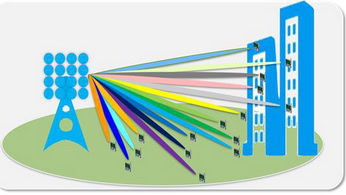
Massive MIMO and beamforming are intrinsically linked. The large number of antennas in a Massive MIMO system provides the hardware necessary to perform highly precise and complex beamforming, allowing the network to serve many users simultaneously with high-speed, dedicated beams.
Why Broad-Beam Coverage Still Matters
But wait—if narrow, focused beams are so great, does that mean we can ditch everything else? Not quite. While narrow-beam traffic channels are perfect for turbocharging your individual data connection, there’s still an important role for broader beam coverage in 5G networks.
Why? Some essential network tasks require reaching every device within the cell, not just one. For example, when your phone first tries to connect, it listens for broadcast signals—like the 5G New Radio Synchronization Signal Block (SSB)—that help it find and synchronize with the network. These signals need to flood the entire area so that no matter where you are (hidden behind a tree, or at the edge of the city), your device can catch the signal and get on board.
In short, broad-beam coverage is the friendly neighborhood announcer, making sure everyone’s invited to the party, while narrow traffic beams are like personalized, high-speed delivery for those already in. Both are needed for seamless, robust 5G coverage that leaves nobody out—whether you’re connected in the heart of downtown or finding your signal at the county fair.
The Challenge of Creating Broad Beams in Massive MIMO
Let’s zoom in on one lingering challenge: generating broad beams with large antenna arrays—the backbone of Massive MIMO magic. You’d think just cranking up the size of the array would let you spray signals everywhere, but the universe has other plans. As you increase the array’s aperture, the energy focuses into tighter, narrower beams, making it surprisingly tough to cover a wide area all at once.
So how do engineers tackle this? Sometimes they’ll revert to just one antenna element, since it naturally throws a broad, gentle beam. The problem? You lose out on the power and efficiency that all those fancy antennas are supposed to provide—so coverage drops, especially at the cell edges.
To finesse this, researchers and the wireless industry have cooked up optimization tricks. Some approaches tweak the amplitude (the power level) across different antenna elements, widening the beam—but dialing down the juice in the process. Others play with just the phase (the timing) of the signals, which keeps total power high but can create “ripples” in the beam pattern that lead to uneven coverage.
Another popular tactic is the beam sweep. Instead of trying to cover a whole sector with a single, broad beam, the network sweeps several narrower beams across the area, one after another. It’s like scanning a flashlight beam around a dark room instead of flipping on every overhead light at once. This way, each part of the sector gets a moment in the (beamformed) sun, ensuring nobody is left in the dark. But there’s a tradeoff: the network gets more complex, devices have to stay alert for longer, and your phone’s battery can feel the burn from all that extra listening.
Early academic research even suggested it might be impossible to create a truly broad, flat, and powerful beam from a large array without falling back on single-element transmission—that is, unless you’re cool with serious tradeoffs. This fueled debate in standards bodies like 3GPP, sparking discussions about whether networks should always rely on beam sweeps for things like synchronization signals in 5G NR.
But flexibility has become the name of the game. Modern Massive MIMO systems can now mix and match strategies, depending on the environment and specific needs. This innovation means that, with the right mix of signal processing smarts, even broad beams can be wrangled out of large antenna arrays without sacrificing as much in terms of power or complexity.
Now, with these challenges addressed…
The Future is Focused
The combination of beamforming and phased array antennas is more than just an incremental improvement; it’s a fundamental shift in how we approach wireless communication. By moving from a “broadcast to all” model to a “focus on you” approach, 5G can finally deliver on its promises of incredible speed and reliability. This technology is instrumental in making the high-frequency mmWave spectrum a viable and powerful tool for a new generation of connectivity.
As 5G networks continue to expand and evolve, the role of these smart antenna technologies will only become more critical. They are the unsung heroes working behind the scenes to ensure that your connection is strong, fast, and ready for whatever the future holds.
So, the next time you’re enjoying a seamless 4K video stream in a crowded place, you can thank the elegant dance of beamforming and phased array antennas. What other areas of our lives do you think this pinpoint wireless connectivity will transform next?
 Acehnese
  English
  Spanish
  German
  French (France)
  Korean
  Russian
  Indonesian
  French (Canada)
  Vietnamese
  Armenian
  Albanian
  Assamese
  Amharic
  Czech
Czech  Bulgarian
  Cebuano
  Malayalam
  German (Switzerland)
  Japanese
  Dutch
Dutch