 Skip to content

Metamaterial antennas are an emerging technology that uses artificial materials engineered to have properties not found in nature. This enables them to enhance performance and create miniaturized antenna systems that can operate more efficiently. In a world where connectivity and compact designs are crucial, metamaterial antennas offer significant advantages for modern wireless communication systems. This article will provide you an overview of metamaterial antennas, explain how they work, and explore their potential applications.
Metamaterial antennas are a type of antenna that use specially engineered materials called metamaterials to control electromagnetic waves in unique ways. These antennas are designed to improve performance, reduce size, and increase efficiency compared to traditional antennas. Metamaterial antennas achieve this by manipulating the behavior of electromagnetic waves, enabling them to focus, bend, or direct signals more precisely, making them ideal for applications in advanced communication systems, military radars, and compact electronic devices.
Understanding the unique properties and potential of metamaterial antennas requires a closer look at their uses, designs, and impact on modern technology.
What is Metamaterial Used For?
Metamaterials are engineered materials with unique properties not found in nature, primarily due to their structure rather than their composition. They have a wide range of applications across various fields, including:
1. Electromagnetic Applications: Metamaterials can manipulate electromagnetic waves, leading to applications in:
– Superlenses: Creating lenses that can focus light beyond the diffraction limit, allowing for imaging at a higher resolution.
– Invisibility Cloaks: Designing materials that can bend light around an object, rendering it effectively invisible to certain wavelengths.
– Wireless Communication: Enhancing antenna performance and creating more efficient wireless communication devices.

2. Acoustic Metamaterials: These materials can control sound waves, leading to applications in:
– Noise Reduction: Designing materials that can absorb sound or block certain frequencies.
– Acoustic Lenses: Focusing and directing sound waves for applications in sonar and medical imaging.
3. Seismic Metamaterials: Used to mitigate the effects of earthquakes by redirecting seismic waves, potentially protecting structures.
4. Thermal Metamaterials: Engineering materials that can control heat flow, which could lead to applications in thermal insulation or heat management in electronic devices.
5. Optical Devices: Metamaterials can be used to create devices such as:
– Sensors: Highly sensitive sensors for detecting chemical and biological substances.
– Photonic Devices: Components for advanced optical circuits, including switches and modulators.
6. Medical Applications: Metamaterials are being explored for use in imaging technologies, such as MRI and ultrasound, to improve resolution and contrast.
7. Energy Harvesting: Metamaterials can be designed to enhance the efficiency of solar panels and other energy-harvesting technologies.
The versatility of metamaterials makes them a promising area of research and development, with potential to revolutionize many technologies in the future.
What Are Examples of Metamaterials?
Some common examples of metamaterials include negative index metamaterials, chiral metamaterials, and photonic metamaterials. These materials are crafted with structures that affect how electromagnetic waves propagate through them, enabling novel applications like superlenses, electromagnetic cloaks, and advanced antenna designs. Other variations include plasmonic metamaterials and tunable metamaterials for dynamic applications.

What Are Metamaterial Antennas Used For?
Metamaterial antennas are specialized antennas that utilize engineered materials with unique electromagnetic properties to enhance performance in various applications. Here are some key uses of metamaterial antennas:
1. Improved gain and directivity: Metamaterials can help create antennas with higher gain and better directivity compared to traditional antennas, making them suitable for applications requiring focused signal transmission and reception.In recent developments, the use of metamaterials in antenna design has not only improved gain and directivity but has also led to significant advances in miniaturization, isolation enhancement, and overall antenna efficiency. Current state-of-the-art research highlights how metamaterial antennas are outperforming conventional methods, especially in wireless communications, by enabling compact designs without sacrificing performance. These advancements allow for more reliable and efficient antennas—poised to play an active role in the future of mobile networks, smart devices, and emerging wireless technologies.
2. Miniaturization: These antennas can be designed to be smaller than conventional antennas while maintaining or even improving performance. This is particularly useful in mobile devices, IoT applications, and wearable technology.
3. Broadband performance: Metamaterial antennas can be engineered to operate over a wide range of frequencies, making them suitable for broadband communication systems, including 5G and beyond.
4. Beamforming and steering: They can enable advanced beamforming techniques, allowing for dynamic control of the radiation pattern. This is beneficial in applications like radar, satellite communications, and wireless networks.
5. Polarization control: Metamaterial antennas can manipulate polarization, enabling the design of antennas that can transmit and receive signals with specific polarization requirements, which is crucial in various communication systems.
6. Enhanced sensitivity: In sensor applications, metamaterial antennas can improve sensitivity, allowing for the detection of weak signals, which is useful in medical imaging and environmental monitoring.
7. Wireless power transfer: Metamaterial antennas can be used in systems designed for wireless power transfer, improving efficiency and range of energy transmission.
8. Stealth and covert applications: Due to their unique properties, metamaterial antennas can be designed to have reduced radar cross-sections, making them useful in military applications for stealth technology.
Overall, metamaterial antennas represent a significant advancement in antenna technology, offering enhanced performance and versatility for a wide range of applications in telecommunications, defense, medical fields, and more.
How Does the Metamaterial Antenna Work?
A metamaterial antenna is a type of antenna that uses metamaterials to enhance its performance. Metamaterials are artificially structured materials engineered to have properties not typically found in natural materials, such as negative refractive index or customized electromagnetic responses. These properties allow metamaterial antennas to achieve unique functionalities and improved performance characteristics compared to traditional antennas. Here’s how they work:

1. Structure and Composition: Metamaterials are composed of periodic or aperiodic arrangements of unit cells, often smaller than the wavelength of the electromagnetic waves they interact with. These unit cells can be designed to manipulate electromagnetic waves in specific ways.
2. Wave Manipulation: The unique structure of metamaterials allows them to control electromagnetic waves in unconventional ways. For instance, they can bend, focus, or redirect waves more effectively than conventional materials. This is achieved by engineering the effective permittivity and permeability of the material.
3. Size Reduction: One of the significant advantages of metamaterial antennas is their ability to reduce the size of the antenna without compromising performance. By using metamaterials, antennas can be made smaller while maintaining or even enhancing their radiation efficiency and bandwidth.
cURL Too many subrequests.
cURL Too many subrequests.

cURL Too many subrequests.
cURL Too many subrequests.
cURL Too many subrequests.
cURL Too many subrequests.
- cURL Too many subrequests. cURL Too many subrequests.
- cURL Too many subrequests. cURL Too many subrequests.
- cURL Too many subrequests. cURL Too many subrequests.
- cURL Too many subrequests. cURL Too many subrequests.
- cURL Too many subrequests. cURL Too many subrequests.
- cURL Too many subrequests. cURL Too many subrequests.
cURL Too many subrequests.
What Are the Current State-of-the-Art Techniques in Metamaterial-Inspired Antenna Design?
Today’s most advanced metamaterial antenna designs center around three primary improvements: miniaturization, enhanced gain, and improved isolation. By leveraging engineered structures like split-ring resonators, mushroom-like EBGs (Electromagnetic Band Gap structures), and metasurfaces, researchers have achieved antennas that are not only smaller but also maintain strong performance metrics.
Key innovations include:
- Miniaturization with Performance Preservation: Using sub-wavelength unit cells and innovative periodic structures, manufacturers can dramatically reduce antenna size—ideal for smartphones, IoT devices, and wearable tech—without sacrificing bandwidth or efficiency.
- Gain and Directivity Enhancement: Advanced metasurface coatings and shaped metamaterial substrates help focus radiated energy, offering considerable improvements in gain and directivity. This is especially valuable for satellite communications and 5G infrastructure.
- Isolation Boosts for Multi-Antenna Systems: Electromagnetic bandgap materials and artificial magnetic conductors can be integrated into multi-antenna arrays (like MIMO setups) to suppress mutual coupling, leading to better isolation and less interference—a critical factor for modern wireless communications.
These practical architectures are now making their way into commercial products, and the ongoing research indicates they will play a pivotal role in next-generation wireless networks, where space, efficiency, and performance requirements are more demanding than ever.
Recent Advancements in Metamaterial Antenna Design
Recent years have seen remarkable progress in the development of metamaterial-based antennas, with researchers focusing on pushing the boundaries of size, performance, and integration. Cutting-edge advancements include:
- Miniaturization Breakthroughs: Designers have achieved even greater reductions in antenna size without sacrificing gain or bandwidth, thanks to innovative metamaterial structures. This is opening doors for ultra-compact antennas in next-gen smartphones, IoT sensors, and medical implants.
- Improved Gain and Isolation: Advanced metamaterial geometries, such as graphene-infused surfaces and 3D-printed periodic arrays, are being used to enhance antenna gain and reduce interference. This translates to clearer signals and more consistent performance in crowded environments—think busy city centers or large venue networks.
- Practical Application Focus: More attention is being paid to real-world deployment. Recent designs emphasize not just laboratory success but also manufacturability, cost-effectiveness, and environmental durability. Companies like Samsung and Qualcomm are already exploring these metamaterial solutions for future mobile and Wi-Fi platforms.
- Integration with Cutting-Edge Technologies: Modern metamaterial antennas now frequently pair with reconfigurable intelligent surfaces (RIS) and are tailored for advanced wireless standards, including 5G and the emerging 6G. This ensures they’re ready to meet the demands of data-intensive applications like augmented reality and autonomous vehicles.
These developments are helping metamaterial antennas transition from experimental setups to high-impact roles in commercial technology, paving the way for a new generation of wireless devices that are smaller, smarter, and more efficient than ever before.
What Are the Benefits of Metamaterial Antennas?
Metamaterial antennas offer several benefits over traditional antenna designs, thanks to their unique properties and the ability to manipulate electromagnetic waves in unconventional ways. Here are some of the key advantages:
1. Size Reduction: Metamaterial antennas can be significantly smaller than conventional antennas while maintaining similar performance characteristics. This makes them ideal for applications where space is limited, such as in mobile devices and wearable technology.
2. Enhanced Bandwidth: These antennas can provide broader bandwidth capabilities, which is beneficial for applications requiring the transmission of large amounts of data or the support of multiple frequency bands.
3. Improved Directivity and Gain: Metamaterials can be engineered to focus electromagnetic waves more efficiently, leading to improved directivity and gain. This can enhance the performance of communication systems by focusing the signal in a desired direction and reducing interference.

4. Reconfigurability: Metamaterial antennas can be designed to be tunable or reconfigurable, allowing them to adapt to different frequencies or operational conditions dynamically. This flexibility is advantageous for modern communication systems that need to operate across multiple frequency bands.
5. Reduced Weight and Cost: The materials used in metamaterial antennas can be lighter and potentially cheaper than those used in traditional antennas. This can lead to cost savings and easier integration into various platforms, including drones and satellites.
6. Improved Efficiency: By minimizing energy losses and optimizing radiation patterns, metamaterial antennas can achieve higher efficiency levels, which is crucial for battery-powered devices where energy conservation is important.
7. Novel Functionalities: Metamaterial antennas can support advanced functionalities such as beam steering without the need for mechanical movement, polarization control, and even cloaking, which can be useful for stealth applications.
8. Enhanced Performance in Challenging Environments: These antennas can be designed to perform well in environments that are typically challenging for traditional antennas, such as in the presence of obstacles or in cluttered urban settings.
Overall, metamaterial antennas offer a versatile and powerful solution for a wide range of applications, from consumer electronics to advanced military systems, by providing enhanced performance, flexibility, and efficiency.
Metamaterial Antenna Frequency
The operating frequency of metamaterial antennas can be tailored by adjusting the size and shape of the metamaterial elements. This flexibility allows designers to create antennas that can work across a wide range of frequencies, from low MHz bands to high GHz bands, depending on the application. This is particularly beneficial for multi-band devices and broadband applications.
In addition to the size and shape of the metamaterial elements, the operating frequency of a metamaterial antenna can also be influenced by the material properties of the metamaterial itself. By selecting different materials with specific electrical properties, such as permittivity and permeability, the resonant frequency of the antenna can be adjusted.
Furthermore, the design of the metamaterial structure itself can also affect the operating frequency of the antenna. For example, the spacing between the metamaterial elements or the arrangement of the elements can be modified to change the resonant frequency.
Overall, the ability to tailor the operating frequency of metamaterial antennas makes them highly versatile and suitable for a wide range of applications.
Metamaterial Antenna Polarization
Metamaterial antennas offer remarkable capabilities in controlling electromagnetic wave properties, including polarization. By engineering the arrangement, shape, and orientation of metamaterial elements, designers can tailor the antenna’s response to produce specific polarization states—linear, circular, or elliptical.
Metamaterials themselves are artificial structures engineered to exhibit electromagnetic properties not typically found in nature—such as negative permittivity and permeability. These exotic characteristics have generated widespread excitement in the antenna design community, as they allow antennas to break through the traditional barriers of size, efficiency, and adaptability. By harnessing these unique properties, metamaterial-based antennas can outperform conventional designs and are poised to play a significant role in the evolution of future wireless communication systems.
Key Aspects of Metamaterial Antenna Polarization
cURL Too many subrequests.
cURL Too many subrequests.
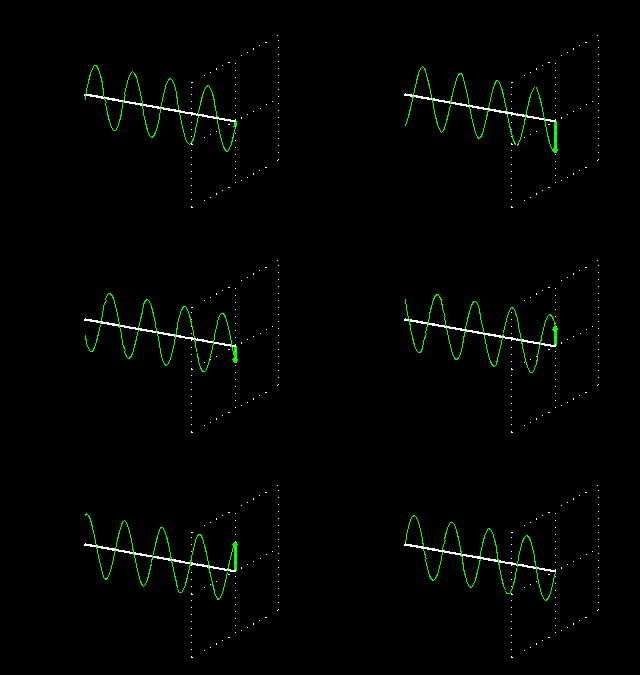
cURL Too many subrequests.
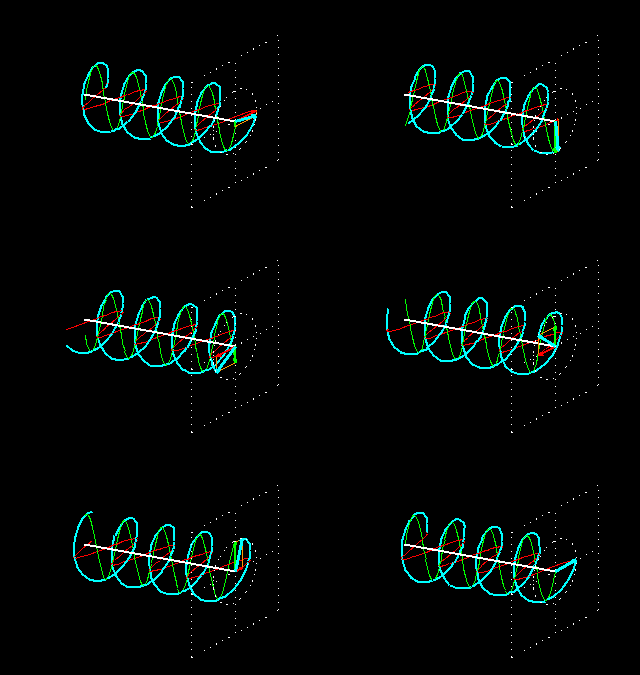
cURL Too many subrequests.
cURL Too many subrequests.
cURL Too many subrequests.
cURL Too many subrequests.
cURL Too many subrequests.
cURL Too many subrequests.
cURL Too many subrequests.
cURL Too many subrequests.
cURL Too many subrequests.
cURL Too many subrequests.
5. Applications:
cURL Too many subrequests.
cURL Too many subrequests.
cURL Too many subrequests.
cURL Too many subrequests.
cURL Too many subrequests.
cURL Too many subrequests.
cURL Too many subrequests.
- Manufacturing Precision: Achieving consistent material properties and element geometries at large scales remains a challenge. Industry leaders like Ansys and Keysight are working on refining simulation and fabrication tools to support commercial-scale deployment.
- Material Improvements: Developing new metamaterials with lower losses and enhanced durability will expand operating frequency ranges and environmental resilience, particularly important for outdoor and aerospace applications.
- cURL Too many subrequests. Seamlessly combining metamaterial antennas with conventional equipment and protocols, such as those found in Wi-Fi, IoT, or 5G infrastructure from companies like Qualcomm, requires additional engineering to ensure compatibility and optimize system performance.
- Dynamic Reconfiguration: Advancements in tunable or adaptive metamaterials will enable “smart” antennas that can adjust properties like polarization and frequency in real time, supporting versatile applications from satellite communications to smart homes.
- Cost Reduction: Continued development is needed to bring down manufacturing costs, making these advanced antennas accessible for mass-market solutions—in everything from consumer electronics to automotive radar.
Through ongoing efforts in these areas, metamaterial-based antennas will continue to push the boundaries of what’s possible in communication technology.
cURL Too many subrequests.
Metamaterial antennas mark a notable progression in antenna technology, offering compact designs, enhanced efficiency, and increased versatility for a range of applications. Their unique capability to manipulate electromagnetic waves in ways that traditional antennas cannot makes them a crucial component in the advancement of wireless communication systems, satellite technologies, and more.
 German (Switzerland)
  English
  Spanish
  German
  French (France)
  Korean
  Russian
  Indonesian
  French (Canada)
  Vietnamese
  Armenian
  Albanian
  Assamese
  Acehnese
  Amharic
  Czech
Czech  Bulgarian
  Cebuano
  Malayalam
  Japanese
  Dutch
Dutch