 Skip to content

In the fast-paced and ever-evolving landscape of communication technology, it is increasingly important to understand the various tools and devices that enable seamless and efficient signal transmission. Among these tools, the circular polarized parabolic dish antenna stands out as a critical component, particularly in the realms of satellite communications and radio frequency (RF) systems.
A circular polarized parabolic dish antenna is a type of antenna that uses a parabolic reflector to focus radio waves into a narrow beam, combined with circular polarization to enhance signal integrity. This combination allows the antenna to transmit and receive signals with high precision and reduced interference, making it ideal for applications like satellite communications and Telemetry systems where reliable signal transmission is crucial.
Let’s explore the details of how these antennas work, their advantages, disadvantages, and the specific scenarios where they are most effective.
Why Understanding Basic Antenna Parameters Matters
For those new to antenna technology, getting familiar with basic antenna parameters is essential for grasping how circularly polarized parabolic dish antennas work. By learning about concepts such as radiation pattern, gain, polarization, efficiency, and bandwidth, you build a foundation that makes the intricacies of circular polarization far less daunting.
Key Concepts Simplified
- cURL Too many subrequests. This tells you where the antenna sends and receives the strongest signals—think of it like the beam from a flashlight.
- cURL Too many subrequests. Higher gain means the antenna can focus energy more narrowly, resulting in better range or reception.
- Polarization: This describes the orientation of the signal’s electric field. Circular polarization, specifically, helps signals cut through various types of interference.
- Bandwidth & Efficiency: These define how much information the antenna can handle and how effectively it converts electrical power into radio waves (and back).
Variety of Circular Polarized Antenna Types
Once you’re comfortable with these basics, it becomes easier to understand why different types of circularly polarized antennas—like patch antennas, crossed dipoles, helical (helix) antennas, quadrifilar helix (QHA), spiral, slot, and dielectric resonator antennas—are suited for specific tasks. For example, patch antennas and helical antennas each have unique performance strengths, making them favorites in everything from satellite TV dishes to Wi-Fi routers made by companies like TP-Link or Ubiquiti.
Armed with these fundamentals, even beginners can start to see how the choice of antenna type, matched with the right parameters, directly impacts the quality and reliability of signal transmission. That foundation paves the way for exploring where circular polarized parabolic dish antennas excel in real-world scenarios.
What are the Circular Polarized Parabolic Dish Antennas Used For?
Circularly polarized parabolic dish antennas are used in various applications due to their ability to receive and transmit signals with reduced interference and improved performance. Here are some common uses:
1. Satellite Communication: These antennas are widely used in satellite communication systems, particularly for receiving signals from satellites in geostationary orbits. The circular polarization helps in mitigating the effects of signal degradation due to atmospheric conditions.
2. Television Broadcasting: Circularly polarized antennas are used in satellite TV systems to enhance signal quality and reduce multipath interference, allowing for clearer reception of broadcast signals.
3. Radio Astronomy: In radio telescopes, circularly polarized antennas can be used to observe celestial objects, as they can effectively capture signals that may be polarized in different orientations.
4. Telemetry: Circularly polarized antennas are utilized in telemetry systems to ensure reliable data transmission from remote sensors or devices, particularly in environments where signal integrity is crucial.

5. Remote Sensing: Circularly polarized antennas are used in remote sensing applications, such as radar systems, to improve the quality of the data collected from the environment.

6. Amateur Radio: Ham radio operators often use circularly polarized antennas for satellite communication and to improve their communication range and clarity.
7. Wi-Fi and Wireless Networks: Some advanced Wi-Fi systems utilize circularly polarized antennas to enhance signal strength and coverage, especially in environments with obstacles that can cause signal reflections.

8. Drones and UAVs: Circularly polarized antennas are used in unmanned aerial vehicles (UAVs) for communication and telemetry, providing reliable connectivity even in challenging environments.
Overall, the primary advantage of circular polarization in these antennas is the ability to maintain signal integrity and reduce the effects of interference, making them suitable for a wide range of communication and observational applications.
How Does the Circular Polarized Parabolic Dish Antenna Work?
A circular polarized parabolic dish antenna is designed to transmit and receive signals with circular polarization, which can be particularly advantageous in various communication applications, including satellite communications, where signal integrity can be affected by factors like rain or multipath interference.
Key Components and Operation:

1. Parabolic Dish:
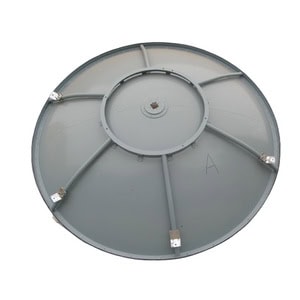
The parabolic shape of the dish is crucial for focusing incoming signals onto a single focal point. When a signal (like a radio wave) hits the dish, the parabolic geometry reflects it towards the focal point, where the feedhorn is located. This design maximizes the gain and directivity of the antenna.
2. Feedhorn:
The feedhorn is placed at the focal point of the parabolic dish. It is responsible for both transmitting and receiving signals. To achieve circular polarization, the feedhorn is typically designed as a specific type, such as a circular patch or a helical design, which can generate circularly polarized waves.
3. Circular Polarization:
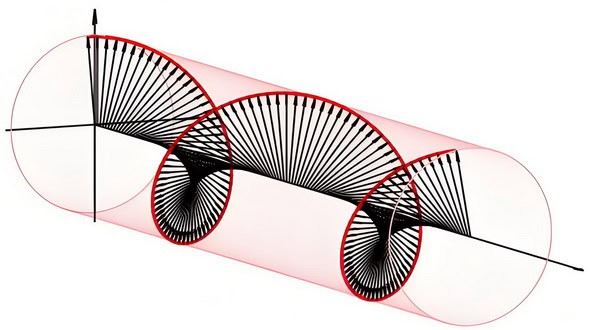
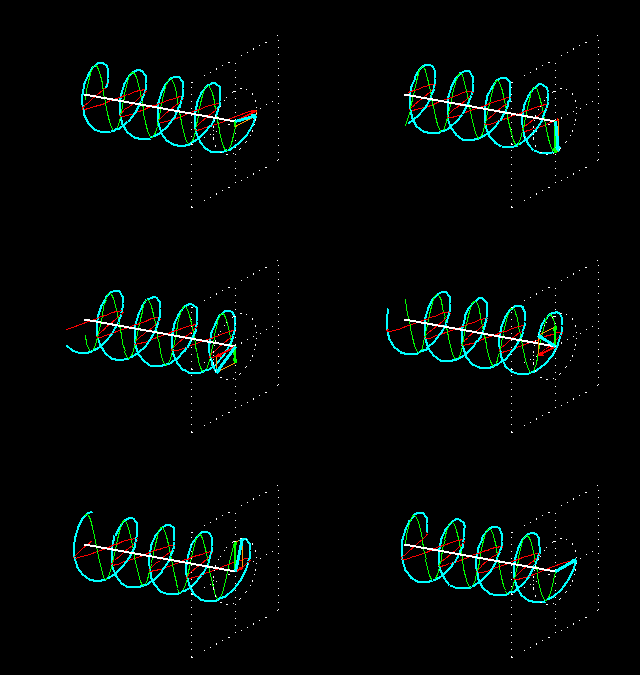
Circular polarization can be right-handed or left-handed, depending on the direction of the electric field vector’s rotation as the wave propagates. This is achieved by feeding the feedhorn with two orthogonal signals (90 degrees out of phase) or using a specific design that naturally produces circularly polarized waves.
4. Transmission and Reception:
cURL Too many subrequests.
cURL Too many subrequests.
cURL Too many subrequests.
cURL Too many subrequests.
cURL Too many subrequests.
cURL Too many subrequests.
cURL Too many subrequests.
cURL Too many subrequests.
- cURL Too many subrequests. cURL Too many subrequests.
- cURL Too many subrequests. cURL Too many subrequests.
- cURL Too many subrequests. cURL Too many subrequests.
- cURL Too many subrequests. cURL Too many subrequests.
- cURL Too many subrequests. cURL Too many subrequests.
- cURL Too many subrequests. By carefully arranging slots in a metallic plane and feeding them in the right way, designers can synthesize circular polarization. Slot arrays are simply larger versions, stacking many slots in a pattern for increased gain.
- Dielectric Resonator Antennas: Leveraging the unique properties of dielectric materials, these antennas can be shaped and excited to support two orthogonal resonant modes that combine into circular polarization.
- Patch Arrays: Much like a single patch antenna, but scaled up—multiple patch elements are arranged in an array and fed with the correct amplitudes and phase shifts to produce a strong, directed beam of circularly polarized waves.
Each of these designs tackles circular polarization from a different angle—whether by geometry, feeding techniques, or resonant modes—but they all share the same goal: ensuring your signals don’t get tripped up by pesky polarization mismatches or adverse weather.
What’s the gain of Circular Polarized Parabolic Dish Antenna ?
The gain of a circularly polarized parabolic dish antenna typically ranges from about 20 dBi to 46 dBi, depending on several factors such as the size of the dish, the frequency of operation, and the design specifics of the antenna.

Larger dishes generally provide higher gain due to their ability to collect more signals from a specific direction, while the gain can also be influenced by the efficiency of the feed and the quality of the dish surface.
Key Parameters Affecting Gain
To understand gain in more detail, it’s helpful to consider a few basic antenna parameters:
- cURL Too many subrequests. This describes how the antenna directs energy in space. Parabolic dishes focus energy into a narrow beam, resulting in high gain.
- Polarization: In this case, circular polarization allows better signal integrity in challenging environments.
- Efficiency: Higher efficiency in both the dish and feed translates directly to increased effective gain.
- Bandwidth: While not directly influencing peak gain, a wider bandwidth can help maintain high gain across a broader frequency range.
Why Gain Matters
Antenna gain is crucial because it determines how well the antenna can transmit or receive signals over long distances. For applications like satellite communications, deep-space telemetry, or long-range point-to-point wireless links, higher gain means stronger, more reliable connections.
For precise calculations or specifications, it’s best to refer to the manufacturer’s datasheet or perform simulations based on the specific parameters of the antenna in question.
What’s the range of Circular Polarized Parabolic Dish Antenna ?
cURL Too many subrequests. circular polarized parabolic dish antenna can vary significantly based on several factors, including:
1. Antenna Size: Larger dishes typically offer greater gain and can transmit or receive signals over longer distances.
2. Frequency: The operating frequency affects the range. Higher frequencies may have shorter ranges due to increased atmospheric attenuation.
3. Transmission Power: The power of the transmitter also plays a crucial role. Higher power can extend the range.
4. Environmental Factors: Terrain, obstacles, and atmospheric conditions can impact signal propagation.
5. Receiver Sensitivity: The sensitivity of the receiving equipment will influence the effective range.
As a rough estimate, a typical circular polarized parabolic dish antenna can have a range of several kilometers to hundreds of kilometers, depending on the above factors. For example, in satellite communications, these antennas can effectively communicate with satellites in geostationary orbit, which are approximately 35,786 kilometers above the Earth.
For specific applications, it’s essential to consider these factors and conduct a link budget analysis to determine the effective range of the system.
What are the Advantages of Circular Polarized Parabolic Dish Antennas?
Circularly polarized parabolic dish antennas offer several advantages, making them suitable for various applications, particularly in satellite communications, radar systems, and broadcasting. Here are some of the key benefits:
1. Reduced multipath interference: Circular polarization helps mitigate the effects of multipath interference, where signals bounce off surfaces and create phase differences. This is particularly useful in urban environments or areas with obstacles.
2. Improved signal reception: Circular polarization can enhance signal reception, especially in scenarios where the orientation of the transmitting and receiving antennas may not be perfectly aligned. This is beneficial for mobile applications or when tracking satellites.
3. Less sensitivity to orientation: Unlike linear polarization, which requires precise alignment between transmitting and receiving antennas, circular polarization maintains performance even if the antennas are misaligned. This is advantageous for applications involving moving platforms, such as drones or vehicles.
4. Better performance in rain and weather: Circularly polarized signals tend to penetrate rain and other atmospheric conditions more effectively than linear signals, making them more reliable in adverse weather conditions.
5. Reduced cross-polarization loss: Circularly polarized antennas can reduce the impact of cross-polarization, where signals intended for one polarization are received by the antenna in the opposite polarization. This can enhance overall system performance.
6. Higher data rates: Circular polarization can support higher data rates in communication systems due to its ability to effectively utilize bandwidth and reduce interference.
7. Versatility: Circularly polarized antennas can be used in a variety of applications, including satellite communications, television broadcasting, and wireless data transmission, making them highly versatile.
8. Improved antenna gain: Parabolic dish antennas typically offer high gain, and when combined with circular polarization, they can provide excellent directivity and signal strength.
9. Compatibility with existing systems: Many modern communication systems and satellites are designed to use circular polarization, making circularly polarized antennas compatible with a wide range of existing technologies.
cURL Too many subrequests.
cURL Too many subrequests.
Circularly polarized parabolic dish antennas cURL Too many subrequests.
cURL Too many subrequests.

cURL Too many subrequests.
cURL Too many subrequests.
cURL Too many subrequests.
cURL Too many subrequests.
cURL Too many subrequests.
cURL Too many subrequests.
cURL Too many subrequests.
cURL Too many subrequests.
cURL Too many subrequests.
cURL Too many subrequests.
cURL Too many subrequests.
- cURL Too many subrequests. cURL Too many subrequests.
- Environmental Factors: cURL Too many subrequests.
- cURL Too many subrequests. Engineers often need to balance theoretical performance with practical realities such as size constraints, mounting options, and system integration with existing communication infrastructures.
As with any advanced technology, these design requirements and challenges should be carefully weighed alongside the benefits. Reviewing practical case studies and technical references can provide additional guidance for those considering circularly polarized parabolic dish antennas for their application.
Overall, while circularly polarized parabolic dish antennas have their unique advantages, these disadvantages must be carefully considered when selecting the appropriate antenna for a specific application.
Circular Polarized Parabolic Dish Antenna Frequency
The frequency range of a circular polarized parabolic dish antenna is a crucial factor that impacts its performance. These antennas are typically utilized in various frequency bands, including:
– S-Band (2.0-4.0 GHz):
– 2.2-2.4 GHz: Commonly used in radar systems, satellite communications, and some Wi-Fi applications.
– cURL Too many subrequests. (4.0-8.0 GHz):
– 4.4-4.8 GHz: Used for terrestrial microwave communications.
– 5.090-5.250 GHz: Commonly employed in satellite communications, particularly for fixed satellite services.
– Ku-Band (12.0-18.0 GHz):
– 12.2-12.7 GHz: Used for satellite TV broadcasting.
– 14.0-14.5 GHz: Commonly used for uplink transmissions in satellite communications.
– 17.7-18.4 GHz: Utilized for downlink transmissions and certain radar applications.
– Ka-Band (26.5-40.0 GHz):
– 26.5-30.0 GHz: Increasingly utilized for high-throughput satellite services and broadband communications.
– 30.0-31.0 GHz: Used for satellite uplink and downlink communications.
– 37.0-40.0 GHz: Applied in various high-frequency satellite services and some radar systems.
Each frequency band presents its own advantages and challenges, influencing the antenna’s size, design, and overall performance.
Circular Polarized Parabolic Dish Antenna Polarization
Circular polarized parabolic dish antennas are designed to transmit or receive signals that are circularly polarized, which can be advantageous in various applications such as satellite communications, radar, and wireless communications. Here’s an overview of the types and the concept of dual polarization in relation to these antennas:
Types of Circular Polarized Parabolic Dish Antennas

1. Left-Hand Circular Polarization (LHCP):
– The electric field rotates counterclockwise when viewed from the receiver towards the source.
– Commonly used in satellite communications and some wireless applications.
2. Right-Hand Circular Polarization (RHCP):
– The electric field rotates clockwise when viewed from the receiver towards the source.
– Also widely used in satellite communications and other applications.
3. Single Circular Polarized Antennas:
– Designed to operate with either LHCP or RHCP, but not both.
– Typically used in applications where one polarization is sufficient.
4. Dual Circular Polarized Antennas:
– Capable of receiving and transmitting both LHCP and RHCP signals.
– Useful in environments where signals from different sources may have different polarizations or for systems that require diversity in signal reception.
Common Antenna Types for Achieving Circular Polarization
A variety of antenna designs can be used to generate circular polarization, each with its own operating principles and advantages. Some of the most widely used types include:
- cURL Too many subrequests. cURL Too many subrequests.
- cURL Too many subrequests. cURL Too many subrequests.
- cURL Too many subrequests. cURL Too many subrequests.
- cURL Too many subrequests. cURL Too many subrequests.
- cURL Too many subrequests. cURL Too many subrequests.
- cURL Too many subrequests. cURL Too many subrequests.
- Dielectric Resonator Antennas: cURL Too many subrequests.
- cURL Too many subrequests. cURL Too many subrequests.
cURL Too many subrequests.
cURL Too many subrequests.
cURL Too many subrequests.
cURL Too many subrequests.
cURL Too many subrequests.
cURL Too many subrequests.
cURL Too many subrequests.
cURL Too many subrequests.
cURL Too many subrequests.
– Employing two feeds, one for each polarization, often combined with a hybrid coupler to manage the signals.
In summary, circular polarized parabolic dish antennas can be categorized based on their polarization type, and dual polarization offers significant advantages in terms of performance and capacity in various communication applications.
cURL Too many subrequests.
In conclusion, as communication technologies continue to advance and expand, understanding the functionality and advantages of tools like the circular polarized parabolic dish antenna becomes increasingly important. Its role in enhancing signal transmission and reception is pivotal, making it an essential component in the infrastructure of satellite communications and RF systems. As we move forward in this digital age, the significance of such technologies will only continue to grow, underscoring the need for ongoing research and development in the field of communication engineering.
 German (Switzerland)
  English
  Spanish
  German
  French (France)
  Korean
  Russian
  Indonesian
  French (Canada)
  Vietnamese
  Armenian
  Albanian
  Assamese
  Acehnese
  Amharic
  Czech
Czech  Bulgarian
  Cebuano
  Malayalam
  Japanese
  Dutch
Dutch