 Skip to content

In the intricate landscape of RFID systems, the concept of antenna polarization emerges as a critical factor influencing overall efficiency and data accuracy. Specifically, the linear polarization of UHF RFID antennas commands a pivotal role, but its implications and mechanics often go unexplored. Why is linear polarization so vital, and what makes it a key consideration for industry professionals ranging from engineers to product managers?
Linear polarized antennas emit electromagnetic waves along a single plane, either horizontally or vertically. This specific orientation is paramount for RFID systems, affecting read zone performance significantly. Optimal functionality is achieved when the RFID tag is stationary and aligned precisely with the antenna’s polarization plane.
But why does this detail hold so much weight in RFID technology choice?
Understanding Linear vs. Circular Polarization in RFID Antennas
cURL Too many subrequests. and circular polarization are two different ways in which radio frequency (RF) energy can be transmitted from an RFID antenna. Understanding the differences between these two types of polarization is crucial for optimizing the performance of an RFID system.
Linear polarization refers to the orientation of the electromagnetic waves as they are emitted from the antenna. In linear polarization, the electromagnetic waves are oriented in a specific direction, either vertically or horizontally. This means that the RF energy is transmitted in a focused beam along a single plane. Linear polarization can be further divided into two types: vertical polarization and horizontal polarization.
In contrast, circular polarization refers to the rotation of the electromagnetic waves as they are emitted from the antenna. In circular polarization, the electromagnetic waves rotate in a circular motion. This means that the RF energy is transmitted in a broader, conical emission pattern. Circular polarization can be further divided into two types: right-hand circular polarization (RHCP) and left-hand circular polarization (LHCP).
The main advantage of linear polarization is its focused RF energy transmission. Because the RF energy is transmitted in a focused beam along a single plane, linear polarization allows for greater range and penetration through materials. This makes linear polarization ideal for applications where long read ranges or penetration through liquids or metals is required.
On the other hand, circular polarization is advantageous in situations where the orientation of the RF energy is constantly changing or unknown. Circular polarization is less affected by the orientation of the RFID tag or the reader antenna, making it more reliable in environments where tags can be randomly oriented or moving. Circular polarization also helps mitigate the effects of multipath interference, where the RF signals bounce off objects and create reflections that can interfere with the readability of the RFID tags.
In summary, linear polarization provides focused RF energy transmission, while circular polarization offers a broader, conical emission pattern. The choice between linear and circular polarization depends on the specific requirements of the RFID application, such as read range, penetration, and the reliability of tag detection in various orientations.
What is the difference between linear and circular polarization RFID?
In the context of RFID (Radio Frequency Identification) technology, linear and circular polarization refer to the way RF energy is transmitted and received between an RFID reader and a tag. Here are the main differences between the two:
1. Propagation Pattern: With linear polarization, the RF energy is concentrated in a single plane, either vertically or horizontally. This means that the RFID reader antenna emits energy in a specific direction, and the tag antenna must be aligned in the same plane to receive the energy efficiently. On the other hand, circular polarization emits energy in a spiral or helical pattern, covering a wider area. This makes it more forgiving of tag orientation, as the tag can receive the energy regardless of its position or rotation.
2. Efficiency: Linear polarization offers higher efficiency when the tag’s orientation matches the antenna’s polarization. This means that if the tag antenna is parallel to the reader antenna, it will receive the maximum amount of energy. However, if the tag is rotated or not aligned with the reader antenna, the efficiency decreases, and the tag may not be able to receive the energy effectively. Circular polarization, on the other hand, is less affected by tag orientation. The tag can be positioned at various angles or orientations, and it will still be able to receive the energy efficiently.
3. Tag Positioning: Linear polarization requires precise positioning and alignment of the tag antenna with the reader antenna for optimal performance. If the tag is not positioned correctly, it may not be able to receive the energy or communicate with the reader effectively. Circular polarization, due to its wider coverage and forgiving nature, allows for more flexibility in tag positioning. The tag can be placed in different orientations or locations relative to the reader, and it will still be able to receive the energy and function properly.
In summary, linear polarization is more efficient when the tag is aligned with the reader antenna, while circular polarization is more forgiving of tag orientation and allows for more flexibility in tag positioning. The choice between linear and circular polarization depends on the specific RFID application and the requirements of tag positioning and orientation.
What is the radiation pattern of an RFID antenna?
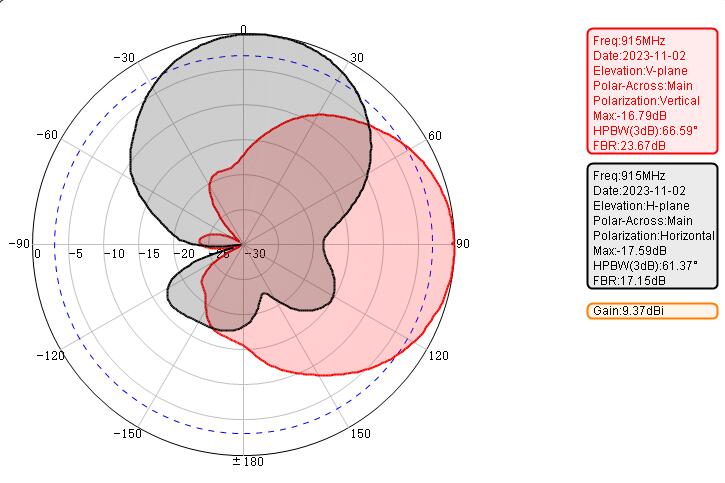
The radiation pattern of an RFID antenna is typically omni-directional, meaning that it radiates energy in all directions equally. This allows the antenna to communicate with RFID tags regardless of their orientation or position relative to the antenna. However, the strength of the signal may vary depending on the angle of the tag with respect to the antenna.
Practical Insights: Linear Polarization in Action
Linear polarization is the most commonly used polarization method in UHF RFID antennas due to its practical benefits and suitability for a wide range of applications. Here are some practical insights and examples that highlight the preferred use cases for linear polarization in UHF RFID antennas and the tangible benefits they bring to real-world applications:
1. Reading Range Improvement: Linearly polarized antennas can significantly enhance the reading range of UHF RFID systems. By aligning the polarization of the reader and tag antennas, the received signal strength is maximized, resulting in longer read distances. This is especially useful in applications where tags are placed far from the reader or in environments with high interference levels.
2. Tag Orientation Insensitivity: Linear polarization allows UHF RFID systems to be less sensitive to tag orientation. As long as the tag and reader antennas have the same polarization, the system can read tags regardless of their orientation. This is advantageous in applications where tags are attached to objects in various orientations or where users cannot control the tag orientation during reading.
3. Tag Placement Flexibility: Linear polarization provides flexibility in tag placement. Since the orientation of the tag doesn’t affect its readability, tags can be placed in any orientation, allowing for easy integration into different form factors, such as labels, cards, or embedded tags. This flexibility is particularly beneficial in applications where tags need to be discreetly placed or embedded within products.
4. Reduced Multipath Interference: Linear polarization helps minimize multipath interference in UHF RFID systems. Multipath interference occurs when signals bounce off surfaces and reach the tag at different times, causing signal cancellation or degradation. By using linear polarization, the reader can significantly reduce the interference caused by reflected signals, resulting in more reliable and accurate tag reads.
5. Integration with Existing Infrastructure: Linearly polarized antennas can be seamlessly integrated into existing infrastructure. Many existing RFID systems and installations use linear polarization, making it easier to upgrade or expand the system without the need to change the entire infrastructure. This compatibility allows businesses to leverage their previous investments and adopt new RFID technology more efficiently.
6. Cost-Effectiveness: Linear polarization offers a cost-effective solution for UHF RFID systems. Linearly polarized antennas are simpler in design and easier to manufacture compared to other polarization methods, such as circular polarization. This simplicity reduces the production costs, making linearly polarized antennas more affordable for a wide range of applications.
In summary, linear polarization is preferred in UHF RFID antennas due to its ability to enhance reading range, reduce tag orientation sensitivity, offer tag placement flexibility, minimize multipath interference, integrate with existing infrastructure, and provide a cost-effective solution. These practical benefits make linear polarization ideal for various real-world applications, including supply chain management, inventory tracking, access control, asset tracking, and many others.
Linear Polarization of UHF RFID Antennas: Practical Examples and Applications
1. Inventory Management in Retail Stores:
Linear polarization is preferred in inventory management systems in retail stores as it helps to improve the read range and accuracy of UHF RFID tags. By using linearly polarized antennas, the system can read tags that are aligned with the antenna’s polarization, while minimizing the interference from tags that are misaligned. This ensures that the inventory counts are more accurate and reduces the chances of false readings.
Case study: A large retail chain implemented a UHF RFID system with linearly polarized antennas in their stores. The system improved their inventory accuracy from 70% to 98%, resulting in reduced out-of-stock situations and improved customer satisfaction.
2. Asset Tracking in Manufacturing Facilities:
Linear polarization is commonly used in asset tracking systems in manufacturing facilities. By using linearly polarized antennas, the system can read tags attached to assets (such as tools, equipment, or containers) accurately and consistently, even in challenging environments with metal or other reflective surfaces. The linear polarization helps to minimize the interference caused by reflections and improve the read range of the system.
cURL Too many subrequests.
cURL Too many subrequests.
cURL Too many subrequests.
cURL Too many subrequests.
cURL Too many subrequests.
cURL Too many subrequests.
cURL Too many subrequests.
cURL Too many subrequests.
 German (Switzerland)
  English
  Spanish
  German
  French (France)
  Korean
  Russian
  Indonesian
  French (Canada)
  Vietnamese
  Armenian
  Albanian
  Assamese
  Acehnese
  Amharic
  Czech
Czech  Bulgarian
  Cebuano
  Malayalam
  Japanese
  Dutch
Dutch