 Skip to content
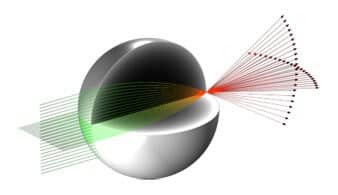
Discover the innovative world of Luneburg lens antennas, the pivotal technology reshaping modern communications and radar systems. Unravel the mystery behind their design, functionality, and unparalleled benefits.
A Luneburg lens antenna is an advanced type of antenna that utilizes a spherical lens with a gradient refractive index to direct radio waves efficiently. Unlike conventional antennas, its unique structure allows for uniform signal distribution and high-gain performance across multiple directions without the need for physical reorientation. This makes it especially valuable in applications requiring broad coverage and precise signal focus.
But how does this translate into real-world applications and benefits?
What Does a Luneberg Lens Do?
A Luneburg lens is a type of lens that is used in radar systems to enhance radar reflectivity and improve signal reception without the need for additional energy. It is named after the German mathematician Rudolf Luneburg, who first described the lens in 1944.
A Luneburg lens is a spherical lens made of a dielectric material with a varying refractive index. The refractive index of the lens decreases from the center to the outer edge, following a specific mathematical profile known as the Luneburg profile. This profile allows the lens to focus incoming radar waves onto a specific point, improving the signal strength and clarity.
The key advantage of a Luneburg lens is that it can focus the incoming radar waves without the need for any additional energy. Traditional lenses used in radar systems, such as parabolic reflectors, require an energy source to generate the radar waves and then focus them onto a target. In contrast, a Luneburg lens simply redirects and focuses the incoming radar waves, without requiring any additional energy input.

The way a Luneburg lens achieves this is by exploiting the property of refraction. When radar waves pass through a material with a varying refractive index, they change direction. By carefully designing the refractive index profile of the lens, the Luneburg lens can bend the incoming radar waves towards a specific point, effectively focusing them.
The ability of a Luneburg lens to focus radar waves has several benefits in radar systems. Firstly, it increases the radar reflectivity of the target. When radar waves are focused onto a target, they bounce back towards the source, resulting in a stronger radar signal. This can be particularly useful when trying to detect small or low-reflectivity targets.
Secondly, a Luneburg lens improves the signal reception of the radar system. By focusing the incoming radar waves, it reduces the loss of signal strength that occurs when waves spread out over a larger area. This means that the radar system can detect weaker signals or targets at longer distances.
In summary, a Luneburg lens is a type of lens used in radar systems to enhance radar reflectivity and improve signal reception. By redirecting and focusing incoming radar waves, it increases the radar reflectivity of targets and improves the sensitivity of the radar system, all without requiring any additional energy input.
What Are the Two Main Types of Lens Antennas?
When it comes to lens antennas, you’ll typically encounter two main categories, each distinguished by its construction and the way it shapes electromagnetic waves:
Dielectric Lens Antennas: Built from dielectric materials with varying refractive indices, these antennas use the principles of refraction—much like a Luneburg lens—to bend and focus electromagnetic waves. The material choice and its refractive profile play a crucial role in determining the lens’s ability to efficiently direct signals.
Metal Plate Lens Antennas: Instead of relying on dielectric materials, these antennas employ carefully spaced metal plates to guide and focus waves. The arrangement and geometry of the plates are engineered to steer the radio waves much like optical lenses focus light.
Both types are designed to enhance signal direction and gain, but their construction methods offer different advantages depending on the application—whether it’s precision, bandwidth, or manufacturing considerations.
What Does a Luneburg Lens Antenna Do?
A Luneburg lens antenna is a type of lens antenna that is used to focus and direct electromagnetic waves. It is named after its inventor, Rudolf Luneberg.
The main function of a Luneburg lens antenna is to collect and concentrate electromagnetic waves, such as radio waves or microwaves, and direct them to a specific point or area. It is designed using a dielectric material with varying refractive index, which allows it to bend and focus the waves. The lens shape is spherical, with the highest refractive index at the center and gradually decreasing towards the edges.
The Luneburg lens antenna is commonly used in radar systems, satellite communication, and other applications where precise focusing and direction of electromagnetic waves are required. It can improve the performance and efficiency of the antenna system by concentrating the waves in a specific direction, reducing signal loss and interference.
What is the Principle of the Luneburg Lens?
The Luneburg lens is a type of lens that was first proposed by Rudolf Karl Luneburg in 1944. It is a spherical lens with a varying dielectric constant, which allows it to refract and focus energy in a unique way.
The principle of the Luneburg lens is based on the fact that the speed of light changes when it passes through different materials. This change in speed causes the light to bend or refract. In a traditional lens, such as a glass lens, the refractive index is constant throughout the lens, which allows it to focus light to a point.
In the case of the Luneburg lens, the refractive index is not constant, but varies as a function of the distance from the center of the lens. The refractive index is highest at the center of the lens and decreases radially towards the edge. This variation in refractive index causes the light to bend and focus in a specific way.
The key to understanding how the Luneburg lens works lies in the concept of the gradient index. The gradient index is a measure of how the refractive index changes as a function of position. In the Luneburg lens, the gradient index is highest at the center of the lens and decreases radially towards the edge.
When light passes through the Luneburg lens, it experiences a gradual change in refractive index, which causes it to bend gradually. This gradual bending allows the lens to focus the light to a specific point, just like a traditional lens. The difference is that the Luneburg lens achieves this focus by varying the refractive index, rather than using a curved surface.
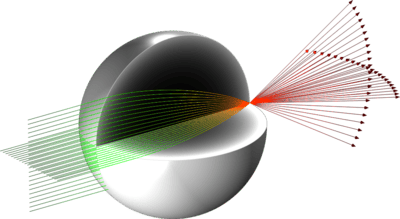
The varying dielectric constant of the Luneburg lens allows it to control the path of electromagnetic waves, not only for visible light, but also for other frequencies such as microwaves or radio waves. This makes the Luneburg lens useful in a wide range of applications, including telecommunications, radar systems, and satellite communications.
In summary, the principle of the Luneburg lens is based on the varying dielectric constant of the lens, which causes light to bend and focus. By controlling the gradient index, the lens can focus electromagnetic waves of different frequencies to a specific point. This unique property makes the Luneburg lens a valuable tool in various fields of technology.
What is the Frequency of the Luneburg Lens?
The frequency of the Luneburg lens can vary depending on its design and application. In general, Luneburg lenses can be designed to operate at a wide range of frequencies, from radio waves to optical frequencies.
For radio frequency applications, Luneburg lenses can be designed to operate at frequencies ranging from a few megahertz (MHz) to several gigahertz (GHz). These lenses are commonly used in microwave and satellite communication systems.
In the optical frequency range, Luneburg lenses can operate in the visible, infrared, and even in the terahertz frequency range. These lenses find applications in areas such as optical imaging, laser focusing, and even in advanced optical devices like metasurfaces.
The versatility of the Luneburg lens across a broad spectrum of frequencies makes it highly adaptable in diverse technological fields. Its ability to focus and manipulate electromagnetic waves at different frequencies enables its use in various applications, from long-range communication systems to high-resolution imaging systems.
Frequency Limitations of Dielectric Lens Antennas and Solutions
Dielectric lens antennas are particularly advantageous at higher frequencies, such as those found in microwave and millimeter-wave bands. However, at frequencies below approximately 3 GHz, these antennas tend to become unwieldy, with increased size and weight making them less practical for most applications. This limitation arises because the physical dimensions of the lens scale with the wavelength; lower frequencies mean longer wavelengths, which in turn require larger lenses to achieve proper focusing.
To address these size-related challenges, engineers often turn to stepped or zoned dielectric lens designs. Instead of a uniform structure, these lenses are segmented into discrete regions or “zones,” which allow for a reduction in overall bulk without sacrificing performance. The width of the steps in such a lens is governed by both the wavelength and the refractive index of the lens material, described mathematically as:
- Step width ≈ wavelength divided by (refractive index minus one).
Additionally, zoned lens antennas exhibit a bandwidth that depends on the number of zones and the refractive index, with more zones generally resulting in narrower operational bandwidth. By carefully optimizing the zoning and selection of materials—such as polystyrene, lucite, or polyethylene—engineers can balance the competing demands of size, bandwidth, and performance.
In summary, while dielectric lens antennas are less suited for lower-frequency use due to physical constraints, modern design approaches like stepped and zoned configurations can significantly mitigate these issues, allowing the technology to be used more broadly across a range of frequencies.
What are the Benefits of a Luneburg Lens Antenna?
1. Wide bandwidth: Luneburg lens antennas have a wide bandwidth, which means they can operate over a wide range of frequencies. This makes them versatile and suitable for various applications.
2. Low profile: Luneburg lens antennas are typically low profile, which means they have a small physical size compared to other types of antennas. This makes them suitable for applications where space is limited or where a compact design is desired.
3. Omnidirectional radiation pattern: Luneburg lens antennas have an omnidirectional radiation pattern, which means they can radiate or receive electromagnetic waves equally in all directions. This makes them suitable for applications where communication needs to occur in multiple directions or where the antenna needs to be able to receive signals from any direction.
4. High gain: Luneburg lens antennas can achieve high gain, which means they can focus or concentrate the radiated or received energy in a specific direction. This makes them suitable for applications where long-range communication is required or where the signal needs to be concentrated in a specific direction.
5. Low sidelobes: Luneburg lens antennas have low sidelobes, which means they radiate or receive most of the energy in the desired direction and minimize the energy radiated or received in other directions. This helps improve the signal quality and reduce interference from other sources.
6. Scalability: Luneburg lens antennas can be scaled to different sizes, which means they can be used for different frequency bands or different applications. This makes them flexible and adaptable to different requirements.
7. Simple construction: Luneburg lens antennas can be relatively simple to construct compared to other types of antennas. This makes them cost-effective and easier to manufacture.
8. Low loss: Luneburg lens antennas can have low loss, which means they can efficiently radiate or receive energy without significant power loss. This helps improve the overall system performance and efficiency.
What are the Main Disadvantages of Lens Antennas Compared to Reflector Antennas?
While Luneburg lens antennas offer an impressive range of advantages, it’s important to consider their drawbacks—especially when comparing them to their more ubiquitous counterparts, reflector antennas (such as the classic dish you’ll spot on rooftops and satellite installations).
Some of the notable disadvantages include:
Higher Cost: Lens antennas generally require more material and precise manufacturing processes than reflector antennas to achieve similar levels of gain and bandwidth. This often translates into a higher upfront price, which can be a deciding factor in large-scale deployments.
Weight and Bulk: Especially at lower frequencies (which demand larger lenses), lens antennas can become quite bulky and heavy. In contrast, reflector antennas, like those made by Andrew or Channel Master, tend to be lighter for comparable performance.
Complexity in Fabrication: The gradient index and precise shaping needed for a high-performance lens antenna make them more challenging—and sometimes more expensive—to manufacture than standard parabolic reflectors.
Handling and Integration: Due to their shape and size, lens antennas can be harder to integrate seamlessly into compact or mobile systems, where a slim profile and minimal weight are at a premium.
In summary, while lens antennas deliver unique benefits, these practical limitations sometimes lead engineers to favor reflector antennas for applications prioritizing cost, weight, or simplicity.
What is a Luneburg Lens Antenna Used For?
Luneburg lens antennas are used in various applications where their unique properties and characteristics are beneficial. Some of the major applications include:
1. Telecommunications: Luneburg lens antennas are used in wireless communication systems, such as cellular networks and satellite communication. Their ability to focus and direct the radio waves enables efficient transmission and reception of signals over long distances.
2. Radar Systems: Luneburg lens antennas are commonly used in radar systems for both military and civilian applications. They are used to transmit and receive radar signals, providing accurate detection and tracking of objects in the air, on land, or at sea.
3. Radio Astronomy: Luneburg lens antennas are used in radio telescopes to capture and analyze radio waves emitted by celestial objects. By focusing the radio waves onto the receiver, Luneburg lens antennas allow astronomers to study the universe and gather valuable data about stars, galaxies, and other astronomical phenomena.
4. Satellite Communication: Luneburg lens antennas are used in satellite communication systems to transmit and receive signals between satellites in space and ground-based stations. Their ability to focus signals over a wide range of angles and frequencies makes them ideal for satellite communication applications.
5. Wireless Power Transmission: Luneburg lens antennas can be used in wireless power transmission systems to efficiently transfer electrical power wirelessly over long distances. By focusing the transmitted power, Luneburg lens antennas can increase the power transfer efficiency and reduce energy losses.
6. Imaging Systems: Luneburg lens antennas are used in imaging systems, such as medical imaging devices and security scanners, to focus and direct electromagnetic waves for high-resolution imaging. Their ability to focus waves of different frequencies allows for the creation of detailed images and accurate diagnostics.
7. Defense and Military Applications: Luneburg lens antennas are used in defense and military applications, such as radar systems, surveillance systems, and communication systems. Their ability to provide wide-angle coverage, high gain, and low sidelobes makes them suitable for various military applications.
Overall, Luneburg lens antennas find applications in a wide range of fields where their unique properties, such as wide-angle coverage, high gain, and frequency independence, make them highly useful and effective.
What is a Luneburg Lens Antenna Made Of?
A Luneburg lens antenna is made of a dielectric material, typically a high-permittivity material such as polystyrene or polyethylene. These materials are chosen for their low-loss properties, allowing for efficient transmission and reception of electromagnetic waves.
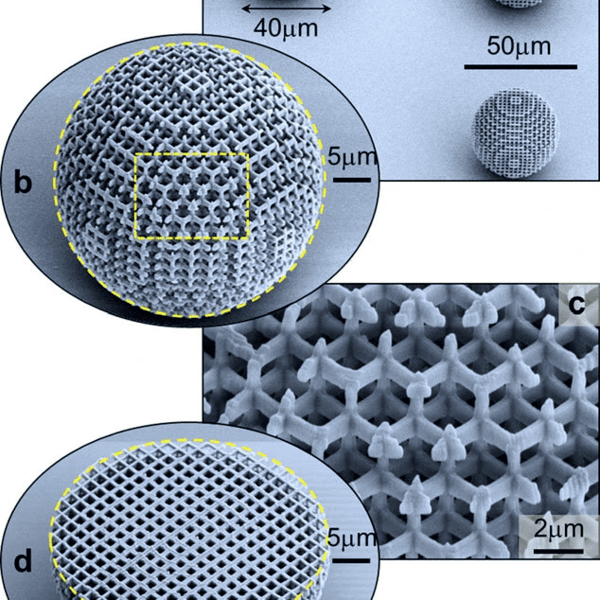
The lens is typically manufactured using a process called injection molding. In this process, the dielectric material is melted and injected into a mold that has the shape of the lens. Once the material cools and solidifies, the lens is removed from the mold and any excess material is trimmed off.
To create the gradient index profile of the lens, the dielectric material is often mixed with a dopant. This dopant is typically a lower-permittivity material, such as air or a low-permittivity polymer. By carefully controlling the concentration of the dopant throughout the lens, the refractive index of the lens can be varied to create the desired gradient.
In some cases, multiple layers of different dielectric materials are used to create the lens. These layers are bonded together using an adhesive or by applying heat and pressure. This allows for even more precise control over the refractive index gradient and can result in lenses with improved performance.
Overall, the materials and manufacturing processes used to create Luneburg lens antennas are carefully chosen to ensure high performance and efficient operation.
How Do Metal Plate and Dielectric Lens Antennas Work?
Metal plate lens antennas and dielectric lens antennas each serve to direct electromagnetic waves, but they operate on distinct principles and offer different advantages depending on the application.
Metal Plate Lens Antenna:
In a metal plate lens antenna, carefully shaped metallic plates are used to manipulate the propagation of electromagnetic waves. When a spherical wavefront from a source reaches the metal lens, the wave is essentially sped up—meaning the phase of the outgoing electromagnetic wave advances as it passes through the structure. This causes the originally curved wavefront to flatten, producing a plane wave suitable for efficient transmission or reception. It’s a bit like straightening the ripples in a pond, ensuring the waves leave in a unified direction. Because the speed of electromagnetic waves can effectively change in this configuration (by altering the path length the wave travels between the plates), metal plate lens antennas can achieve focusing without relying on bulk material, making them comparatively lightweight and resistant to some forms of signal loss.
Dielectric Lens Antenna:
A dielectric lens antenna, on the other hand, uses a material with a higher permittivity (such as polystyrene or Teflon) to slow down and delay portions of the wavefront. Picture a camera lens focusing light: a spherical wave from the feed antenna enters the dielectric lens, which slows some parts of the wave more than others to effectively “collimate” it—that is, convert the curved wavefront into a flat, synchronized one. Because the electromagnetic waves are delayed as they travel through the dielectric, this type of antenna is often called a “delay lens” antenna.
Key Differences:
- Material and Mechanism: Metal plate lenses use air and metal structures to advance the wave’s phase, while dielectric lenses employ plastic or similar materials to delay it.
- Physical Properties: Metal plate lenses are generally lighter and may be preferred for their mechanical durability, whereas dielectric lenses can provide very precise focusing when crafted with the proper gradient in material composition.
- Signal Management: Metal plate designs are advantageous for frequencies where dielectric losses become significant, while dielectric lenses excel at higher frequencies (like those used in advanced radar and imaging systems) due to their ability to maintain performance with precise refractive indexing.
Both technologies are valuable in the design arsenal of microwave and millimeter-wave engineers, with their selection tailored to the specific requirements of coverage, bandwidth, and application environment.
How are the Width and Bandwidth of Stepped or Zoned Dielectric Lens Antennas Calculated?
When designing stepped or zoned dielectric lens antennas, engineers make use of certain formulas to determine key parameters like the width of each step and the overall bandwidth of the lens.
Calculating Step Width
The width of each step in a stepped dielectric lens is determined by the wavelength (λ) of the operating frequency and the refractive index (n) of the material used. The formula commonly used is:
Step Width = λ / (n – 1)
This equation shows that as the refractive index increases (or as the wavelength decreases), the steps of the lens become narrower. This helps in controlling phase variations and improving lens performance at different frequencies.
Calculating Bandwidth for Zoned Lenses
To estimate the bandwidth of a zoned lens antenna, both the refractive index (n) and the number of defined zones (K) within the lens are considered. The bandwidth can be calculated using the following relationship:
Bandwidth = (50 × n) / [1 + (K × n)]
Here, increasing the number of zones allows for finer control of the phase, but can also affect the usable bandwidth. By adjusting the number of zones and selecting appropriate materials, designers optimize lens antennas for better efficiency and frequency response.
In summary, stepped and zoned dielectric lenses offer greater flexibility in tailoring antenna properties for specific applications by carefully managing these parameters.
What is the Difference Between a Luneburg Lens and Corner Reflector?
A Luneburg lens and a corner reflector are both types of retroreflectors used for various applications. However, they differ in terms of efficiency, cost, and application scenarios.
Efficiency:
– A Luneburg lens is highly efficient as it can redirect the incident light back to its source with minimal loss. It achieves this by utilizing a graded index of refraction, which allows for continuous focusing of the light.
Luneburg lenses, a type of dielectric lens antenna, are especially effective at higher frequencies. The unique graded-index structure of these lenses transforms a spherical wavefront—produced by the primary feed antenna—into a plane wavefront, ensuring that electromagnetic rays are collimated and precisely delayed by the lens material. This design not only boosts efficiency but also minimizes signal loss, making Luneburg lenses ideal for demanding applications where signal integrity is critical.
However, it’s worth noting that while Luneburg lenses excel at higher frequencies, they can become heavy and bulky at frequencies below 3 GHz. Typically, they are constructed from low-loss dielectric materials such as polystyrene, polyethylene, or lucite, which contribute to their high efficiency and reliable performance.
– On the other hand, a corner reflector is less efficient. It consists of three mutually perpendicular, intersecting flat mirrors that reflect the light back towards the source. However, due to multiple reflections, some light is lost in each reflection, resulting in a lower efficiency.
Cost:
– Luneburg lenses are generally more expensive to manufacture. The graded index of refraction requires precise control of the lens material, which increases the production cost.
– Corner reflectors, on the other hand, are relatively inexpensive to produce. They consist of simple flat mirrors that can be easily manufactured and assembled.
Application Scenarios:
– Luneburg lenses are commonly used in radar applications. They are suitable for scenarios where high efficiency and accurate beam control are required, such as in satellite communication systems, weather radar, and military applications.
– Corner reflectors find applications in various fields, including surveying, optical alignment, and retro reflective road signs. They are often used when cost is a significant factor and high efficiency is not crucial. For example, in surveying, corner reflectors are used to reflect laser beams back to their source for accurate distance measurements.
In summary, Luneburg lenses are highly efficient but more expensive, making them suitable for applications requiring accurate beam control. Corner reflectors, while less efficient, are cost-effective and find applications where cost is a significant factor and high efficiency is not crucial.
Luneburg lens antennas are a breakthrough in engineering that will change the way we communicate and observe the world. Join us on this journey to discover their secrets and embrace a future of precision and efficiency.
Join us on a journey to uncover the secrets of Luneburg lens antennas, a technological marvel that will transform the way we communicate and observe the world. Step into the future, where precision and efficiency reign supreme.
 English
  Spanish
  German
  French (France)
  Korean
  Russian
  Indonesian
  French (Canada)
  Vietnamese
  Armenian
  Albanian
  Assamese
  Acehnese
  Amharic
  Czech
Czech  Bulgarian
  Cebuano
  Malayalam
  German (Switzerland)
  Japanese
  Dutch
Dutch