 Skip to content

A plasma antenna is a cutting-edge technology that utilizes ionized gas instead of traditional metal elements to transmit and receive signals. This unique property provides benefits in reconfigurability, portability, and overall performance compared to conventional antennas. In this article, we’ll explore what a plasma antenna is, how it works, its benefits, and how it differs from traditional designs.
A plasma antenna is a type of radio antenna that replaces traditional metal elements with plasma, an ionized gas that can conduct electrical signals. When a gas is ionized, it becomes conductive and can transmit or receive radio waves. Plasma antennas are known for being more lightweight, efficient, and reconfigurable, making them suitable for various advanced communication applications.
Let’s dive deeper into how a plasma antenna works and what sets it apart from traditional antennas.
What is a plasma antenna used for?
Plasma antennas are versatile devices that can be employed in a range of applications, including:
1. Wireless Communication: Plasma antennas can be used in mobile and fixed wireless communication systems, offering advantages such as reconfigurability and the ability to operate across multiple frequency bands.

2. Radar Systems: Their ability to change shape and size makes plasma antennas suitable for advanced radar applications, allowing for adaptive beamforming and improved detection capabilities.

3. Satellite Communications: Plasma antennas can be utilized in satellite systems, providing flexible and efficient communication links that can be adjusted based on operational needs.
4. Military Applications: Due to their ability to be turned on or off, plasma antennas can enhance security and stealth. They can be used in military communications, surveillance, and electronic warfare, where adaptability and reduced radar cross-section are beneficial.

5. Research and Development: Plasma antennas are also explored in academic and industrial research for innovative applications in fields such as telecommunications and sensor technology.
Overall, plasma antennas offer significant advantages in terms of flexibility, efficiency, and performance across various sectors.
What unconventional implementations of plasma antennas exist?
While most plasma antennas rely on electrical or microwave energy to create the ionized gas needed for operation, some unconventional approaches push the boundaries even further. For example, explosive-driven plasma antennas are being explored, where a controlled detonation rapidly creates a column of plasma that can act as a temporary, high-power antenna—useful in applications requiring instant deployment or extreme environments.
On the other hand, laser-induced plasma antennas use high-powered laser pulses to ionize air or specialized gases, generating a plasma channel that can transmit or receive signals without any physical structure at all. This method has attracted interest from research labs and organizations like Lockheed Martin and BAE Systems, as it opens the door to antennas that can be “switched on” in mid-air and reconfigured nearly instantaneously.
These experimental designs are still in early stages but highlight the remarkable versatility and adaptability of plasma antenna technology, especially for mission-critical or rapidly changing scenarios.
How does a plasma antenna work?
Plasma antennas work by utilizing ionized gas, or plasma, as a medium for transmitting and receiving electromagnetic signals. Here’s a more detailed explanation of how they function:
1. Ionization of Gas: Plasma is created by ionizing a gas, which involves stripping electrons from atoms or molecules. This can be achieved through various methods, such as applying high voltages, using microwave energy, or employing lasers. The resulting plasma consists of free electrons and ions, making it highly conductive.

2. Conductive Properties: Once ionized, the plasma behaves similarly to a metal conductor. It can support electromagnetic waves, allowing it to radiate signals when an alternating current is applied. The conductive nature of plasma enables it to effectively transmit and receive radio frequency (RF) signals.

3. Adjustable Characteristics: One of the significant advantages of plasma antennas is their ability to dynamically change their properties. By controlling the ionization process, operators can adjust the antenna’s effective length, shape, and other parameters, which in turn affects its operational frequency and bandwidth. This tunability allows for versatile applications across different communication systems.
4. Surface Waves and Modes: Plasma antennas can also utilize surface waves, which are electromagnetic waves that travel along the surface of the plasma. By manipulating these waves, the antenna can optimize its performance for specific frequencies or applications.
5. Benefits: Plasma antennas offer several advantages over traditional metal antennas, including reduced weight, the ability to operate over a broad range of frequencies, and potentially lower radar cross-section, making them less detectable. They can also be more resilient in harsh environments since they do not rely on solid materials that can corrode or degrade.
How Plasma Antennas Differ from Traditional Designs
Unlike conventional antennas that rely solely on metal conductors, plasma antennas transmit electromagnetic (EM) signals through an ionized gas. This unique property provides not only the ability to quickly reconfigure performance but also introduces new methodologies for antenna design and operation. Researchers have developed a variety of techniques for generating, measuring, and simulating the plasma itself—using everything from gas discharge tubes to microwave-driven plasma columns—giving engineers significant flexibility in tailoring antenna characteristics for specific applications.
By leveraging the electromagnetic properties of plasma, these antennas can be switched on or off electronically, and their operational parameters finely tuned in real time. This adaptability is particularly valuable in environments where communication requirements or operating frequencies may change rapidly, such as in military or advanced wireless communication systems.
Overall, plasma antennas represent an innovative approach to antenna technology, leveraging the unique properties of plasma to enhance communication capabilities.
What are the main architectures of GPAs, and how do active and passive plasma antennas differ in function?
When it comes to Gas Plasma Antenna (GPA) designs, there are two fundamental architectures: active and passive. The key difference lies in whether the plasma itself generates the electromagnetic (EM) signal or simply interacts with existing signals.
- Active Plasma Antennas: In this configuration, the plasma column actually emits or receives electromagnetic signals—much like a traditional metal antenna, but with the plasma acting as the conductor. By energizing the gas to form plasma, these antennas can transmit or capture signals directly, offering reconfigurability and rapid adaptability for various frequencies.
- Passive Plasma Antennas: Rather than radiating signals, passive plasma antennas use plasma to manipulate electromagnetic waves produced by other sources. This may involve steering, shaping, or modulating a beam, similar to how a lens bends light. Here, the plasma behaves more like a tunable material that influences the path or characteristics of incoming or outgoing signals, without contributing its own.
This distinction enables designers to tailor GPA systems for specific needs—whether that’s direct communication or enhancing overall system performance through clever signal manipulation.
Measuring and Simulating Plasma Antenna Properties
To accurately assess the properties and performance of plasma antennas, researchers employ a blend of experimental and computational methods, much like those used for conventional antennas—albeit tailored for the unique characteristics of ionized gas.
Measurement Techniques:
The electromagnetic characteristics of plasma antennas—such as radiation pattern, gain, efficiency, and impedance—are typically measured using network analyzers, spectrum analyzers, and anechoic chambers. The ionized gas within the antenna can be monitored and adjusted in real time to determine how its conductivity, shape, and length affect overall performance. Additionally, specialized probes and diagnostic equipment can track plasma density and uniformity, key factors in antenna efficiency.
Simulation Approaches:
On the simulation side, advanced software tools like CST Microwave Studio or ANSYS HFSS are commonly used, with models customized to account for the variable conductivity of plasma. These simulations enable researchers to predict how changes in plasma parameters—such as electron density and temperature—will affect behavior at different frequencies. Complex electromagnetic field interactions can be explored virtually, saving both time and resources compared to physical prototyping.
Dynamic Testing:
The reconfigurability of plasma antennas adds another layer of complexity. By manipulating the ionization process, operators can test a wide array of antenna configurations without physically rebuilding the device. This is particularly useful for experimenting with adaptive beamforming or frequency agility, where rapid changes are essential.
Altogether, a carefully coordinated combination of hands-on measurement and computer modeling paves the way for continued innovation in plasma antenna technology, ensuring optimal performance across diverse applications.
What are the advantages of a plasma antenna?
Plasma antennas offer several advantages over traditional antennas, including:
1. Reconfigurability: Plasma antennas can be easily tuned to operate at different frequencies, allowing for dynamic adaptability to various communication needs and environments. This makes them suitable for applications requiring flexibility, such as military communications or multi-band systems.

2. Stealth and Security: When not in use, plasma antennas can be turned off, rendering them virtually invisible to detection systems. This characteristic enhances stealth capabilities for military applications and improves security by reducing the risk of interception.
3. Portability: Plasma antennas typically do not rely on heavy metal components, allowing for lightweight and compact designs. This portability makes them ideal for mobile applications, such as drones or portable communication devices.

4. Improved Performance: Plasma antennas can exhibit superior performance in specific frequency ranges compared to traditional antennas. They may offer enhanced bandwidth, reduced interference, and better signal quality, making them advantageous for high-frequency applications.
5. Broadband Capabilities: Many plasma antennas can operate over a wide range of frequencies, providing broadband capabilities without the need for multiple antennas for different bands.
6. Durability: Plasma antennas can be more resilient to environmental factors such as corrosion, moisture, and extreme temperatures, which can prolong their lifespan and reduce maintenance needs.
7. Low Profile: The design of plasma antennas can be made very low profile, making them suitable for applications where space is a constraint or where aesthetics are important.
8. Cost-Effectiveness: As technology advances, the manufacturing processes for plasma antennas may become more cost-effective, potentially leading to lower production costs compared to traditional antenna systems.
Overall, the unique properties of plasma antennas make them a promising alternative for a variety of applications in telecommunications, defense, and other fields.
What is the frequency range of a plasma antenna?
Plasma antennas typically operate in the MHz to GHz frequency range, depending on their specific design and application. Common operational frequencies include around 430 MHz and 2.45 GHz, which makes them suitable for various communication and scientific applications. The ability to adjust their frequency response through plasma control allows for versatile use across different frequency bands.
What is the polarization of a plasma antenna?
Plasma antennas are indeed versatile in terms of polarization. They can be designed to support multiple types of polarization, including:
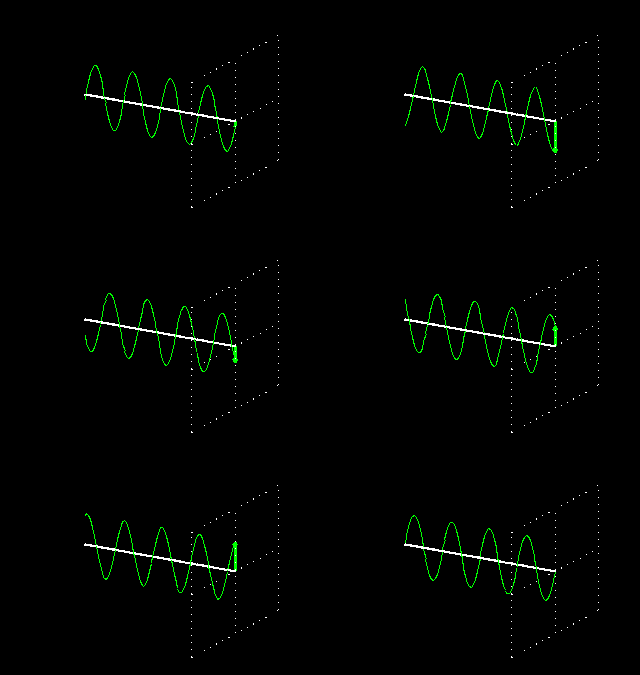
1. Linear Polarization: Plasma antennas can be configured to emit or receive signals that are linearly polarized, which is common in many communication applications.
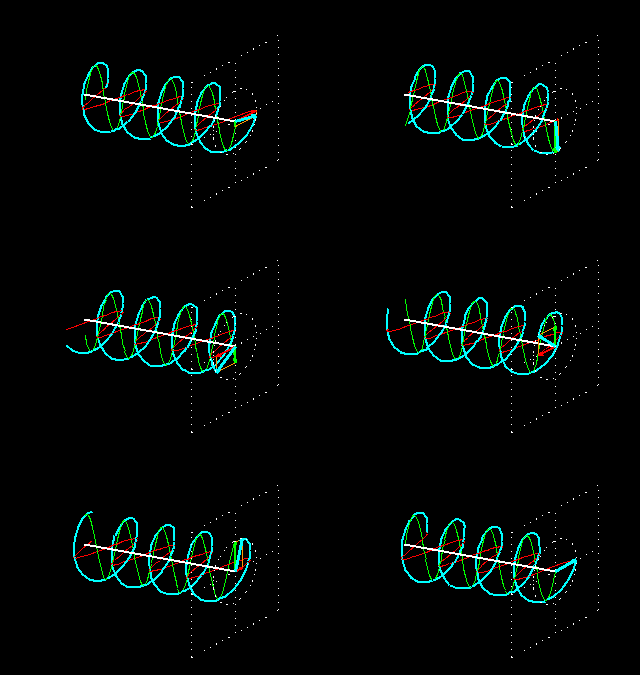
2. Circular Polarization: These antennas can also be designed to produce circularly polarized waves, offering advantages in scenarios where the orientation of the receiving antenna may vary.
3. Elliptical Polarization: Plasma antennas can support elliptical polarization, which is a general form that encompasses both linear and circular polarizations.
The ability to switch between these polarizations makes plasma antennas particularly useful in dynamic environments, enhancing signal integrity and reducing interference. This flexibility allows them to adapt to different communication requirements and improve overall performance in various applications.
What is a plasma antenna made of?
A plasma antenna is typically made of a gas or plasma-generating medium, such as a noble gas (e.g., argon or neon), which is contained within a structure that can generate and control the plasma. The key components of a plasma antenna include:
1. Gas Chamber: This is the enclosure that holds the gas, which can be ionized to create plasma.
2. Electrodes: These are used to apply a voltage to the gas, ionizing it and forming plasma. The design and arrangement of these electrodes can vary based on the intended application of the antenna.
3. Control System: This includes electronics to control the ionization process and shape the plasma, allowing the antenna to be reconfigured for different frequencies or radiation patterns.

4. Insulating Material: The gas chamber and electrodes are often surrounded by insulating materials to prevent unwanted electrical discharge and to protect the components.
5. Cooling System: Depending on the application and duration of operation, a cooling system may be necessary to dissipate heat generated during the ionization process.
Plasma antennas can be advantageous due to their ability to change shape and frequency, potentially offering greater versatility compared to traditional metallic antennas.
What is the difference between a plasma antenna and a traditional antenna?
Traditional antennas use metal elements to transmit and receive signals, while plasma antennas rely on ionized gas. This substitution offers benefits like lighter weight, tunability, and the ability to be switched off when not needed. Plasma antennas are also less susceptible to signal distortion due to their dynamic nature.

Here are some additional details to further clarify these differences:
1. Structure and Materials:
– Traditional Antennas: Typically made from conductive materials like copper or aluminum, which provide stable and consistent performance.
– Plasma Antennas: Utilize ionized gas (plasma) as the radiating medium. This plasma can be generated and controlled, allowing for a more flexible design.
2. Weight and Portability:
– Traditional Antennas: Generally heavier due to the metal components and structural supports required.
– Plasma Antennas: Can be much lighter, as they do not require heavy materials, making them easier to transport and deploy.
3. Tuning and Frequency Range:
– Traditional Antennas: Fixed in design, which means they often require physical adjustments or different antennas for different frequencies.
– Plasma Antennas: Highly tunable, allowing them to change frequency characteristics on the fly. This adaptability can enhance performance across a range of frequencies without needing multiple antennas.
4. Operational Flexibility:
– Traditional Antennas: Always active when powered, which can lead to interference or security concerns.
– Plasma Antennas: Can be turned off or deactivated when not in use, reducing the risk of detection and interference.
5. Signal Integrity and Distortion:
– Traditional Antennas: Can suffer from issues like signal distortion due to environmental factors or physical limitations of the materials used.
– Plasma Antennas: Less susceptible to such distortions due to their dynamic nature and ability to adapt to changing conditions.
6. Applications:
– Traditional Antennas: Widely used in various applications, including broadcasting, telecommunications, and satellite communications.
– Plasma Antennas: Still largely in the experimental and developmental stages, with potential applications in military communications, advanced telecommunications, and potentially in space exploration.
Overall, plasma antennas present innovative advantages over traditional antennas, but they are still being researched and developed for broader practical applications.
Summary
Plasma antennas are revolutionizing communication systems with their reconfigurable, lightweight, and high-performance characteristics. By replacing metal elements with plasma, these antennas can achieve superior functionality in various applications, from military systems to commercial communications. As research continues, plasma antennas are poised to become a core component of next-generation wireless technologies.
 English
  Spanish
  German
  French (France)
  Korean
  Russian
  Indonesian
  French (Canada)
  Vietnamese
  Armenian
  Albanian
  Assamese
  Acehnese
  Amharic
  Czech
Czech  Bulgarian
  Cebuano
  Malayalam
  German (Switzerland)
  Japanese
  Dutch
Dutch