 Skip to content
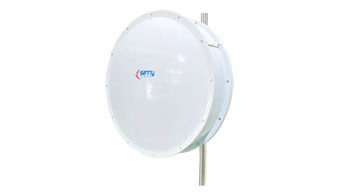
A parabolic dish antenna is a directional antenna. The parabolic dish antenna can amplify signals because its shape concentrates the radio waves into a specific focal point. It allows the antenna to achieve a higher gain, or amplification, than other types of antennas.
A high gain directional antenna which is typically used to receive or transmit signals in the wireless backhaul networks at 4.9-7.125GHz, is a WiFi Parabolic Dish Antenna. It can extend the range of a wireless hotspot from 3 miles to 30 miles. However, the parabolic dish antenna can only transmit or receive signals in the infrared and visible light ranges, Light of Sight(LOS).
What are the Main Applications of Parabolic Dish Antennas?
Parabolic dish antennas play a crucial role in modern wireless communication, thanks to their high directivity and signal amplification abilities. Their primary applications include:
Satellite Communication (SATCOM): These antennas are a preferred choice for linking ground stations with satellites, ensuring clear and robust data transmission across vast distances. Organizations like NASA and common satellite TV providers use parabolic dish antennas to maintain stable connections with satellites in orbit.

Telecommunications Infrastructure: Parabolic dishes serve as backbone antennas in wireless backhaul networks and point-to-point communication links. They help extend connections between distant towers, forming part of global internet and telephone systems.
Remote Sensing and Earth Observation: On board satellites and ground stations, parabolic dishes collect and transmit data for applications such as weather forecasting, environmental monitoring, and mapping.
Radar and Defense: Their precision and range make them invaluable for defense and aerospace applications—like tracking and monitoring airborne objects, or relaying signals in military operations.
Scientific Research: Parabolic antennas are often found on radio telescopes, capturing faint radio signals from deep space to help astronomers study distant planets, galaxies, and cosmic phenomena.
In summary, parabolic dish antennas are indispensable in scenarios demanding focused, long-distance wireless communication—whether that’s connecting rural areas, enabling scientific breakthroughs, or providing critical links for defense and satellite systems.
WiFi Parabolic Dish Antenna Frequency:
2.4GHz: 2400-2484MHz
5.8GHz: 4900-6500MHz
6 GHz: 5925-7125MHz
The WiFi Parabolic Dish Antenna offers high gain and a wide frequency range, ideal for long-range wireless applications. The parabolic dish antenna is also highly resistant to interference, making it an excellent choice for congested areas. With a WiFi Parabolic Dish Antenna, you can extend the range of your wireless network and get better performance from your hotspot.
Parabolic Dish Antenna Types
#1 Grid Parabolic Dish Antenna
Grid parabolic dish antennas are a type of directional antenna that can transmit and receive radio frequency signals. It’s widely used for SISO radios. It has been abandoned for a long time during the WiFi networks.
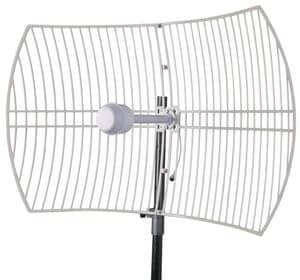
A grid parabolic dish antenna is made from parallel metal rods or wires mounted in a grid pattern on a frame. A reflector is then attached to the frame, and this reflector is shaped like a parabola. Although some antennas use a plastic reflector, the frame and reflector are typically made from metal.
The grid pattern of the metal rods or wires helps focus the signal in a specific direction, and the reflector amplifies the signal. These antennas are often used in long-range communications, such as satellite TV and radio, as they can send and receive signals over great distances.
#2 Solid Parabolic Dish Antenna
A parabolic dish antenna is used to direct radio waves. The most common form is the solid dish antenna. A solid Parabolic Dish Antenna uses a solid reflector rather than wire mesh. Solid dish Parabolic Dish Antenna is often used in applications where a high gain or concentrated signal is needed.
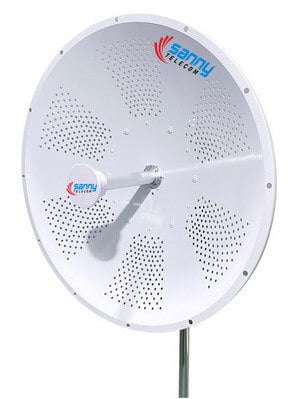
The reflector on a solid dish Parabolic Dish Antenna is made of a single piece of metal(aluminum alloy), making it more durable than a wire mesh reflector. It also eliminates the need for a frame, which can add weight and complexity to a dish antenna. Additionally, a solid Parabolic Dish Antenna can be made larger than a wire mesh reflector without leaking signal through gaps. Thus, it makes a good choice for Point-to-Point applications.
Parabolic Dish Antenna Applications in Earth Observation and Telecommunications
Parabolic dish antennas play a vital role both in monitoring our planet and keeping us connected. In Earth observation, these antennas are mounted on satellites to capture detailed data from vast areas below. Whether it’s tracking weather patterns, monitoring natural disasters, or observing the movement of ships and airplanes, the focused beam of the parabolic dish allows satellites to transmit and receive precise information about objects and their locations.
In telecommunications, parabolic dishes are the backbone of long-distance, point-to-point wireless links. They’re commonly seen atop radio towers, relaying high-speed internet and phone signals across continents and oceans. Because of their high gain and tight beamwidth, these antennas minimize interference and help create reliable connections—even in crowded urban environments or remote regions. So, whether you’re making an international call or browsing the web from a far-flung corner of the globe, there’s a good chance a parabolic dish antenna is working behind the scenes to deliver your data.
Parabolic Dish Antennas in Satellite Communication and Space Operations
Parabolic dish antennas are the workhorses behind much of modern satellite communication and space-based operations. Their unique design makes them ideal for establishing reliable links between ground stations and orbiting satellites—or even spacecraft venturing farther into the solar system.
These antennas play several essential roles:
- Satellite Communication: Parabolic dish antennas are pivotal in ensuring stable, high-gain connections with satellites in geostationary and low Earth orbits. Whether it’s streaming live television, handling global internet traffic, or supporting critical navigation systems like GPS, these antennas focus signals tightly to minimize interference and maximize distance.
- Space Operations: In deep-space missions, parabolic dishes form the backbone of ground-based tracking networks, such as NASA’s Deep Space Network. Their precision allows ground teams to send commands to distant probes or receive faint telemetry signals from Mars, the Moon, or even further afield.
- Earth Observation: On Earth observation satellites, parabolic dishes transmit massive volumes of imagery and sensor data back to Earth, supplying scientists and agencies with up-to-the-minute information about climate, agriculture, disaster zones, and much more.
- Defense and Remote Applications: In military and remote operations, parabolic antennas enable secure, long-range communication—even in challenging environments—by providing excellent directionality and resistance to jamming.
From keeping us connected across continents to exploring the far reaches of space, parabolic dish antennas continue to deliver dependable, high-performance communication in some of the most demanding applications imaginable.
Prime Focus Antenna
A prime focus antenna is another form of parabolic dish antenna, recognized for its straightforward, compact construction. In this design, the feed or receiving element sits directly at the focal point of the reflecting dish, which maximizes the collection and direction of the radio signals. While this placement can slightly block some incoming signals—a bit like putting your hand in front of a flashlight—it ensures efficient signal concentration and reliable performance.
Prime focus antennas are commonly found in satellite ground stations and radio telescopes, handling tasks that require high-precision signal reception. Their design makes them a popular choice for deep-space communications and scientific observations, where every bit of signal strength counts.
Cassegrain Parabolic Dish Antenna
A Cassegrain antenna is a specialized type of parabolic dish antenna featuring not only a main parabolic reflector but also a smaller secondary reflector—typically hyperbolic in shape—suspended in front of the main dish. The purpose of this clever design is to redirect incoming or outgoing signals from the feed antenna at the dish’s base up to the secondary reflector and then back down to the focal point. This dual-reflector setup allows for a more compact feed arrangement behind the dish, reducing signal loss and making the entire antenna more efficient, especially at higher frequencies.
Cassegrain antennas are widely used in applications where high gain and precise signal focus are essential. You’ll often find them in satellite communication systems, deep space probe tracking (think NASA’s dishes at Goldstone), radio telescopes, and even in some radar installations. The configuration helps minimize interference and supports easier maintenance since sensitive components are conveniently located at the dish’s base rather than suspended at the focal point.
Offset Feed Parabolic Dish Antenna
An offset feed parabolic dish antenna features a unique design where the feed horn is positioned away from the center of the dish. This setup minimizes any obstruction of the signal path, allowing more of the reflector to be used effectively. As a result, offset feed antennas boast improved efficiency and deliver stronger signal performance compared to center-fed designs.
You’ll commonly find offset feed antennas in satellite TV dishes and in point-to-point wireless links, thanks to a couple of key advantages:
- Reduced Signal Blockage: By moving the feed horn out of the main signal path, these antennas cut down on signal loss and allow for a cleaner, more direct reflection from the dish surface.
- Higher Efficiency: The unobstructed reflector area captures and focuses more of the incoming signal, making these antennas ideal for applications requiring maximum gain and minimal interference.
- Practical Mounting: Offset designs typically allow for more flexible mounting angles, which can make installation easier—especially on residential rooftops or challenging locations.
With their efficient signal capture and versatility, offset feed parabolic antennas are a popular choice for both consumer and professional wireless setups.
Advantages & Disadvantages of Parabolic Dish Antenna
Advantages of Parabolic Dish Antenna:
- Parabolic dish antennas have a narrow beamwidth, allowing for high gain and directionality.
- They are also relatively easy to construct and can be made quite small.
- Parabolic dish antennas are also very efficient at transmitting and receiving signals.
Disadvantages of Parabolic Dish Antenna:
- One of the main disadvantages of parabolic dish antennas is that they require a precise alignment to work correctly.
- They are also quite sensitive to wind and other environmental factors, affecting their performance.
- Additionally, parabolic dish antennas are often quite expensive to purchase and install.
Considerations Before Choosing a Parabolic Dish Antenna
Before integrating a parabolic dish antenna into your setup, it’s important to have a clear understanding of your needs and budget. Some parabolic antennas can be quite large and costly, and not every application requires the level of precision or performance they offer. While these antennas deliver impressive range and signal focus, they may not offer much flexibility for repositioning or multi-purpose use. Carefully weigh the pros and cons, along with your specific requirements, to determine if a parabolic dish antenna is the best fit for your situation.
In conclusion, while parabolic dish antennas have several advantages, they also have many disadvantages that should be considered. When deciding whether or not to use a parabolic dish antenna, it is essential to weigh all of the pros and cons to make the best decision for your particular situation.
Parabolic Dish Antenna Accessories and Functions
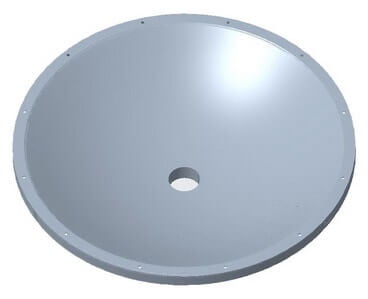
Reflector
The reflector is the most costly component of a parabolic dish antenna. It is a curved surface that reflects the incoming radio waves and focuses them towards the receiver. The reflector is usually made from aluminum alloy with lightweight for low cost and easy installation. It is usually covered with an outdoor powder coating for long service life.
Waveguide Feedhorn
The feedhorn is the most critical a of a parabolic dish antenna. It’s the key because it can decide the parameters ad performance such as frequency range, gain, isolation, etc.

A feedhorn is used to couple the feedline to the reflector in a parabolic dish antenna. The feedhorn is placed at the reflector’s focal point, and the feed line is connected to it. The feedhorn collects the RF energy from the feedline and focuses it onto the reflector, reflecting the energy in the desired direction. There are many different types of feed horns available on the market, and each has its own set of benefits and drawbacks. Some feedhorns are designed to work with a specific feedline, while others are more versatile and can be used with various feedline types.
Flange
A flange is a flat circular piece of metal connected to the dish reflector. It can attach the feedhorn to a parabolic dish reflector. The flange mount has holes that align with the bolts on the dish antenna. The mount is then attached to a flat surface with screws or bolts.
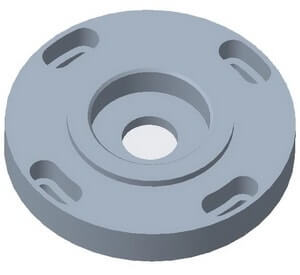
Flange mounts are used when the antenna’s surface is not perfectly flat. The flange mount will help level the dish antenna and keep it from wobbling.
Mounting Bracket
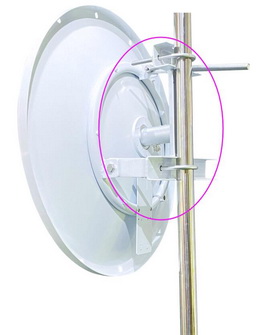
The mounting bracket is the most crucial accessory for a parabolic dish antenna, and it is what allows the dish to be mounted on a structure, usually a mast or pole on the tower. The type of bracket you need will depend on the specific dish you have, so check with the manufacturer or retailer before purchasing one.
Protection Radome
A protection radome is a typically dome-shaped cover installed over the top of a parabolic dish antenna to protect it from the elements. The protection radome shields the antenna from rain, snow, and hail, as well as from wind-blown debris. It also helps to keep the antenna clean, improving its performance.
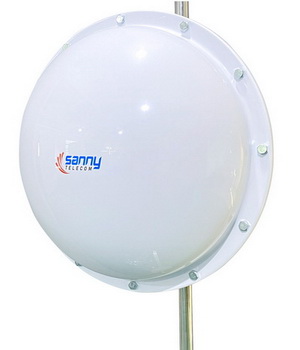
The protection radome is a typically durable and robust material, such as fiberglass or polycarbonate. It is vital to ensure that the radome is sealed correctly to the dish to prevent moisture and dirt from getting inside.
WiFi Parabolic Dish Antenna Polarization
A parabolic dish antenna uses a reflector, a cross-sectional shape curved surface of a parabola, which directs the radio waves. The reflector focuses the waves into a small beam, which is then directed at a receiver.
The waves reflected by the dish are in phase, which means that all waves reach the receiver simultaneously and create a stronger signal. That is why parabolic dish antennas are often used for the backhaul communications.
The polarization of a parabolic dish antenna can be either linear or elliptical. Linear polarization means that the waves are all aligned in the same plane, while elliptical polarization means that the waves are aligned in two planes, horizontal or vertical.
Parabolic dish antennas can be either right-handed or left-handed. Right-handed antennas have a clockwise polarization, while left-handed antennas have a counterclockwise polarization.
Some antenna designs use a combination of linear and elliptical polarization, while others use circular polarization. Circular polarization is created when the waves are aligned in a spiral.
This is useful for antennas mounted on moving vehicles, such as aircraft or ships, because it helps to reduce the amount of interference they receive from other sources.
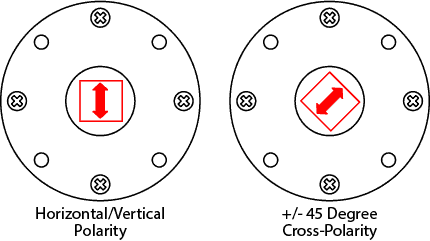
The polarization used for a parabolic dish antenna depends on the application. Sanny Telecom WiFi parabolic dish antennas support both Dual Polarized (horizontal & vertical) and Dual Slant (+45/ -45) polarity.
How To Connect the Parabolic Dish Antenna to the Radio/ AP(Access Point)?
There are various connection types based on the applications and the radio interface.
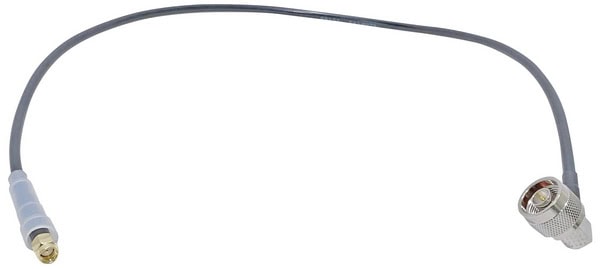
A low loss coax cable assembly(pigtail) is widely used for WiFi networks. It can connect the parabolic dish antenna to radio such as Cambium Networks, Mikrotik, Radwin, Ubiquiti, etc.
Pigtail Connector
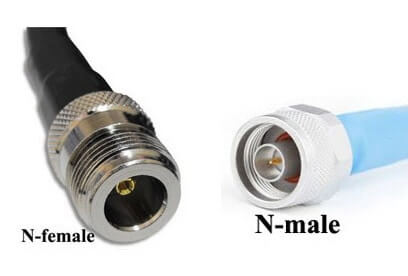
N-Type: This connector is used for coaxial cables with a diameter of about 3.5mm. It has a threaded N-type plug on one end and an N-type socket on the other
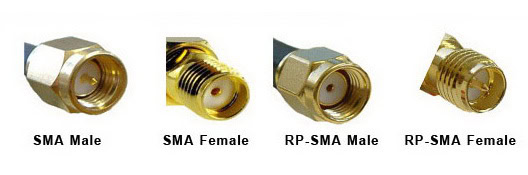
SMA Type: This is a smaller version of the N-type connector used for coaxial cables with a diameter of about 2.4mm. It has a threaded SMA plug on one end and an SMA socket on the other.
Pigtail Coax Cable
195 (3D-FB) Series: This coaxial cable series is a low loss for high-frequency applications up to 6.5 GHz. It has a foam PE dielectric with a jacket diameter of 4.80mm and a solid copper core with a diameter of 1.02mmm.
240 (5D-FB) Series: This series of coaxial cables is low loss for high-frequency applications up to 18 GHz. It has a foam PE dielectric with a jacket diameter of 7.50mm and a CCA core with a diameter of 1.80mm.
400 (7D-FB)Series: This coaxial cable series is low loss for high-frequency applications up to 26.5 GHz. It has a foam PE dielectric with a jacket diameter of 10.16mm and a CCA core with a diameter of 2.74mm.
Applications in Military Operations
Parabolic dish antennas play a crucial role in military communications by enabling secure, long-distance data transmission—even in challenging and remote environments. These antennas are relied upon for their ability to send and receive highly focused microwave signals, which is particularly valuable when establishing robust and interference-resistant links on the battlefield.
Thanks to the concentrated beam and high gain of a parabolic dish, military units can maintain communications over vast distances, whether coordinating operations in remote outposts, directing equipment in the field, or linking up mobile command centers. Their directional nature helps minimize unwanted interception and jamming, a factor especially relevant in tactical and defense scenarios where signal integrity is critical.
Additionally, parabolic dish antennas are favored for mobile applications aboard vehicles, aircraft, and ships, thanks to options for circular polarization—which, as mentioned earlier, helps mitigate interference from multiple sources and rapid movement. This makes them indispensable tools for modern defense networks requiring real-time, uninterrupted connectivity.
 English
  Spanish
  German
  French (France)
  Korean
  Russian
  Indonesian
  French (Canada)
  Vietnamese
  Armenian
  Albanian
  Assamese
  Acehnese
  Amharic
  Czech
Czech  Bulgarian
  Cebuano
  Malayalam
  German (Switzerland)
  Japanese
  Dutch
Dutch