 Skip to content

Discover the essence of dipole antennas, the backbone of modern radio and telecommunications. Simple yet versatile, these antennas are the unsung heroes in the wireless world. Learn what makes them indispensable in our tech-driven society.
A dipole antenna, in radio and telecommunications, is the most basic yet extensively utilized antenna type, consisting of two conductive elements or rods that emit and receive electromagnetic waves. This straightforward design enables it to effectively transmit and receive signals across a wide range of frequencies, making it a fundamental tool in wireless communication systems.
Now that we’ve unveiled the basics, let’s dive deeper into the workings and applications of dipole antennas.
How Does a Dipole Antenna Work?
When an alternating current (AC) is applied to the feedline, it generates an electric field around the antenna. As the AC current changes direction, the electric field also changes direction, creating electromagnetic waves that radiate outwards from the antenna.
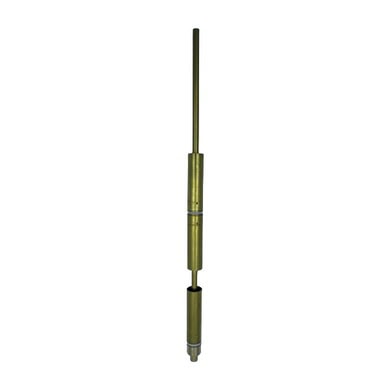
The length of the dipole antenna is crucial for its operation. It must be a specific fraction of the wavelength of the radio waves it is designed to transmit or receive. This length is typically half the wavelength, which is why it is called a “half-wave dipole antenna.” When the length is correctly matched to the wavelength, the antenna efficiently converts the electrical energy into radio waves.
The radiation pattern of a dipole antenna is bidirectional, meaning it radiates and receives signals equally well in two opposite directions perpendicular to the antenna. This is because the electric field generated by the AC current is strongest in the middle of the antenna and weakest at the ends. As a result, the antenna radiates most of its energy perpendicular to its length.

When radio waves strike a dipole antenna, they induce an alternating current in the antenna’s conductors. This current is then sent to the feedline and can be used to power a receiver or other electronic devices. The dipole antenna acts as a receiving antenna by converting the radio waves back into electrical energy.
In summary, a dipole antenna converts electrical energy into radio waves when transmitting and converts radio waves back into electrical energy when receiving. Its design and length are critical for efficient signal transmission and reception.
Connection and Installation Options for Standard Dipole Antennas
One of the advantages of standard dipole antennas lies in their compatibility with a wide array of connectors. You’ll commonly find options such as SMA, N-type, and FAKRA connectors, which are widely supported in many wireless and RF applications. These connectors make installation straightforward—no specialized tools or expertise required.
Because of this universal design, users can quickly connect dipole antennas to various equipment, including routers, base stations, and receivers from brands like Cisco, Ubiquiti, or Netgear. Whether you’re outfitting an indoor network or setting up communications outdoors, these standard connectors ensure a reliable and user-friendly installation process for both amateurs and professionals.
Most dipole antennas are engineered for easy mounting, so you can attach them directly to devices or use a mounting bracket for more flexible placement. This versatility makes them a go-to choice for a wide variety of wireless solutions.
What is a Dipole Antenna Used For?
Some common uses for dipole antennas include:
1. Radio communication: Dipole antennas are commonly used in radio communication systems, such as two-way radios and walkie-talkies. They are used to transmit and receive signals over short distances.
2. Television broadcasting: Dipole antennas are used to transmit television signals from broadcasting stations to homes. They are also used for receiving television signals in homes that do not have cable or satellite television.
3. Wireless networking: Dipole antennas are used in wireless networking systems, such as Wi-Fi routers and access points. They help transmit and receive signals between devices, allowing for wireless internet connectivity.
4. Ham radio: Dipole antennas are popular among amateur radio operators, also known as ham radio operators. They are used for both transmitting and receiving signals in ham radio communications.
5. Radar systems: Dipole antennas are used in radar systems for detecting and tracking objects, such as aircraft, ships, and weather patterns. They help transmit and receive radar signals, allowing for the measurement of distance, speed, and direction of objects.
6. Mobile phones: Dipole antennas are used in mobile phones to transmit and receive cellular signals. They help ensure reliable communication between mobile devices and cellular towers.
Versatility Across Multiple Technologies
A key advantage of dipole antennas is their broad bandwidth, which enables them to support multi-frequency communications. Because of this, dipole antennas are widely adopted in modern wireless technologies, including:
- Wi-Fi (including Wi-Fi 6/6E/7): Providing stable and efficient wireless connectivity in both residential and commercial environments.
- 4G/5G LTE cellular networks: Facilitating fast data transmission for mobile devices and cellular infrastructure.
- Industrial, Scientific, and Medical (ISM) applications: Supporting various equipment and devices that rely on wireless communication in specialized environments.
- GNSS & GPS systems: Enhancing the accuracy and reliability of global navigation and positioning services.
Dipole antennas are foundational in today’s wireless communication landscape due to their simplicity, efficiency, and adaptability. Whether it’s streaming video at home, managing logistics in a factory, or navigating with GPS, the humble dipole antenna plays a vital role in keeping us connected.
Can Dipole Antennas Be Used Both Indoors and Outdoors?
Absolutely! Dipole antennas are remarkably versatile and can be installed both indoors and outdoors depending on your needs. Thanks to their straightforward design and the use of standard connectors—like SMA, N-type, or FAKRA—they can be easily connected to a variety of devices.
For indoor use, dipole antennas are often found in home Wi-Fi routers or as part of a television setup, providing reliable signal transmission without the mess of complex installations. Outdoors, they are commonly mounted on rooftops or external poles to extend range and improve reception for radios, ham equipment, and even weather stations.
This flexibility means dipole antennas are suitable for everything from a home internet network in San Francisco to a ham radio station in rural Vermont, performing reliably in a wide range of environments. Whether you need wireless connectivity inside your home or long-distance reception in the great outdoors, a dipole antenna has you covered.
What is the Most Common Dipole Antenna?
The half-wave dipole antenna is a type of dipole antenna that is resonant at half the wavelength of the frequency it is designed to operate on. It is often referred to simply as a dipole antenna. The half-wave dipole is one of the most common and widely used antenna designs due to its simplicity and effectiveness across a wide range of frequencies.
Types of Dipole Antennas
While the half-wave dipole is the standard for many applications, there are several variations that serve different purposes:
- Half-Wave Dipole Antenna: The classic design, measuring about half the wavelength of the target frequency. Its straightforward construction and reliable performance make it a staple in everything from amateur radio setups to television broadcasting.
- Multiple Half-Wave Dipole Antenna: This configuration combines several half-wave dipoles to create more complex antenna arrays. These setups can provide greater directivity or increase gain, making them useful in specialized communication systems.
- Folded Dipole Antenna: In this design, the conductors are folded back on themselves, forming a loop or additional parallel elements. Folded dipoles are easier to match to a wider range of feedline impedances and are often used in television antennas and certain wireless networking equipment.
Each of these types offers unique advantages depending on the application, but the half-wave dipole remains the most popular choice thanks to its balance of performance, ease of design, and versatility.
What is a Folded Dipole Antenna and How is it Different?
A folded dipole antenna is a variation of the classic dipole design, where instead of a single straight wire, the antenna consists of two parallel conductors that are connected at both ends, forming a “folded” structure. This design creates a loop-like appearance, with the standard dipole element essentially duplicated and closely spaced.
The main difference between a folded dipole and a traditional half-wave dipole is in their construction and performance. While the classic dipole uses a single conductor, the folded dipole’s parallel wires increase the antenna’s input impedance—typically around 300 ohms, compared to the 75 ohms of a standard dipole. This higher impedance makes folded dipoles especially useful for applications where impedance matching with certain types of transmission lines is important, such as in television antennas and FM broadcasting.
Folded dipoles are valued for their broad bandwidth and ease of matching to different transmission lines, making them a practical choice in environments where flexibility and consistent performance across varying frequencies are needed. They retain the basic radiation pattern of a traditional dipole, radiating most efficiently broadside to the wire, but their modified structure gives them added versatility for both design and deployment.
What is a Multiple Half-Wave Dipole Antenna?
A multiple half-wave dipole antenna, sometimes called a collinear dipole array, consists of several half-wave dipole elements arranged in line with one another. Each segment is typically spaced and connected to ensure all sections work together to enhance signal strength and directivity. By increasing the number of dipole segments, these antennas can achieve higher gain, making them especially useful for applications that require stronger, more focused signals—such as certain radio, television, or wireless network systems. This design builds on the fundamental half-wave dipole, offering improved performance while still remaining relatively simple to construct and deploy.
What is the Range of a Dipole Antenna?
At lower frequencies, dipole antennas can offer longer ranges but have narrower bandwidths. In ideal conditions, a dipole antenna can have a range of several kilometers. However, in real-world scenarios, the range is often limited to a few hundred meters due to factors such as signal loss, interference, and obstacles in the environment.

What are Dipole Antennas an Example For?
Dipole antennas are an example of a simple and commonly used type of antenna. They consist of two conductive elements, typically metal rods or wires, that are aligned parallel to each other and separated by a small gap. When an alternating current flows through the dipole, it generates an electromagnetic field that radiates outward as an electromagnetic wave. This wave can be received by another antenna or transmitted to communicate with other devices. Dipole antennas are used in various applications, including radio and television broadcasting, wireless communication systems, and amateur radio.
How Do You Size a Dipole Antenna?
To size a dipole antenna, you need to calculate the length of the antenna elements based on the frequency you want to use. The formula to calculate the length of a dipole antenna is:
Length (in feet) = 468 / Frequency (in MHz)
For example, if you want to use a dipole antenna for a frequency of 100 MHz, the calculation would be:
Length = 468 / 100 = 4.68 feet
You can also convert the length to inches or meters if needed.
It is important to note that this formula assumes the antenna is being used in free space. If the antenna is going to be mounted close to objects or other antennas, the length may need to be adjusted to compensate for the effects of those objects.
Additionally, it is common to cut the dipole antenna slightly shorter than the calculated length to account for the velocity factor of the material used for the antenna elements. The velocity factor is a measure of how fast the electrical signals travel through the material compared to the speed of light in a vacuum. Most commonly used materials for antennas have a velocity factor of around 95-99%, so you would multiply the calculated length by the velocity factor to get the actual length of the antenna elements.
What is the Difference Between Antenna and Dipole Antenna?
A dipole antenna is a type of antenna that consists of two conductive elements, typically metal rods or wires, that are aligned in a straight line and separated by a small gap. These two elements are known as the “poles” or “arms” of the dipole. The dipole antenna is designed to be resonant at a specific frequency or range of frequencies.
On the other hand, an antenna is a general term used to describe any device or structure that is used to transmit or receive electromagnetic waves. Antennas can come in various shapes and sizes, and they can be designed for different purposes and frequency ranges.
So, while a dipole antenna is a specific type of antenna, there are many other types of antennas that are not dipoles. Some examples of other types of antennas include monopole antennas, loop antennas, Yagi antennas, and parabolic dish antennas.
Is a Dipole a Good Antenna?
A dipole antenna is a good antenna because of its simplicity, cost, and performance. It is easy to construct and does not require any complex tuning or matching circuits. It also has a wide bandwidth and can work effectively over a range of frequencies. Additionally, a dipole antenna has a balanced feed, which helps reduce common mode noise and interference. Overall, a dipole antenna is a great choice for many applications.
In summary, dipole antennas are essential for wireless communication. They offer a good balance of simplicity and performance. Whether you are a tech enthusiast, engineer, or product manager, knowing about dipole antennas will help you in the wireless world.
 English
  Spanish
  German
  French (France)
  Korean
  Russian
  Indonesian
  French (Canada)
  Vietnamese
  Armenian
  Albanian
  Assamese
  Acehnese
  Amharic
  Czech
Czech  Bulgarian
  Cebuano
  Malayalam
  German (Switzerland)
  Japanese
  Dutch
Dutch