
cURL Too many subrequests by single Worker invocation. To configure this limit, refer to https://developers.cloudflare.com/workers/wrangler/configuration/#limits
 コンテンツにスキップ
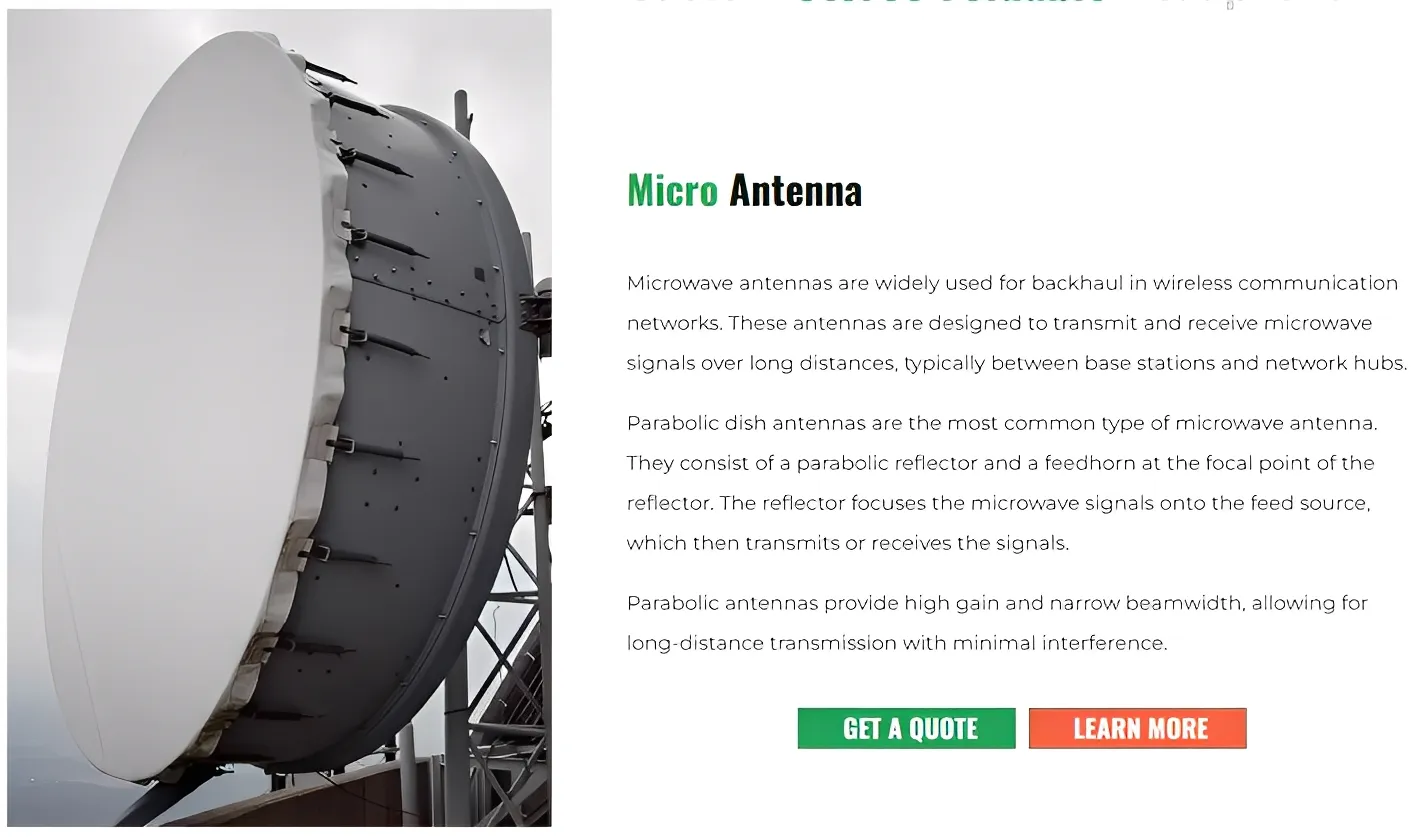
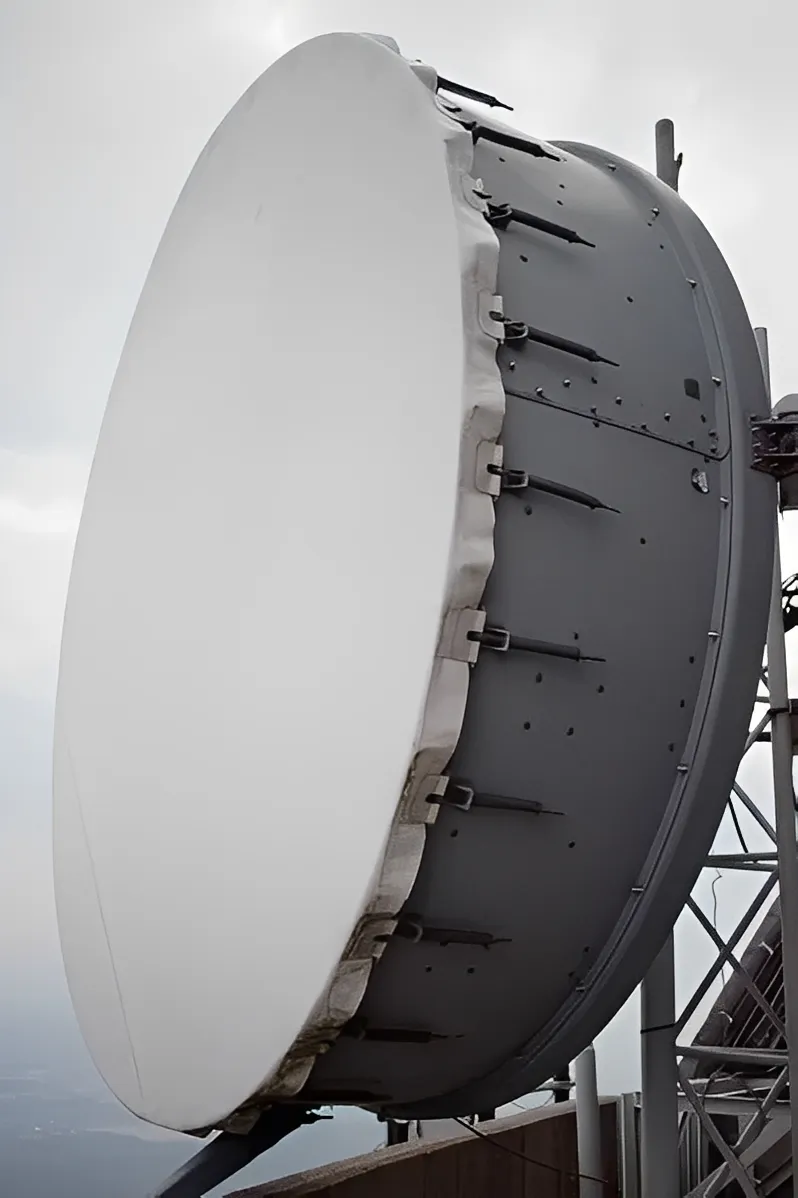
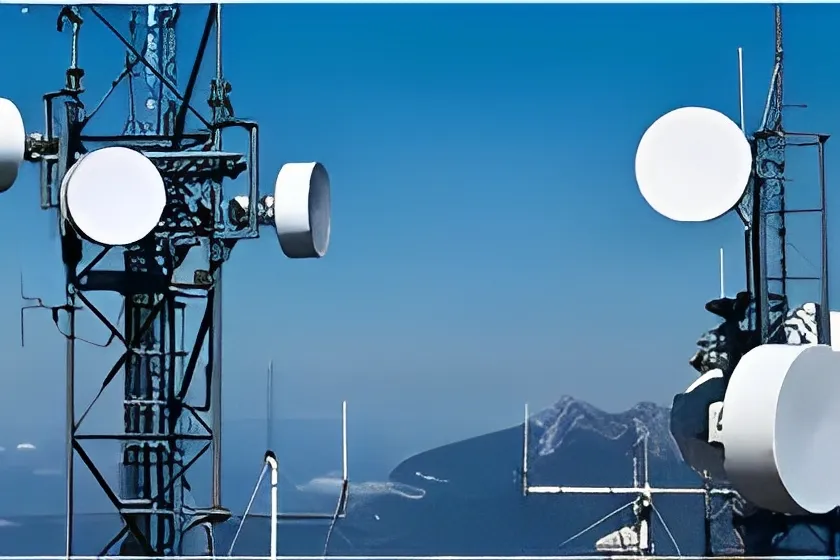
Microwave antennas are widely used for backhaul in wireless communication networks. These antennas are designed to transmit and receive microwave signals over long distances, typically between base stations and network hubs.
Parabolic dish antennas are the most common type of microwave antenna. They consist of a parabolic reflector and a feedhorn at the focal point of the reflector. The reflector focuses the microwave signals onto the feed source, which then transmits or receives the signals.
Parabolic antennas provide high gain and narrow beamwidth, allowing for long-distance transmission with minimal interference.
Microwave frequencies are typically defined as electromagnetic waves with frequencies ranging from 7.125GHz to 86 GHz in most applications. This spectrum is further divided into various bands, each with unique characteristics and applications. For frequencies above 7.125 GHz, several key bands and their attributes are noteworthy.
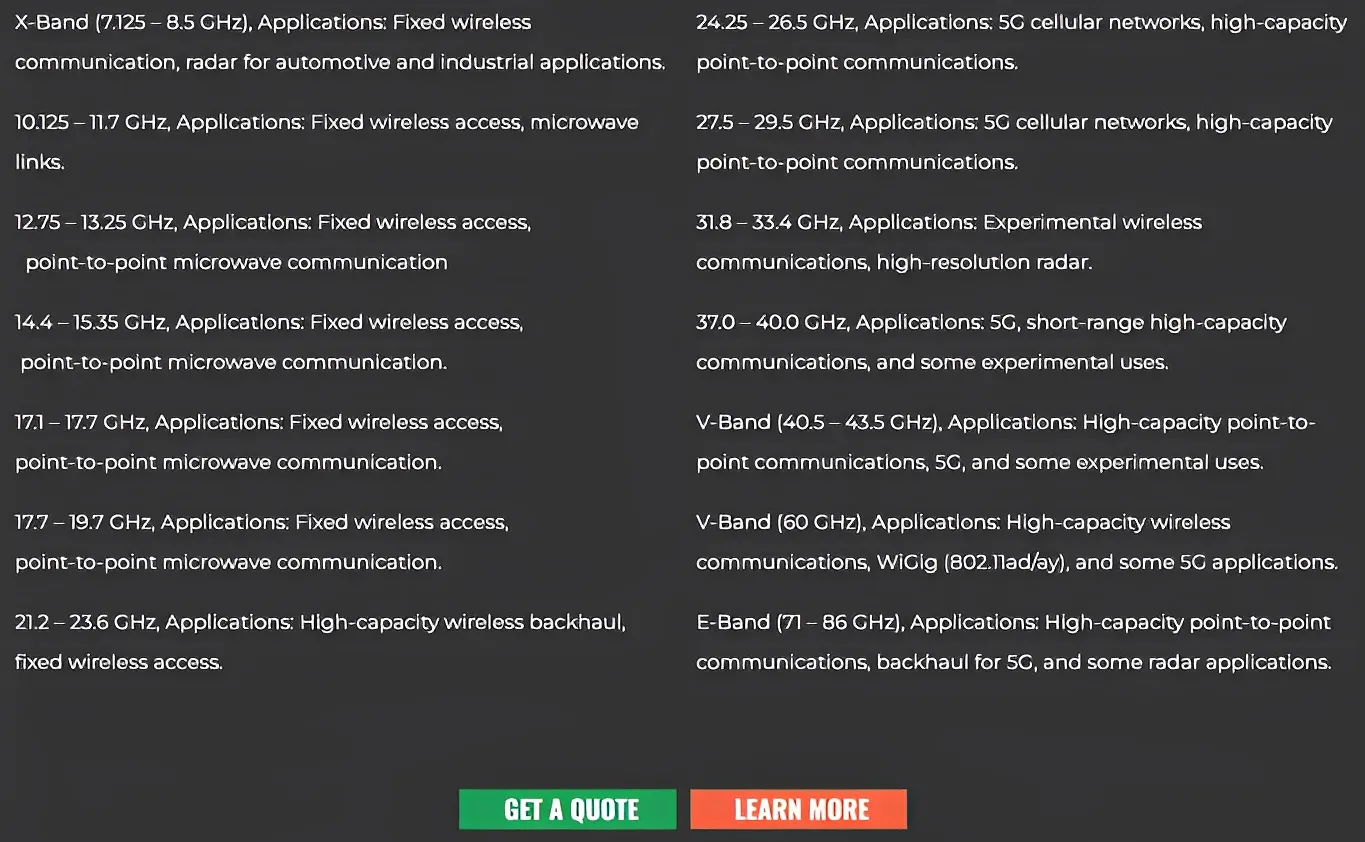
Frequency Bands and Their Applications for Wireless Communication are below:
X-Band (7.125 – 8.5 GHz), Applications: Fixed wireless communication, radar for automotive and industrial applications.
10.125 – 11.7 GHz, Applications: Fixed wireless access, microwave links.
12.75 – 13.25 GHz, Applications: Fixed wireless access, point-to-point microwave communication
14.4 – 15.35 GHz, Applications: Fixed wireless access, point-to-point microwave communication.
17.1 – 17.7 GHz, Applications: Fixed wireless access, point-to-point microwave communication.
17.7 – 19.7 GHz, Applications: Fixed wireless access, point-to-point microwave communication.
21.2 – 23.6 GHz, Applications: High-capacity wireless backhaul, fixed wireless access.
24.25 – 26.5 GHz, Applications: 5G cellular networks, high-capacity point-to-point communications.
27.5 – 29.5 GHz, Applications: 5G cellular networks, high-capacity point-to-point communications.
31.8 – 33.4 GHz, Applications: Experimental wireless communications, high-resolution radar.
37.0 – 40.0 GHz, Applications: 5G, short-range high-capacity communications, and some experimental uses.
V-Band (40.5 – 43.5 GHz), Applications: High-capacity point-to-point communications, 5G, and some experimental uses.
V-Band (60 GHz), Applications: High-capacity wireless communications, WiGig (802.11ad/ay), and some 5G applications.
E-Band (71 – 86 GHz), Applications: High-capacity point-to-point communications, backhaul for 5G, and some radar applications.
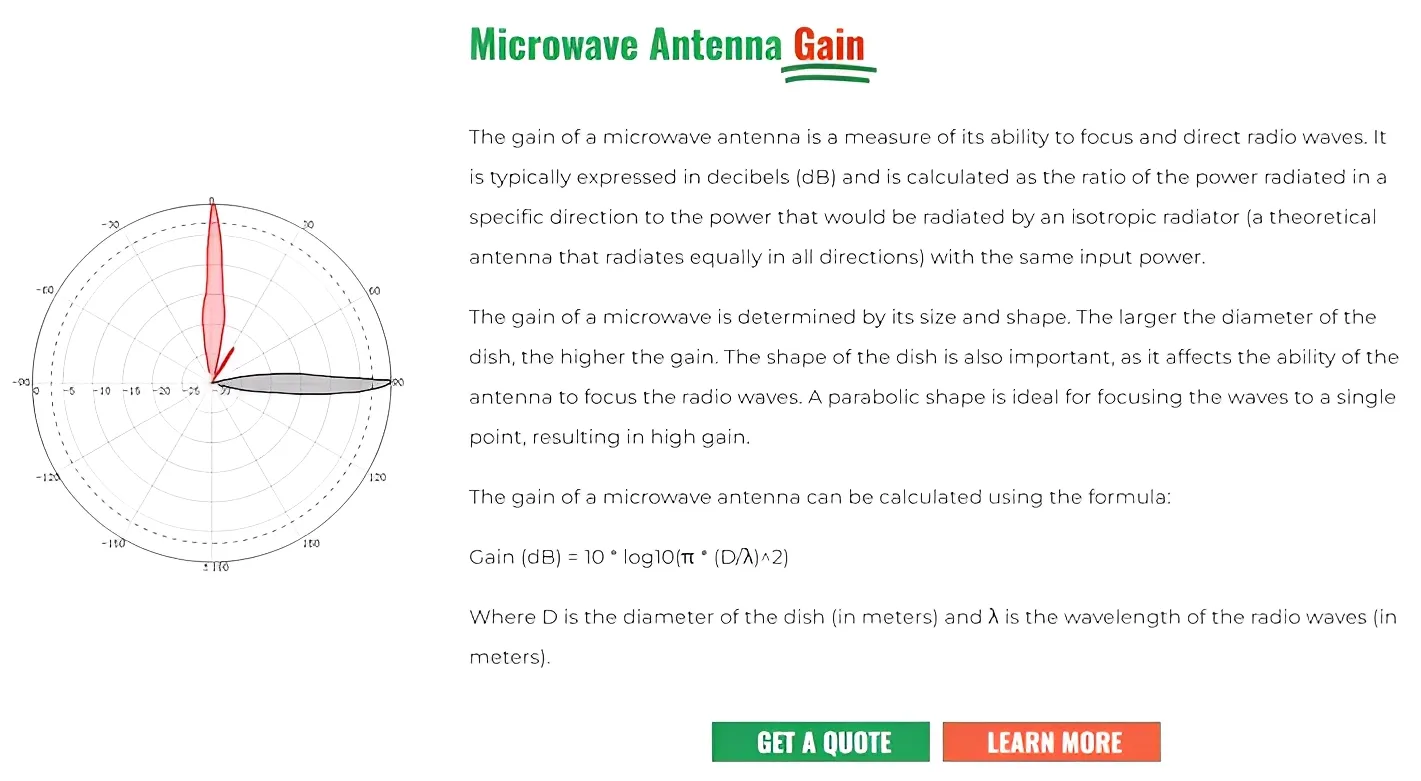
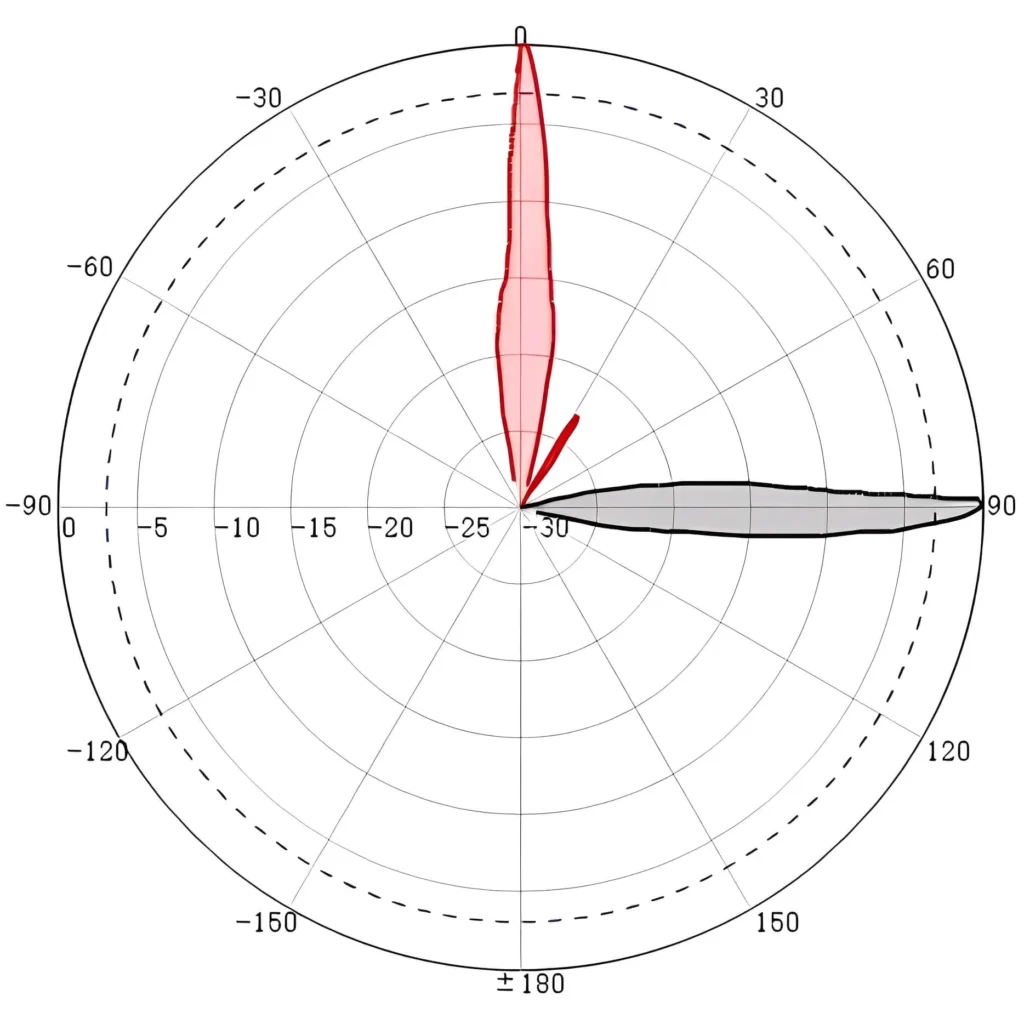
The gain of a parabolic dish antenna is a measure of its ability to focus and direct radio waves. It is typically expressed in decibels (dB) and is calculated as the ratio of the power radiated in a specific direction to the power that would be radiated by an isotropic radiator (a theoretical antenna that radiates equally in all directions) with the same input power.
The gain of a parabolic dish antenna is determined by its size and shape. The larger the diameter of the dish, the higher the gain. The shape of the dish is also important, as it affects the ability of the antenna to focus the radio waves. A parabolic shape is ideal for focusing the waves to a single point, resulting in high gain.
The gain of a microwave antenna can be calculated using the formula:
Gain (dB) = 10 * log10(π * (D/λ)^2)
Where D is the diameter of the dish (in meters) and λ is the wavelength of the radio waves (in meters).
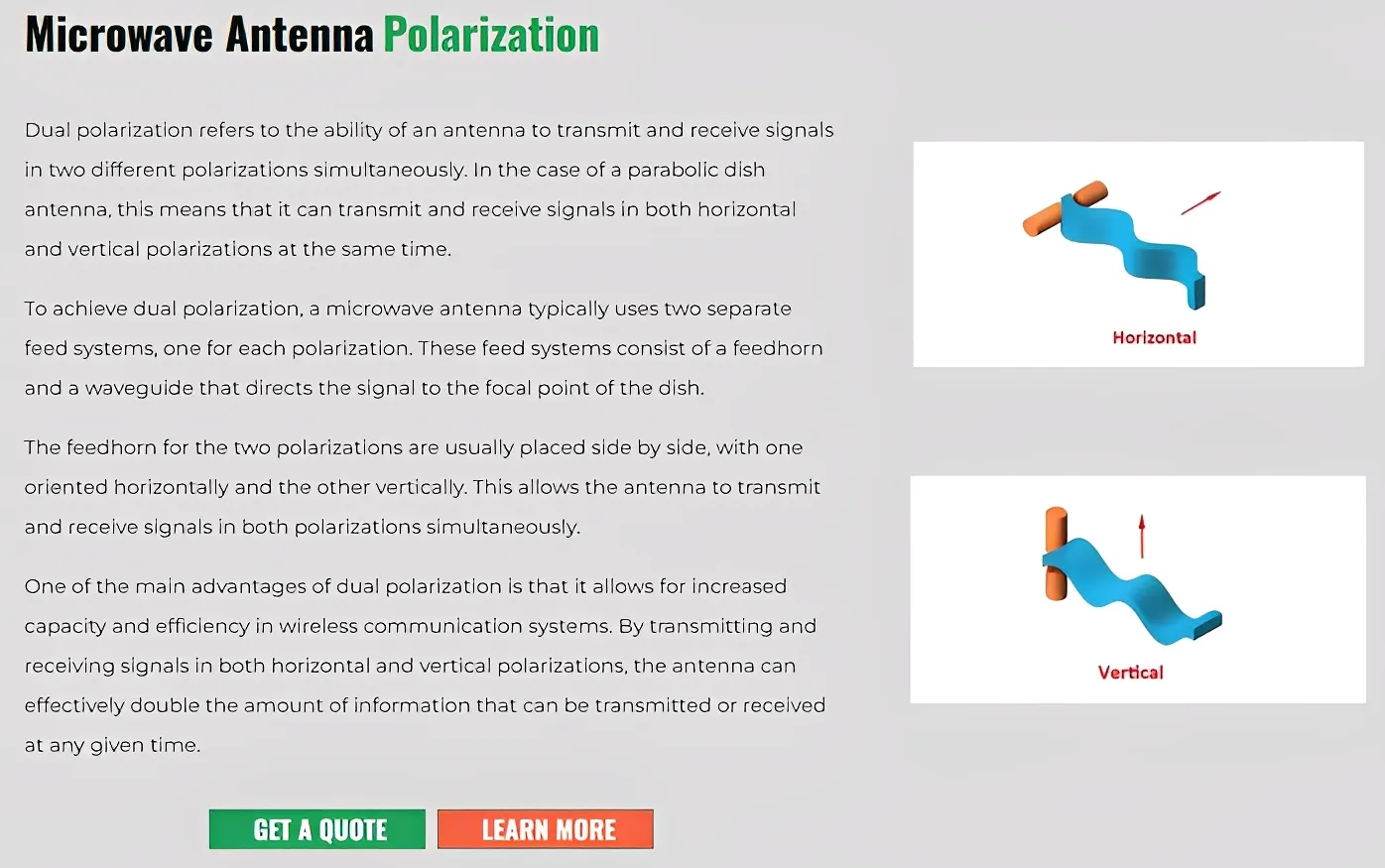
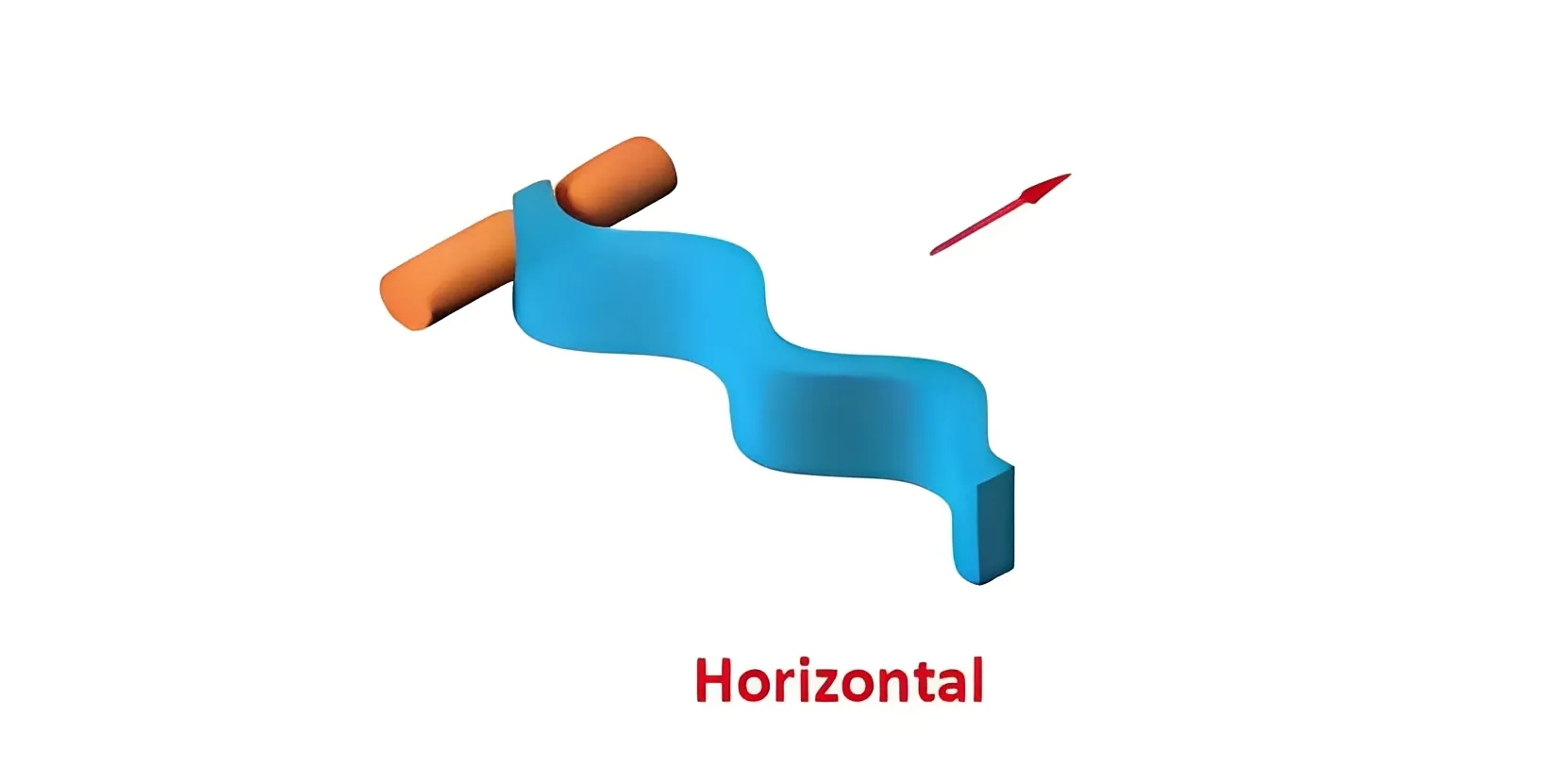
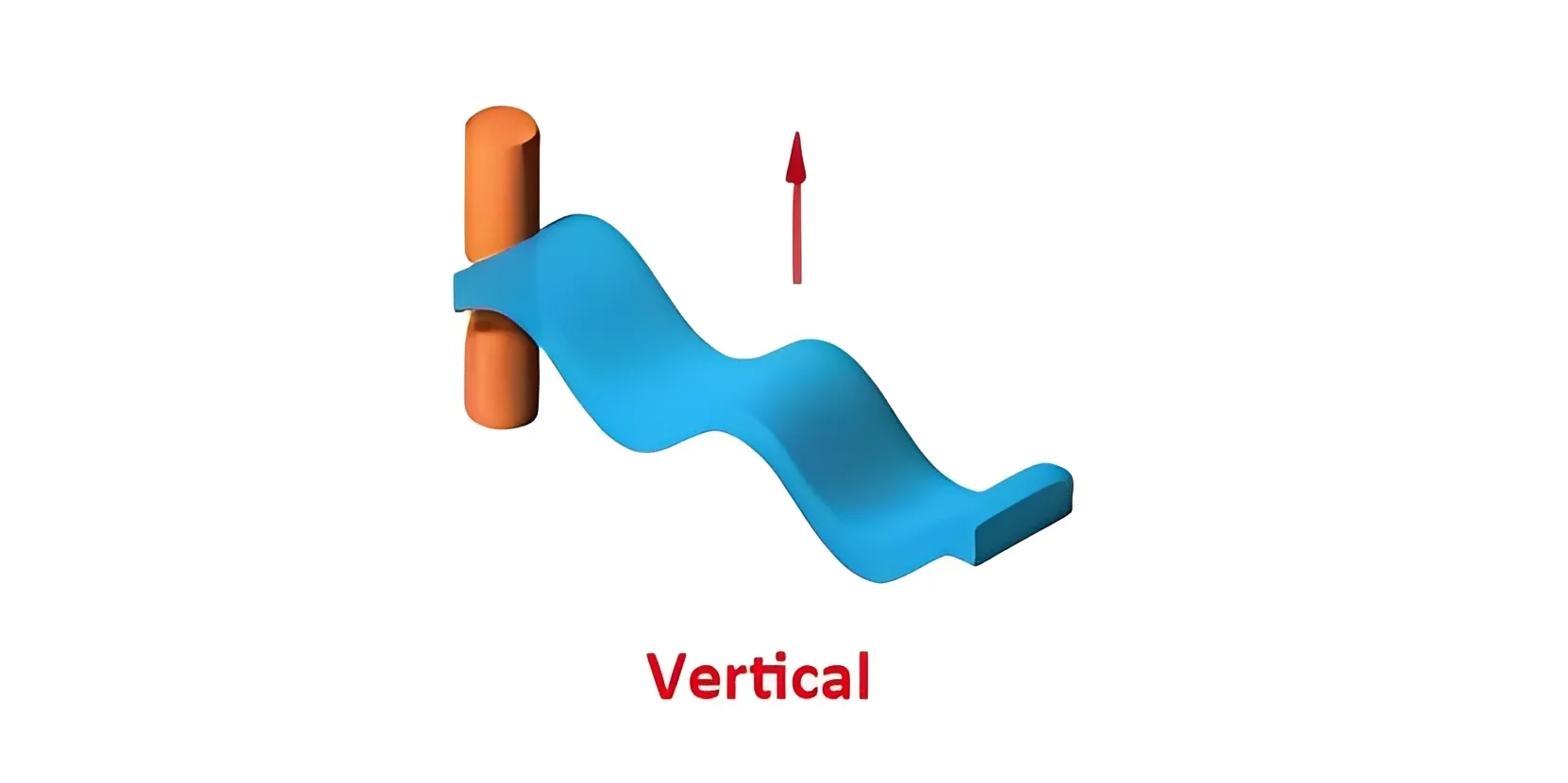
Dual polarization refers to the ability of an antenna to transmit and receive signals in two different polarizations simultaneously. In the case of a parabolic dish antenna, this means that it can transmit and receive signals in both horizontal and vertical polarizations at the same time.
To achieve dual polarization, a microwave antenna typically uses two separate feed systems, one for each polarization. These feed systems consist of a feedhorn and a waveguide that directs the signal to the focal point of the dish.
The feedhorn for the two polarizations are usually placed side by side, with one oriented horizontally and the other vertically. This allows the antenna to transmit and receive signals in both polarizations simultaneously.
One of the main advantages of dual polarization is that it allows for increased capacity and efficiency in wireless communication systems. By transmitting and receiving signals in both horizontal and vertical polarizations, the antenna can effectively double the amount of information that can be transmitted or received at any given time.
It is not easy to introduce all aspects of Symmetrical horn antennas, so we have prepared a lot of information on this page for you to delve into. To make sure you can find the information you want quickly, we have prepared this content directory that will jump to the corresponding location when you click on it.
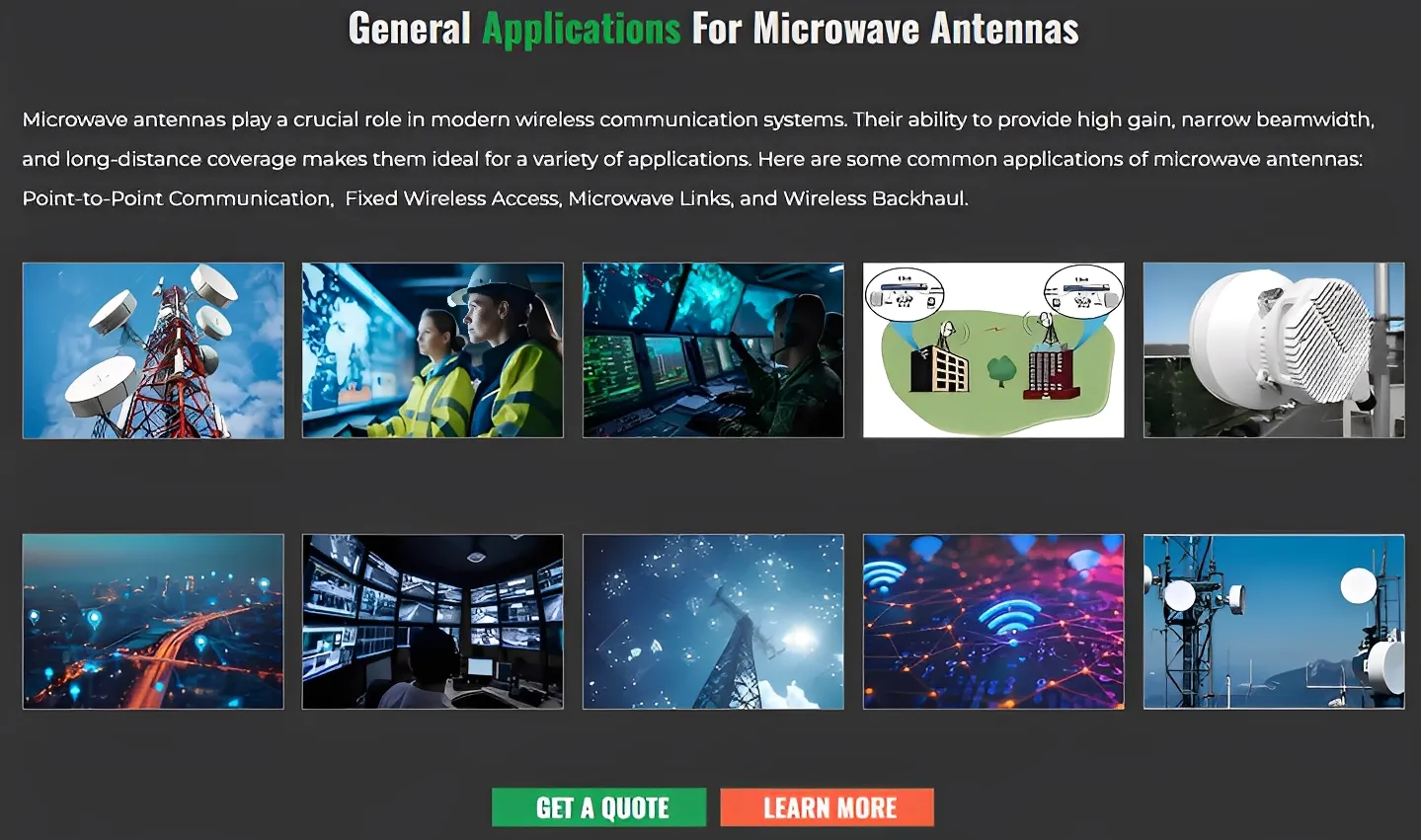
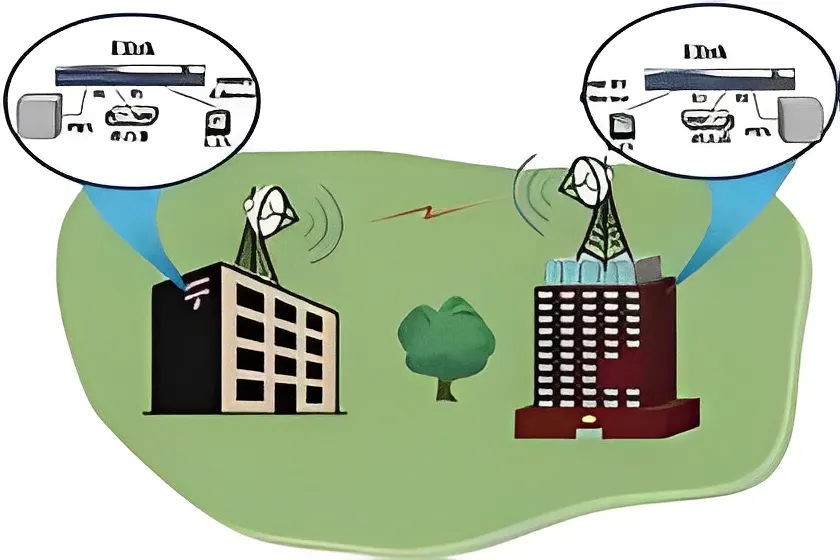
Microwave antennas play a crucial role in modern wireless communication systems. Their ability to provide high gain, narrow beamwidth, and long-distance coverage makes them ideal for a variety of applications. Here are some common applications of microwave antennas: Point-to-Point Communication, Fixed Wireless Access, Microwave Links, and Wireless Backhaul.







cURL Too many subrequests by single Worker invocation. To configure this limit, refer to https://developers.cloudflare.com/workers/wrangler/configuration/#limits
1. Frequency Range: cURL Too many subrequests by single Worker invocation. To configure this limit, refer to https://developers.cloudflare.com/workers/wrangler/configuration/#limits.
2. Gain: cURL Too many subrequests by single Worker invocation. To configure this limit, refer to https://developers.cloudflare.com/workers/wrangler/configuration/#limits.
cURL Too many subrequests by single Worker invocation. To configure this limit, refer to https://developers.cloudflare.com/workers/wrangler/configuration/#limits
cURL Too many subrequests by single Worker invocation. To configure this limit, refer to https://developers.cloudflare.com/workers/wrangler/configuration/#limits.
cURL Too many subrequests by single Worker invocation. To configure this limit, refer to https://developers.cloudflare.com/workers/wrangler/configuration/#limits.
cURL Too many subrequests by single Worker invocation. To configure this limit, refer to https://developers.cloudflare.com/workers/wrangler/configuration/#limits
cURL Too many subrequests by single Worker invocation. To configure this limit, refer to https://developers.cloudflare.com/workers/wrangler/configuration/#limits.
cURL Too many subrequests by single Worker invocation. To configure this limit, refer to https://developers.cloudflare.com/workers/wrangler/configuration/#limits.
cURL Too many subrequests by single Worker invocation. To configure this limit, refer to https://developers.cloudflare.com/workers/wrangler/configuration/#limits
cURL Too many subrequests by single Worker invocation. To configure this limit, refer to https://developers.cloudflare.com/workers/wrangler/configuration/#limits.
cURL Too many subrequests by single Worker invocation. To configure this limit, refer to https://developers.cloudflare.com/workers/wrangler/configuration/#limits.
cURL Too many subrequests by single Worker invocation. To configure this limit, refer to https://developers.cloudflare.com/workers/wrangler/configuration/#limits
cURL Too many subrequests by single Worker invocation. To configure this limit, refer to https://developers.cloudflare.com/workers/wrangler/configuration/#limits
cURL Too many subrequests by single Worker invocation. To configure this limit, refer to https://developers.cloudflare.com/workers/wrangler/configuration/#limits.
Gain
cURL Too many subrequests by single Worker invocation. To configure this limit, refer to https://developers.cloudflare.com/workers/wrangler/configuration/#limits.
cURL Too many subrequests by single Worker invocation. To configure this limit, refer to https://developers.cloudflare.com/workers/wrangler/configuration/#limits
cURL Too many subrequests by single Worker invocation. To configure this limit, refer to https://developers.cloudflare.com/workers/wrangler/configuration/#limitscURL Too many subrequests by single Worker invocation. To configure this limit, refer to https://developers.cloudflare.com/workers/wrangler/configuration/#limits.cURL Too many subrequests by single Worker invocation. To configure this limit, refer to https://developers.cloudflare.com/workers/wrangler/configuration/#limitscURL Too many subrequests by single Worker invocation. To configure this limit, refer to https://developers.cloudflare.com/workers/wrangler/configuration/#limits.
Flange Interface
Standard (UG, CPR, PDR): Ensures compatibility.Custom: For specialized applications.
Radio Mount
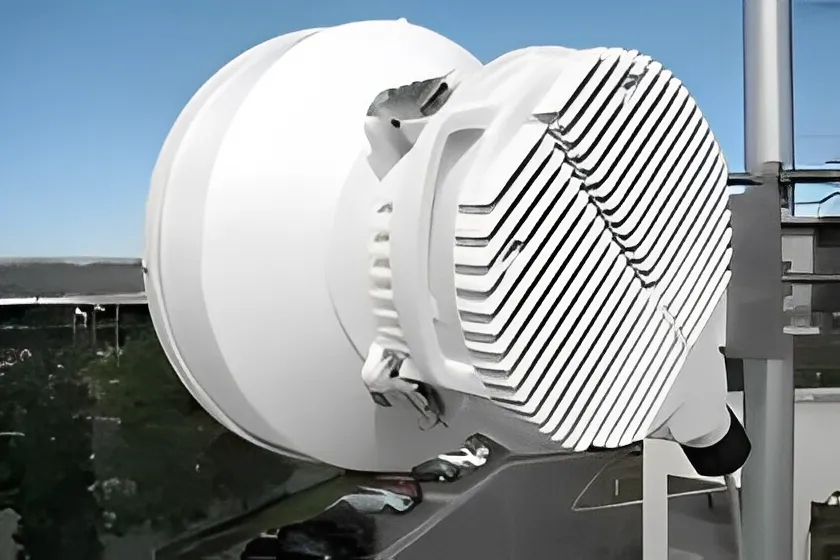
Direct Mount: Radio attaches directly to antenna, low loss, easy installation.Split Mount: Radio separated from antenna via waveguide or cable, flexible but may add loss.
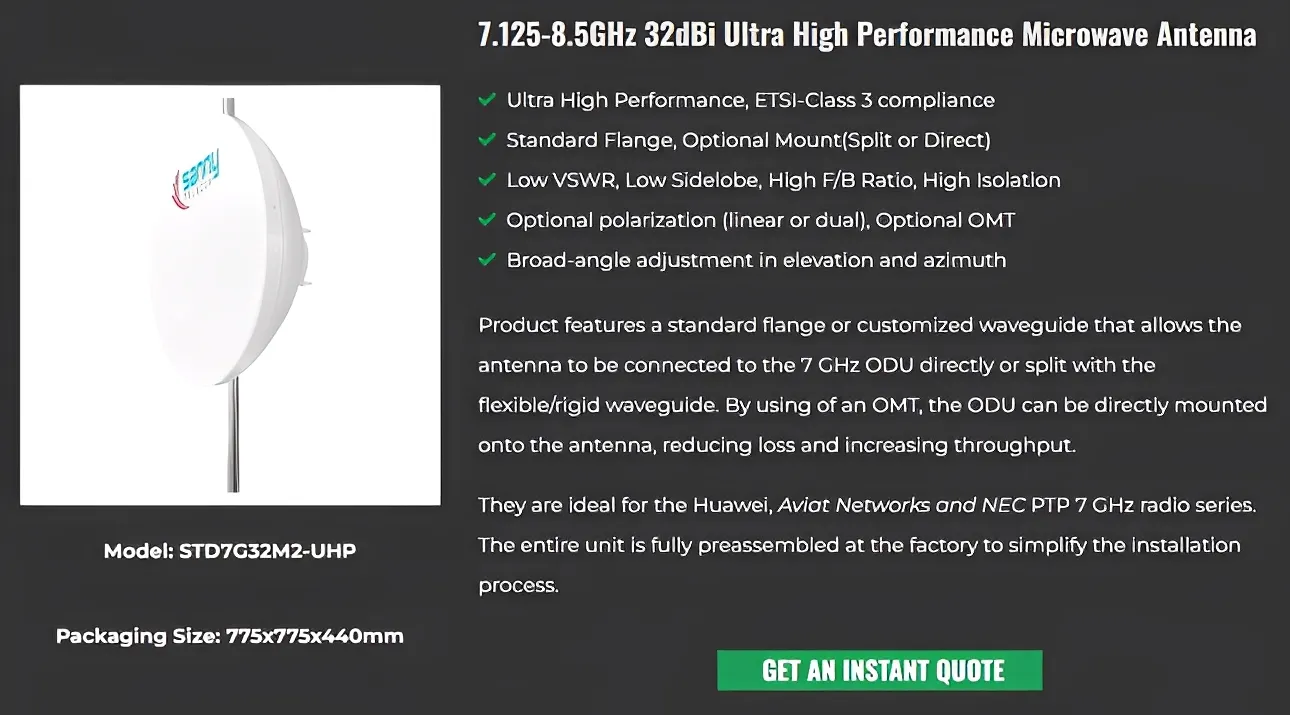
Model: STD7G32M2-UHP
Packaging Size: 775x775x440mm
Product features a standard flange or customized waveguide that allows the antenna to be connected to the 7 GHz ODU directly or split with the flexible/rigid waveguide. By using of an OMT, the ODU can be directly mounted onto the antenna, reducing loss and increasing throughput.
They are ideal for the Huawei, Aviat Networks and NEC PTP 7 GHz radio series. The entire unit is fully preassembled at the factory to simplify the installation process.
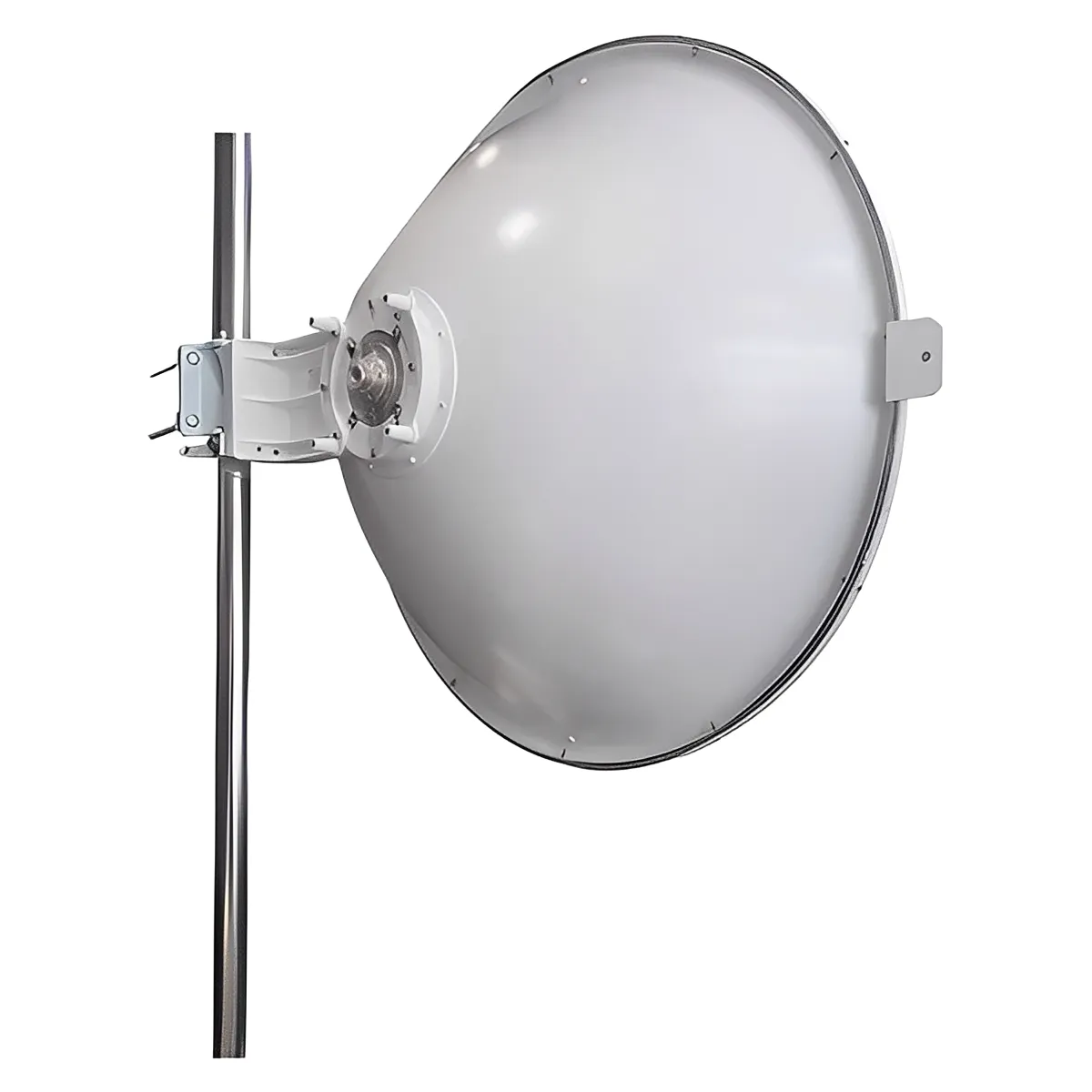
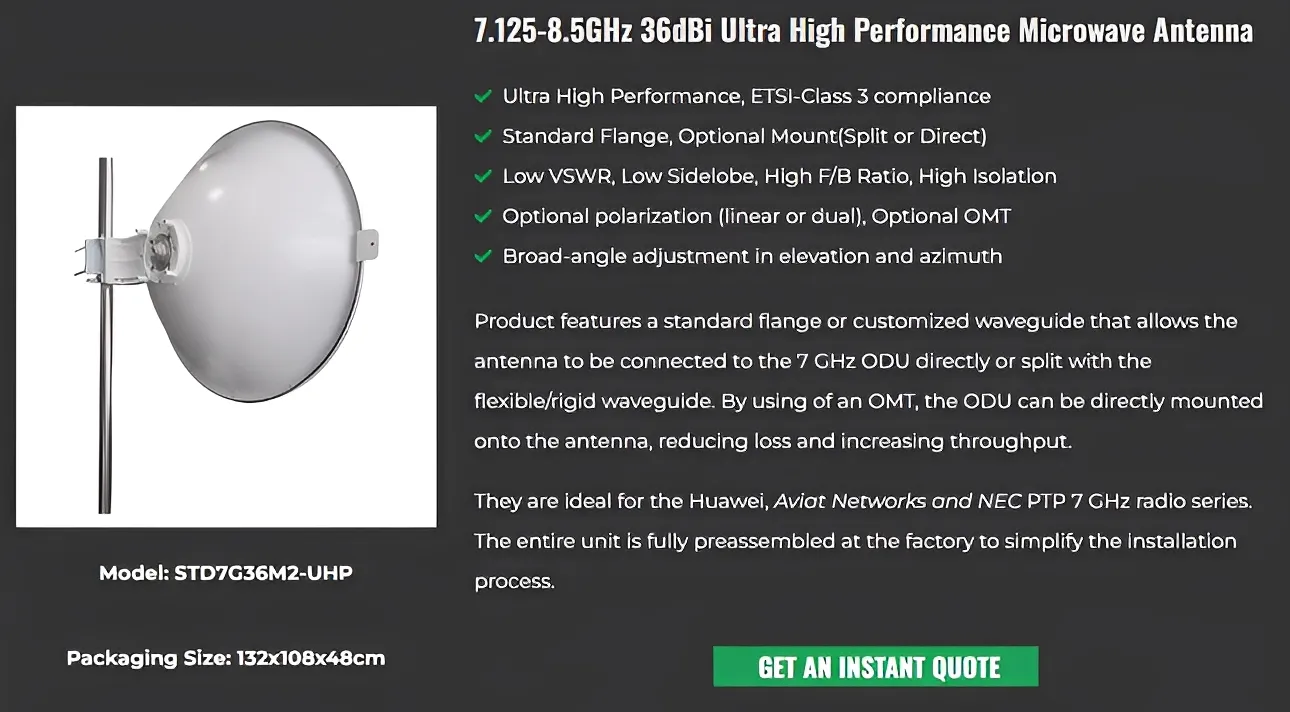
Model: STD7G36M2-UHP
Packaging Size: 132x108x48cm
Product features a standard flange or customized waveguide that allows the antenna to be connected to the 7 GHz ODU directly or split with the flexible/rigid waveguide. By using of an OMT, the ODU can be directly mounted onto the antenna, reducing loss and increasing throughput.
They are ideal for the Huawei, Aviat Networks and NEC PTP 7 GHz radio series. The entire unit is fully preassembled at the factory to simplify the installation process.
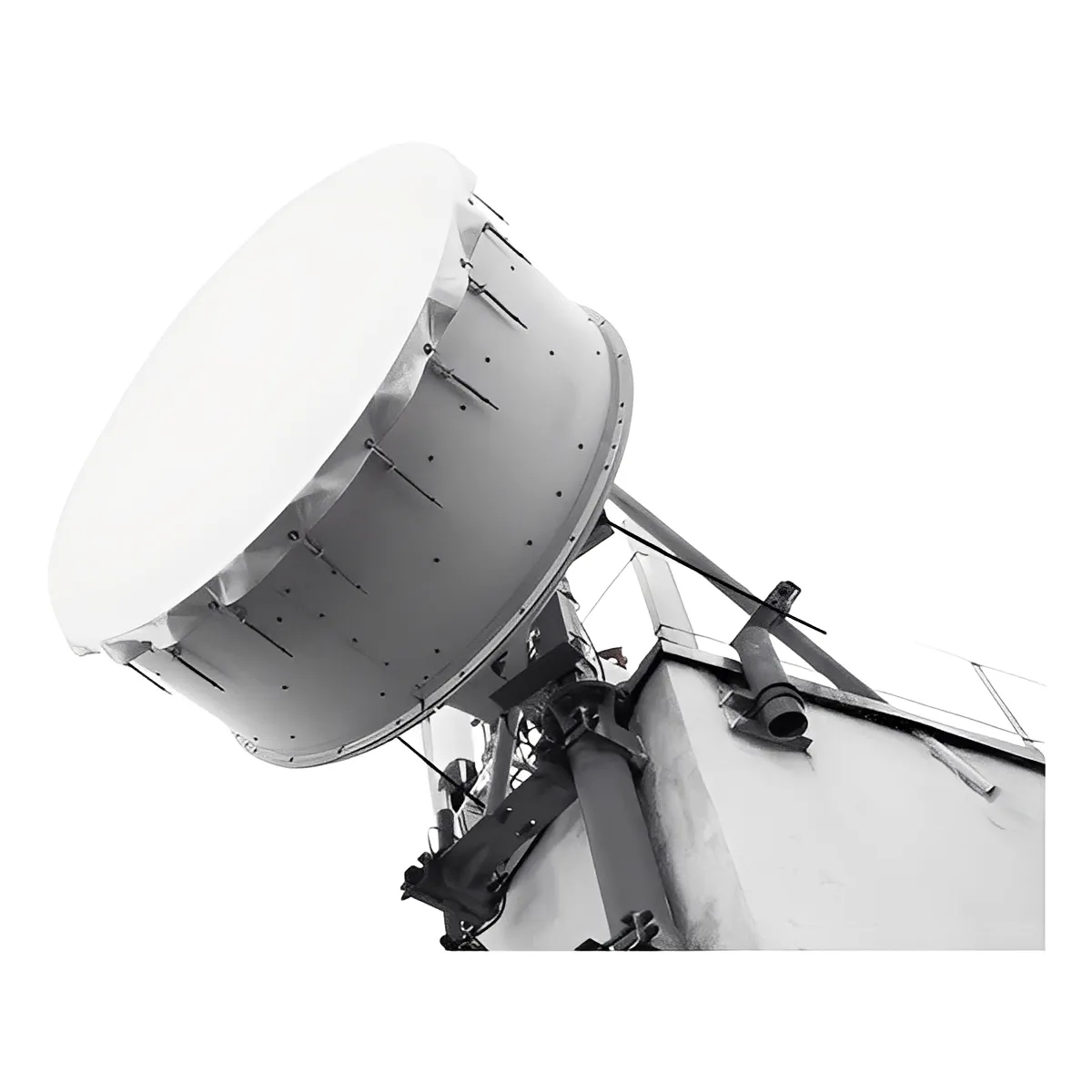
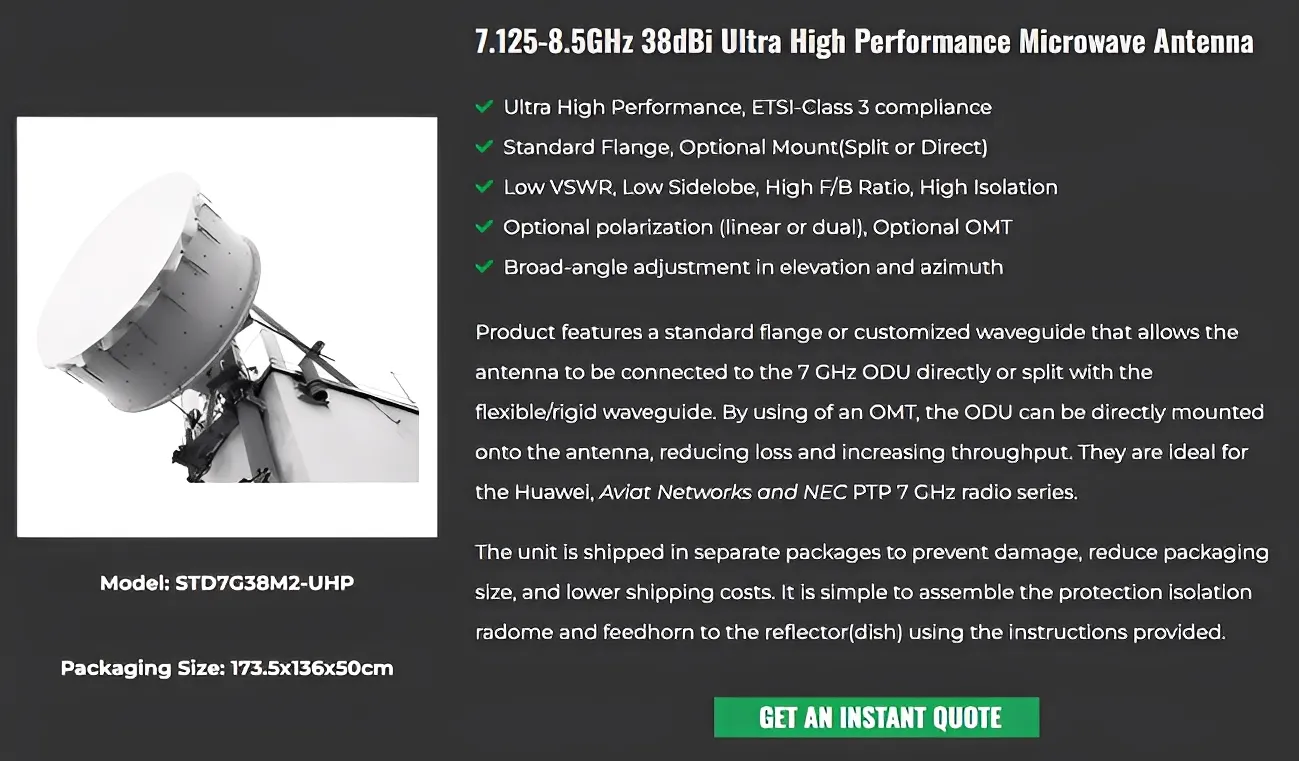
Model: STD7G38M2-UHP
Packaging Size: 173.5x136x50cm
Product features a standard flange or customized waveguide that allows the antenna to be connected to the 7 GHz ODU directly or split with the flexible/rigid waveguide. By using of an OMT, the ODU can be directly mounted onto the antenna, reducing loss and increasing throughput. They are ideal for the Huawei, Aviat Networks and NEC PTP 7 GHz radio series.
The unit is shipped in separate packages to prevent damage, reduce packaging size, and lower shipping costs. It is simple to assemble the protection isolation radome and feedhorn to the reflector(dish) using the instructions provided.
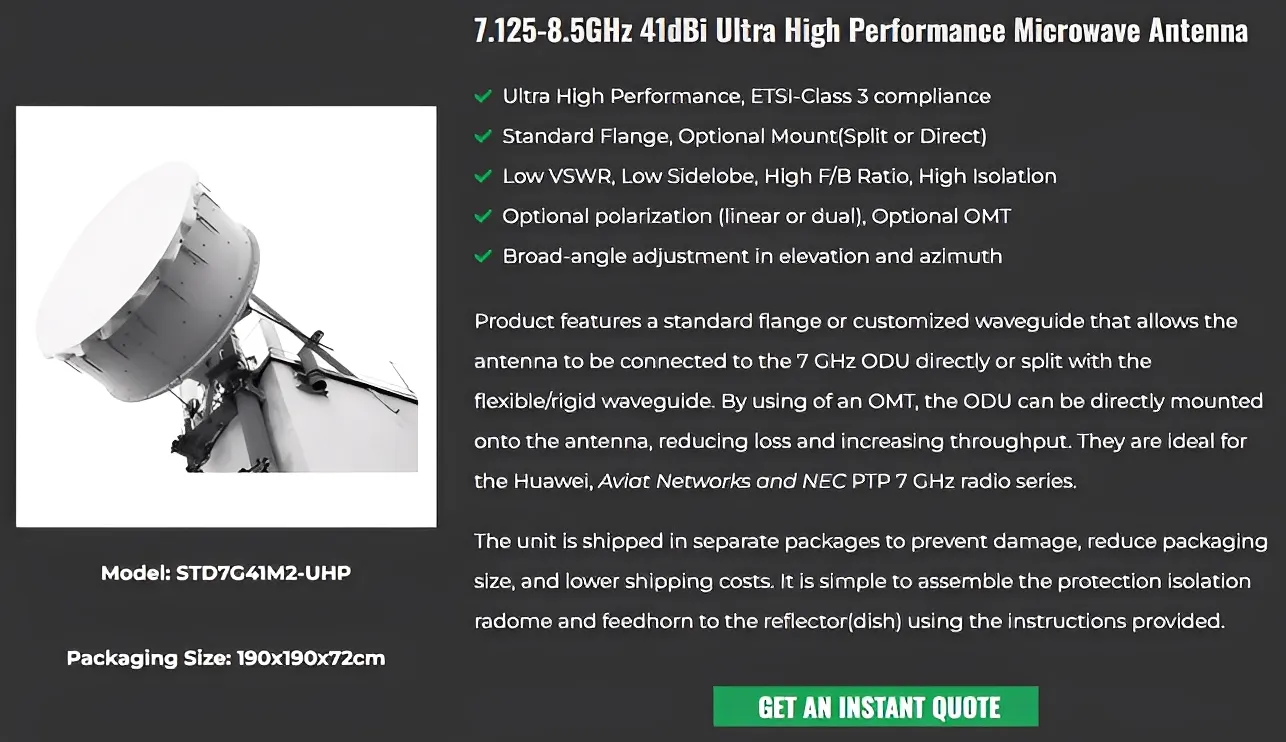
Model: STD7G41M2-UHP
Packaging Size: 190x190x72cm
Product features a standard flange or customized waveguide that allows the antenna to be connected to the 7 GHz ODU directly or split with the flexible/rigid waveguide. By using of an OMT, the ODU can be directly mounted onto the antenna, reducing loss and increasing throughput. They are ideal for the Huawei, Aviat Networks and NEC PTP 7 GHz radio series.
The unit is shipped in separate packages to prevent damage, reduce packaging size, and lower shipping costs. It is simple to assemble the protection isolation radome and feedhorn to the reflector(dish) using the instructions provided.
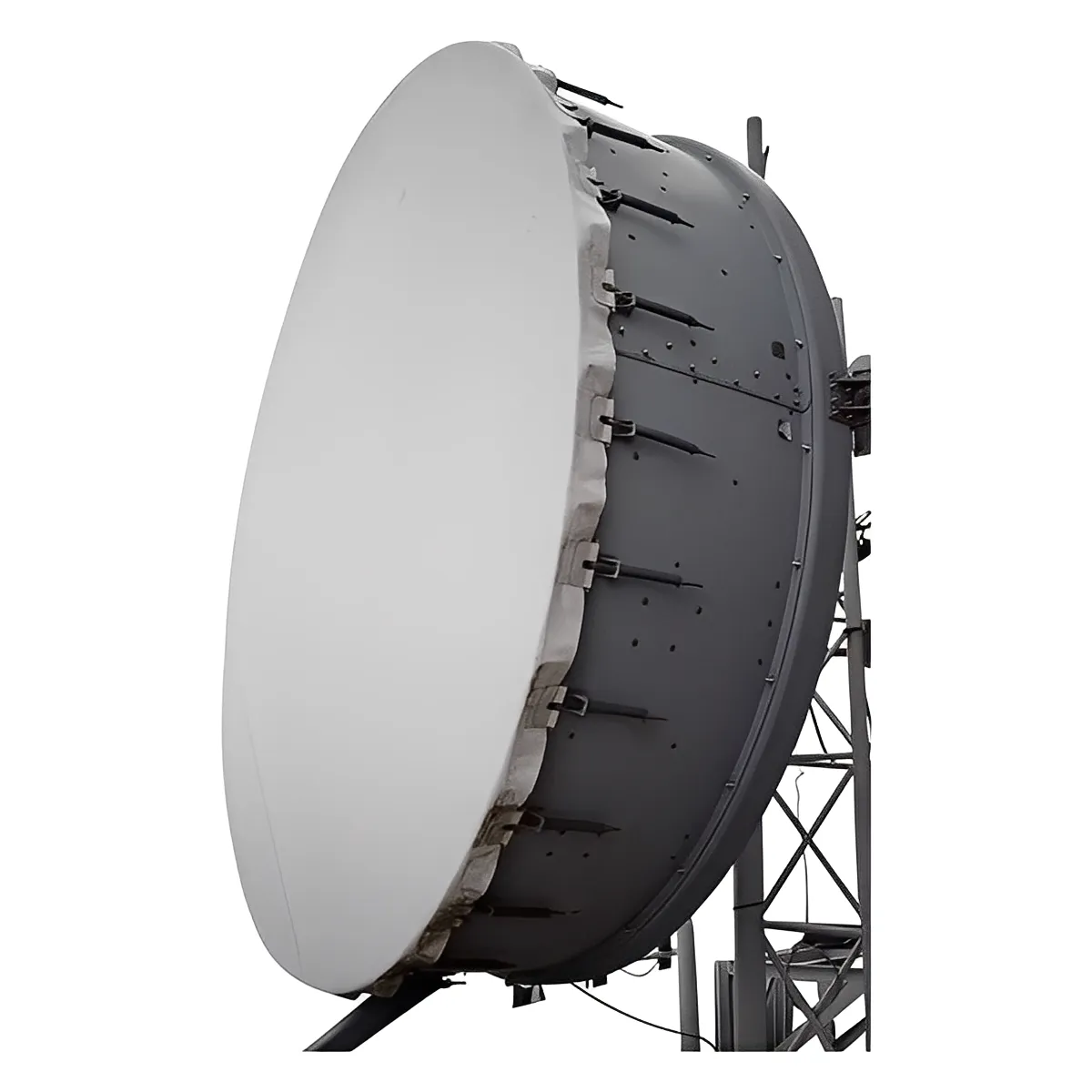
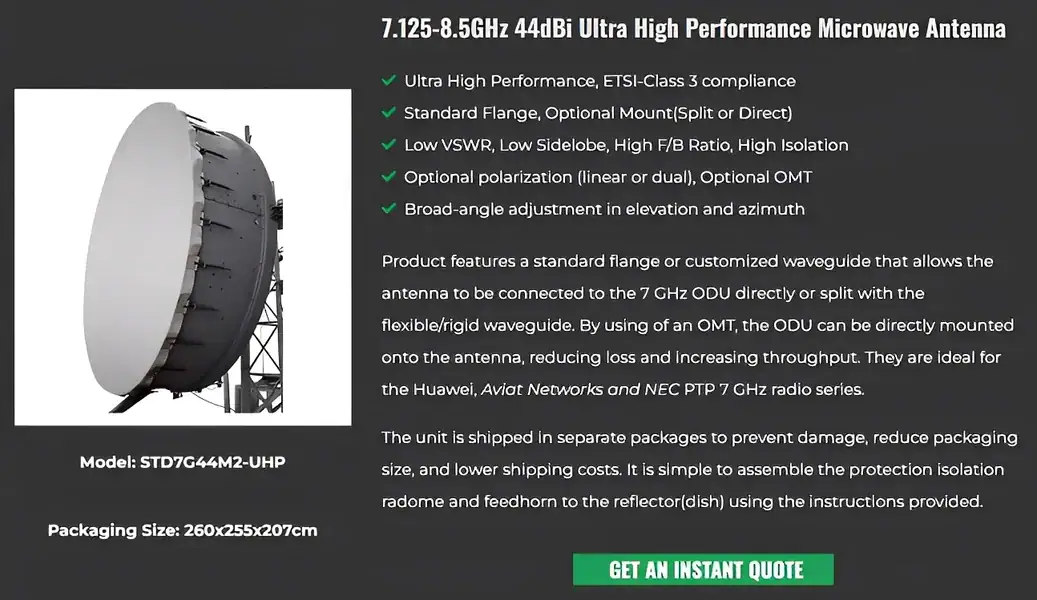
Model: STD7G44M2-UHP
Packaging Size: 260x255x207cm
Product features a standard flange or customized waveguide that allows the antenna to be connected to the 7 GHz ODU directly or split with the flexible/rigid waveguide. By using of an OMT, the ODU can be directly mounted onto the antenna, reducing loss and increasing throughput. They are ideal for the Huawei, Aviat Networks and NEC PTP 7 GHz radio series.
The unit is shipped in separate packages to prevent damage, reduce packaging size, and lower shipping costs. It is simple to assemble the protection isolation radome and feedhorn to the reflector(dish) using the instructions provided.
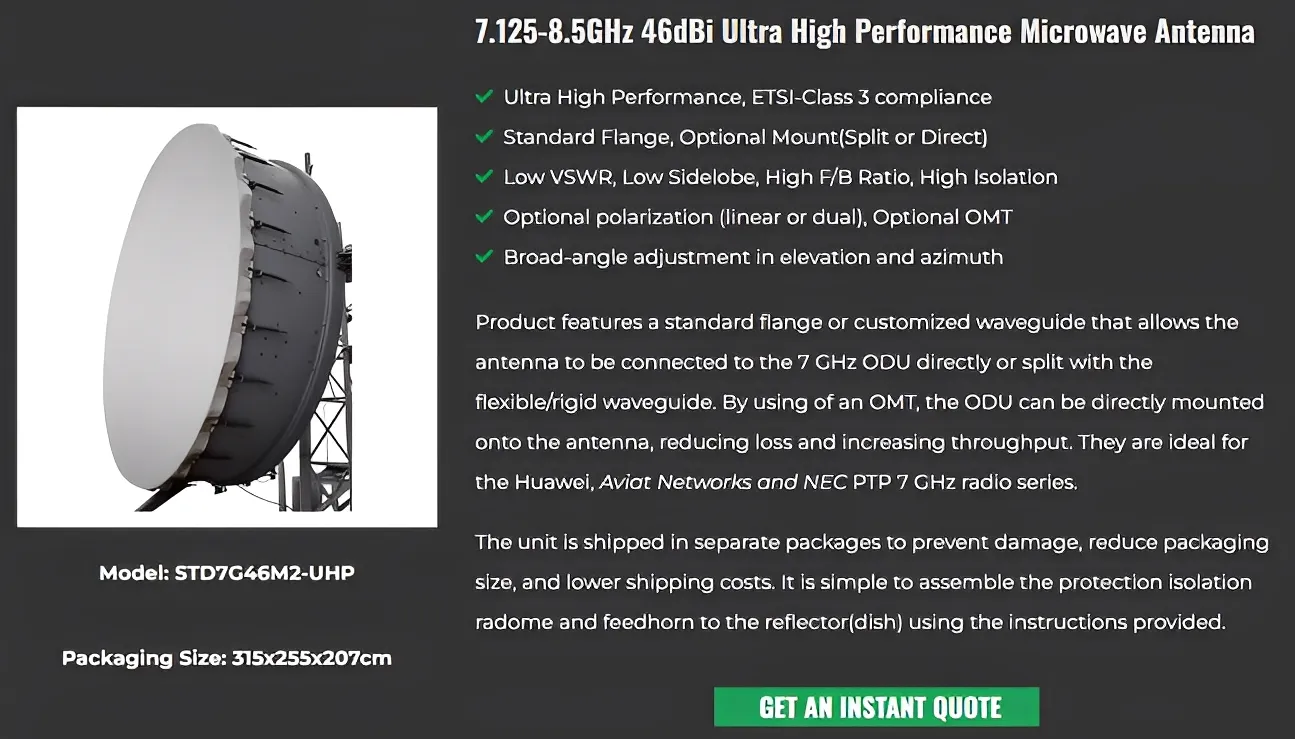
Model: STD7G46M2-UHP
Packaging Size: 315x255x207cm
Product features a standard flange or customized waveguide that allows the antenna to be connected to the 7 GHz ODU directly or split with the flexible/rigid waveguide. By using of an OMT, the ODU can be directly mounted onto the antenna, reducing loss and increasing throughput. They are ideal for the Huawei, Aviat Networks and NEC PTP 7 GHz radio series.
The unit is shipped in separate packages to prevent damage, reduce packaging size, and lower shipping costs. It is simple to assemble the protection isolation radome and feedhorn to the reflector(dish) using the instructions provided.
cURL Too many subrequests by single Worker invocation. To configure this limit, refer to https://developers.cloudflare.com/workers/wrangler/configuration/#limits. cURL Too many subrequests by single Worker invocation. To configure this limit, refer to https://developers.cloudflare.com/workers/wrangler/configuration/#limitscURL Too many subrequests by single Worker invocation. To configure this limit, refer to https://developers.cloudflare.com/workers/wrangler/configuration/#limitscURL Too many subrequests by single Worker invocation. To configure this limit, refer to https://developers.cloudflare.com/workers/wrangler/configuration/#limits
cURL Too many subrequests by single Worker invocation. To configure this limit, refer to https://developers.cloudflare.com/workers/wrangler/configuration/#limits, cURL Too many subrequests by single Worker invocation. To configure this limit, refer to https://developers.cloudflare.com/workers/wrangler/configuration/#limits.
cURL Too many subrequests by single Worker invocation. To configure this limit, refer to https://developers.cloudflare.com/workers/wrangler/configuration/#limits cURL Too many subrequests by single Worker invocation. To configure this limit, refer to https://developers.cloudflare.com/workers/wrangler/configuration/#limits of cURL Too many subrequests by single Worker invocation. To configure this limit, refer to https://developers.cloudflare.com/workers/wrangler/configuration/#limits cURL Too many subrequests by single Worker invocation. To configure this limit, refer to https://developers.cloudflare.com/workers/wrangler/configuration/#limits cURL Too many subrequests by single Worker invocation. To configure this limit, refer to https://developers.cloudflare.com/workers/wrangler/configuration/#limits.
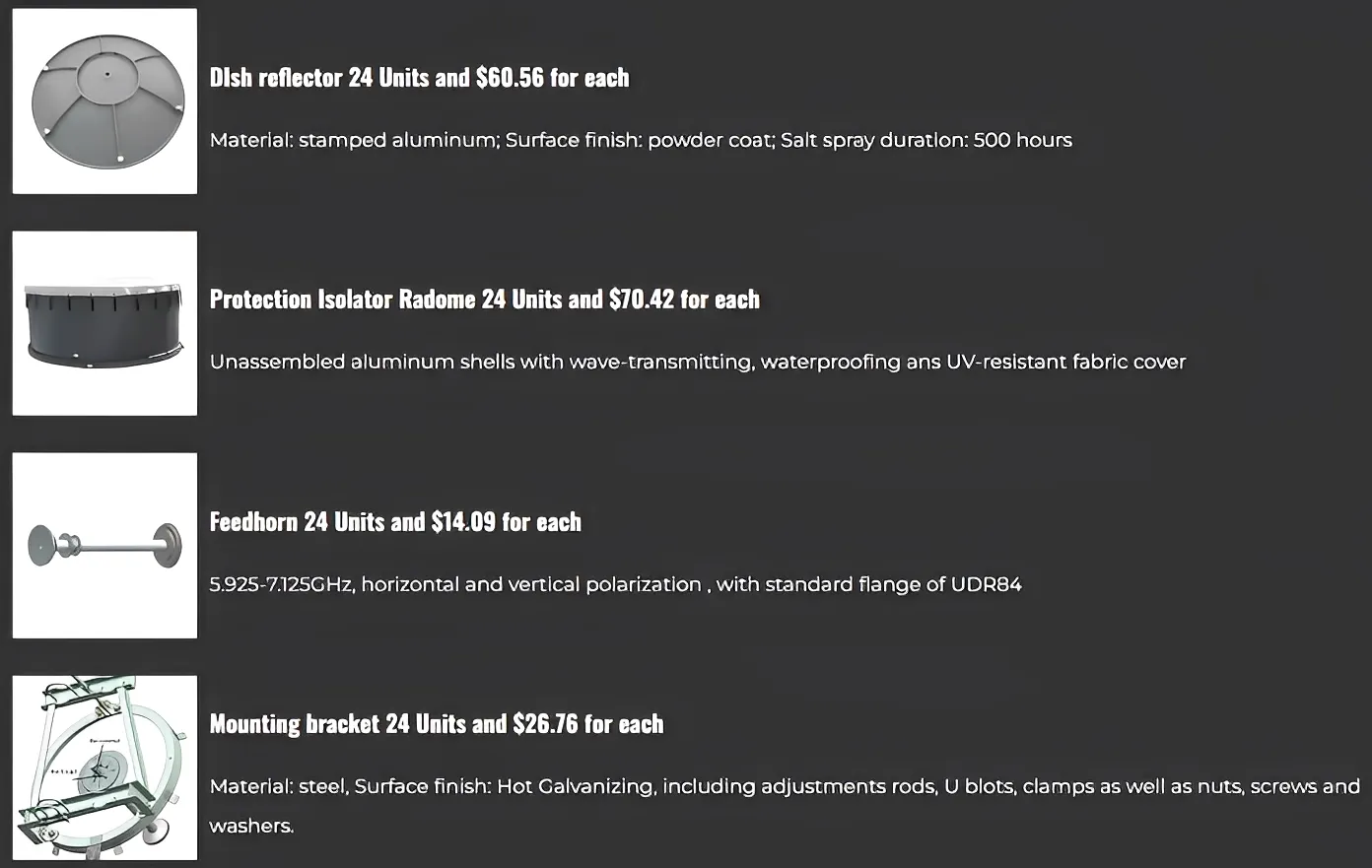
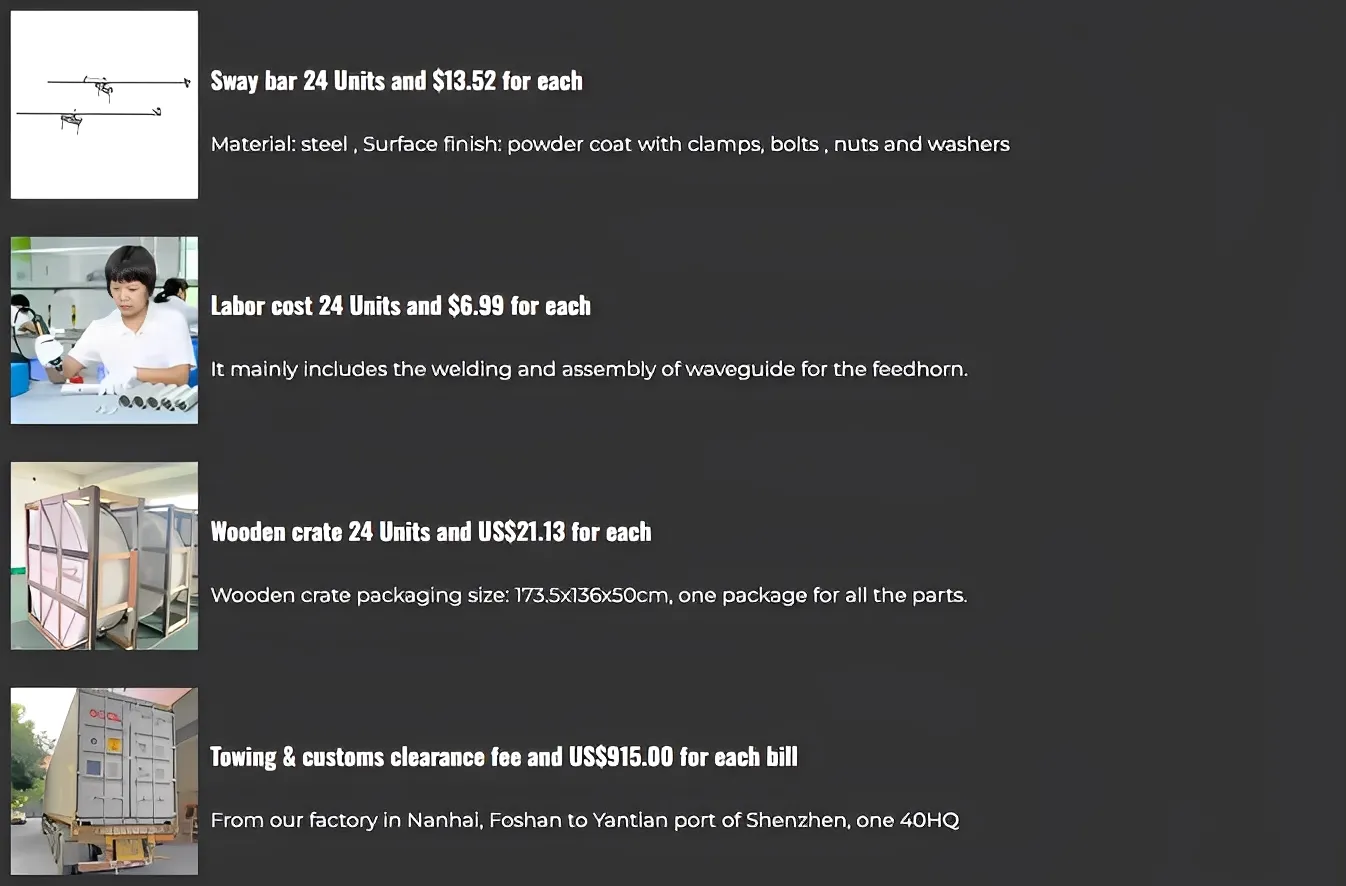

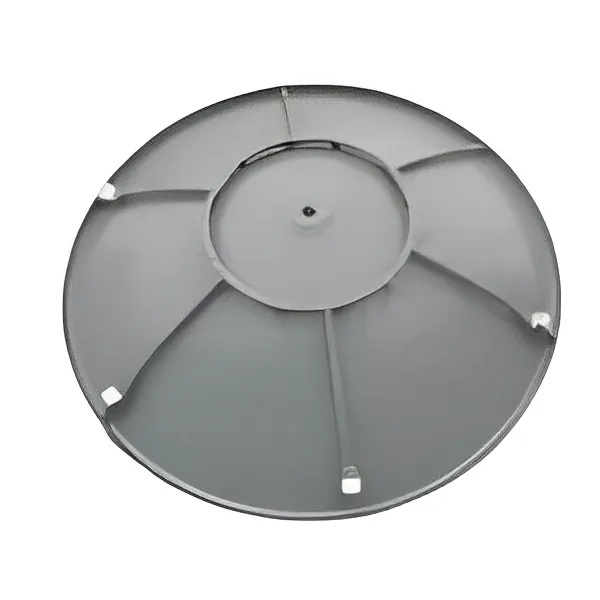
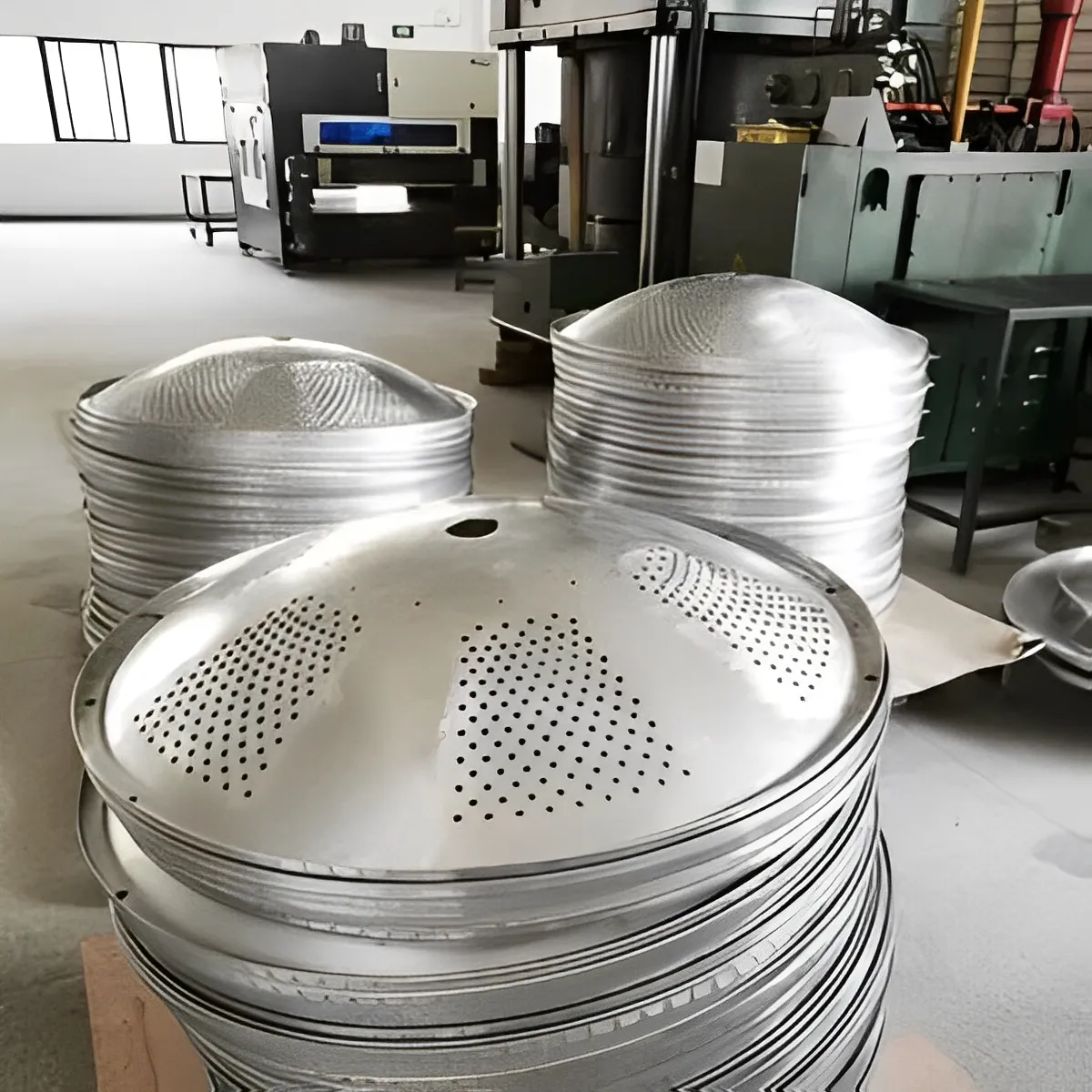
Material: stamped aluminum; Surface finish: powder coat; Salt spray duration: 500 hours
$10,000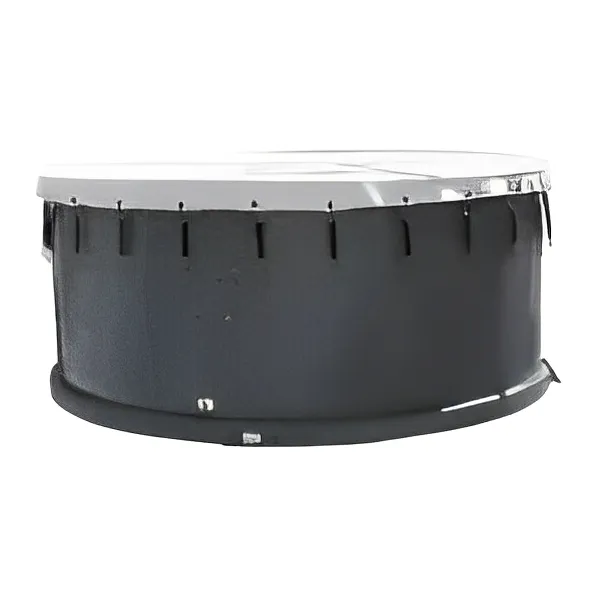
cURL Too many subrequests by single Worker invocation. To configure this limit, refer to https://developers.cloudflare.com/workers/wrangler/configuration/#limits
$10,000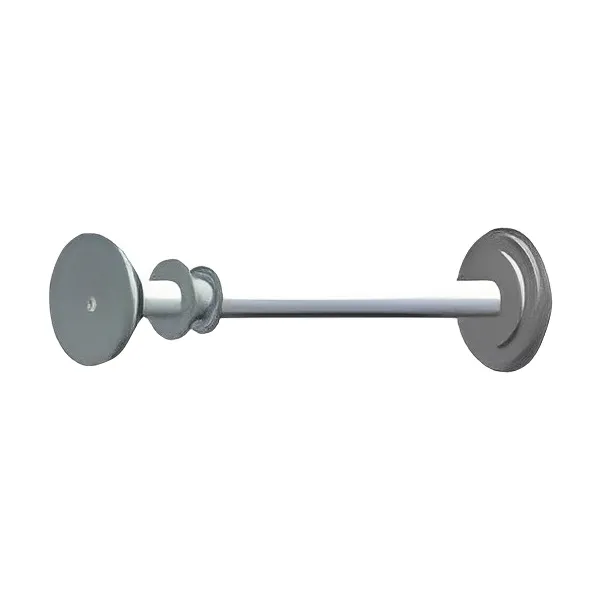
cURL Too many subrequests by single Worker invocation. To configure this limit, refer to https://developers.cloudflare.com/workers/wrangler/configuration/#limits
$10,000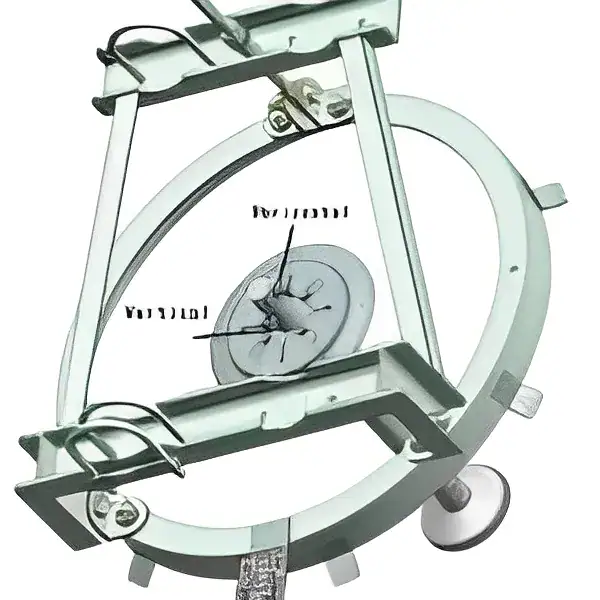
cURL Too many subrequests by single Worker invocation. To configure this limit, refer to https://developers.cloudflare.com/workers/wrangler/configuration/#limits.
$10,000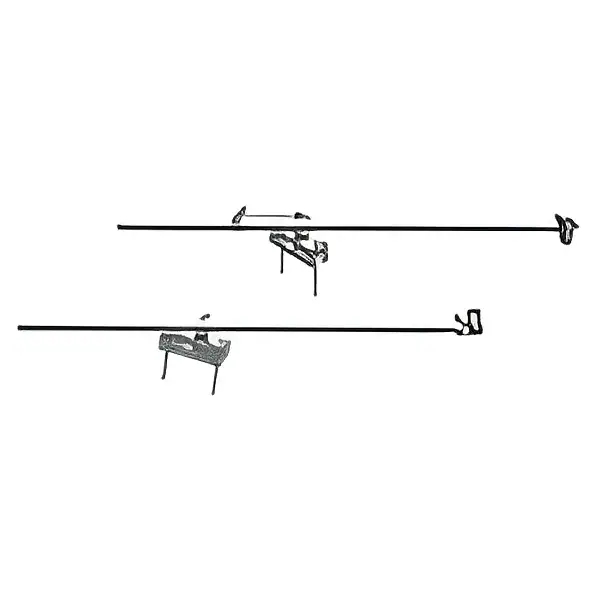
cURL Too many subrequests by single Worker invocation. To configure this limit, refer to https://developers.cloudflare.com/workers/wrangler/configuration/#limits
$10,000
cURL Too many subrequests by single Worker invocation. To configure this limit, refer to https://developers.cloudflare.com/workers/wrangler/configuration/#limits.
$10,000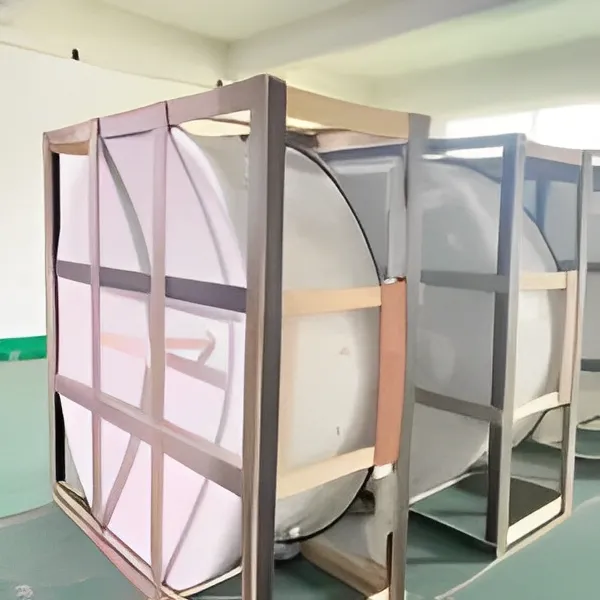
Wooden crate packaging size: 173.5x136x50cm, one package for all the parts.
$4,300
cURL Too many subrequests by single Worker invocation. To configure this limit, refer to https://developers.cloudflare.com/workers/wrangler/configuration/#limits
$4,300
cURL Too many subrequests by single Worker invocation. To configure this limit, refer to https://developers.cloudflare.com/workers/wrangler/configuration/#limits.
$4,300Please note that the final lead-time depends on the customized service you require, electrical & mechanical specifications , the raw material types, product surface finish types, and packaging, etc. Take an example of customizing a 7 GHz 4ft microwave antenna:
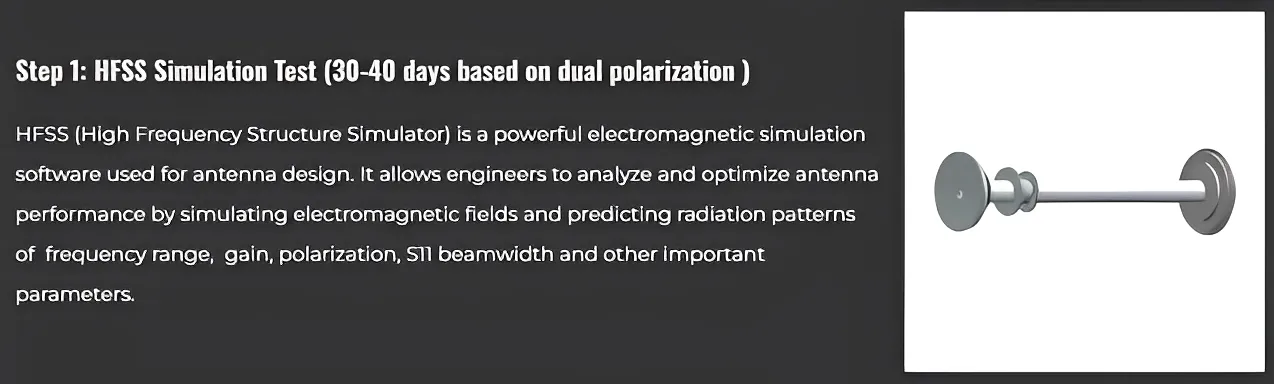



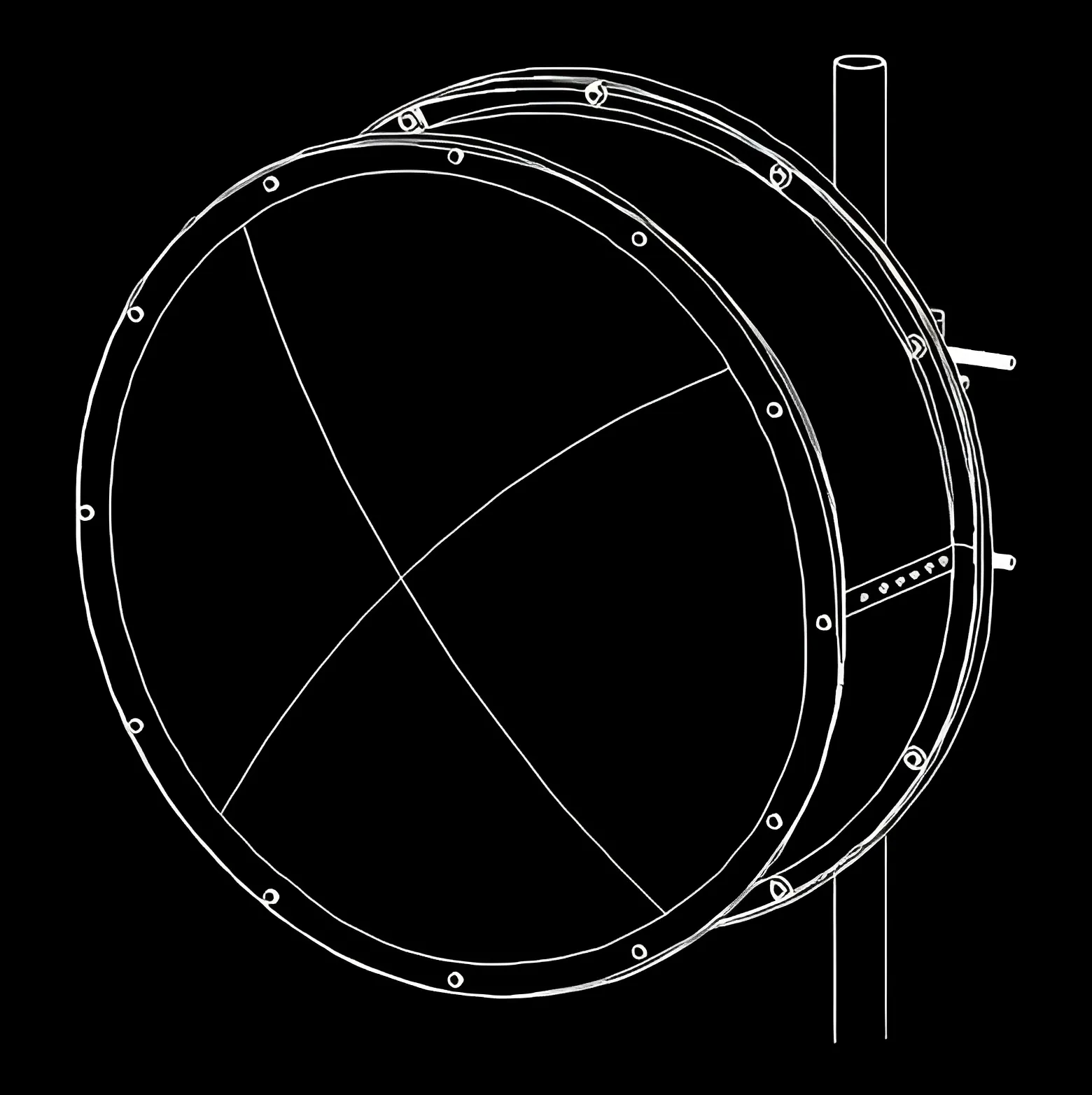
HFSS (High Frequency Structure Simulator) is a powerful electromagnetic simulation software used for antenna design. It allows engineers to analyze and optimize antenna performance by simulating electromagnetic fields and predicting radiation patterns of frequency range, gain, polarization, S11, half-power beamwidth and other important parameters.
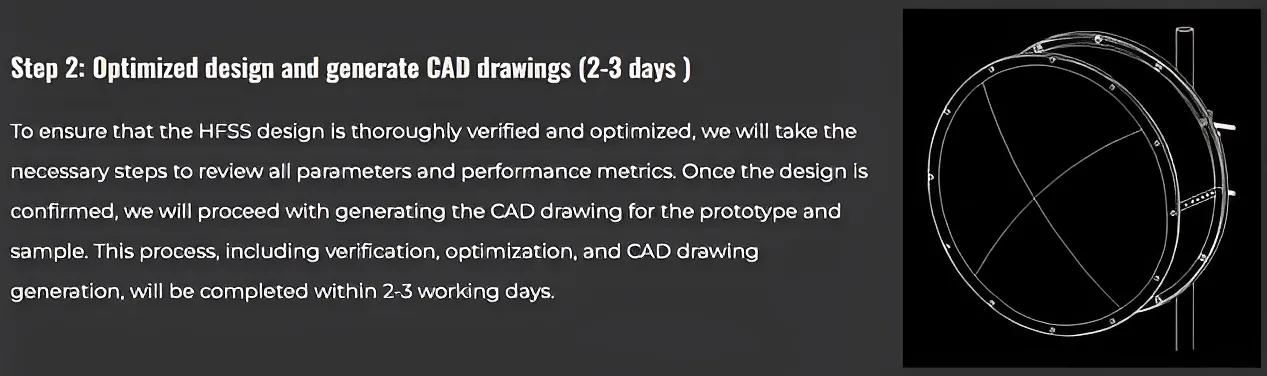
To ensure that the HFSS design is thoroughly verified and optimized, we will take the necessary steps to review all parameters and performance metrics. Once the design is confirmed, we will proceed with generating the CAD drawing for the prototype and sample. This process, including verification, optimization, and CAD drawing generation, will be completed within one working day.
cURL Too many subrequests by single Worker invocation. To configure this limit, refer to https://developers.cloudflare.com/workers/wrangler/configuration/#limits.
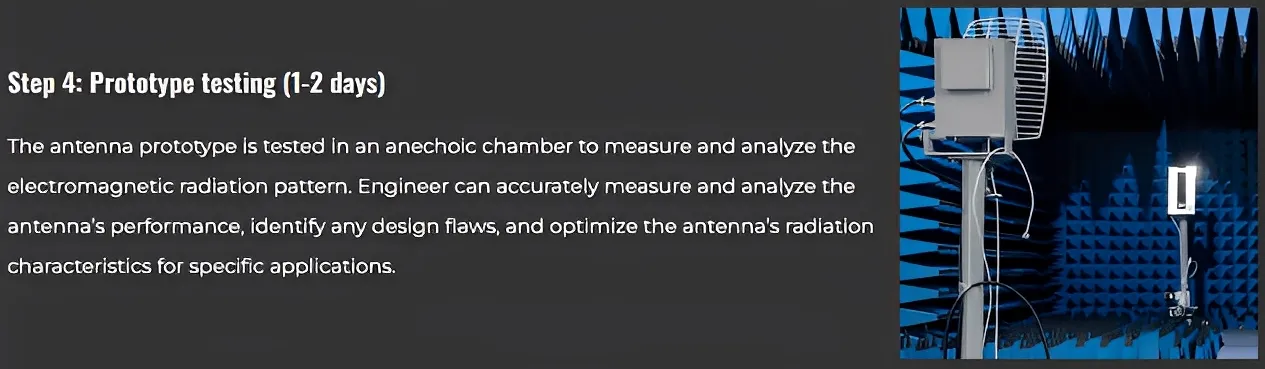
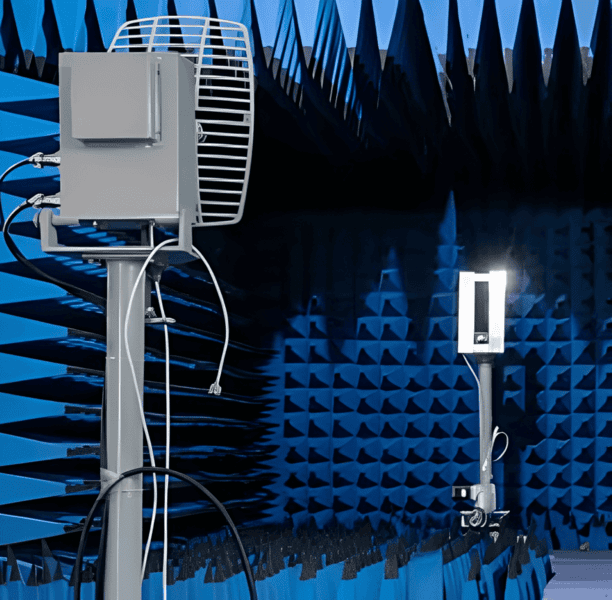
The antenna prototype is tested in an anechoic chamber to measure and analyze the electromagnetic radiation pattern. Engineer can accurately measure and analyze the antenna’s performance, identify any design flaws, and optimize the antenna’s radiation characteristics for specific applications.
Normally, we will arrange the shipment by DHL since it’s the fastest channel for prorotypes. There is no big difference on the freight cost compared with FedEx/UPS.
cURL Too many subrequests by single Worker invocation. To configure this limit, refer to https://developers.cloudflare.com/workers/wrangler/configuration/#limits.

Once the prototypes are received and tested in a real-world conditions and get approved. It’s suggested to place a small quantity trial order. This way, any potential problems or defects can be identified and resolved before moving forward with mass production.

Once the trial order has been successfully completed without any issues, we can proceed with mass production of the new antenna product. What we need to do next is to reduce the cost without compromise on the product quality and performance. It’s included but not limited to optimizing the product performance & structure, improving production efficiency, and source new suppliers, etc.

Compressing lead times for mass production of Microwave antenna is crucial for businesses looking to meet customer demands and stay competitive in the market. By implementing strategies such as optimizing production processes, streamlining supply chain management, and utilizing advanced manufacturing technologies, companies can significantly reduce the time it takes to produce Microwave antennas and improve overall operational efficiency.

We have crafted the following articles to provide you with a comprehensive understanding of the functionality, operation, and applications of Microwave antennas. These articles includes but are not limited to the Microwave antenna operating frequency, polarization, flange, components and applications, etc.
We have prepared articles to give you a clear overview of microwave antennas, covering topics such as operating frequency, polarization, flange, components, and applications.

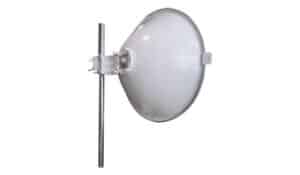
When purchasing Microwave antennas from China, there are several common pitfalls that buyers should be aware of. These pitfalls include poor quality control, misleading specifications, and lack of technical support, etc.
cURL Too many subrequests by single Worker invocation. To configure this limit, refer to https://developers.cloudflare.com/workers/wrangler/configuration/#limits. cURL Too many subrequests by single Worker invocation. To configure this limit, refer to https://developers.cloudflare.com/workers/wrangler/configuration/#limits.
When buying microwave antennas from China, common pitfalls include poor quality control, misleading specifications, and limited technical support. With many suppliers competing, it can be hard to find a reliable partner. Some lack the expertise to ensure performance and durability, while others prioritize quantity over quality, increasing the risk of defective or short-lived products.
cURL Too many subrequests by single Worker invocation. To configure this limit, refer to https://developers.cloudflare.com/workers/wrangler/configuration/#limits.
cURL Too many subrequests by single Worker invocation. To configure this limit, refer to https://developers.cloudflare.com/workers/wrangler/configuration/#limits.
cURL Too many subrequests by single Worker invocation. To configure this limit, refer to https://developers.cloudflare.com/workers/wrangler/configuration/#limits.
Other pitfalls include misleading specifications, where performance is exaggerated but not met in real use. Buyers may also face limited technical support, making installation or troubleshooting difficult. In addition, communication challenges such as language barriers and cultural differences can lead to misunderstandings and delays.



In conclusion, the common pitfalls when purchasing parabolic dish antennas from China include poor quality control, misleading specifications, lack of technical support and communication issues. These pitfalls occur due to the large number of suppliers, the prioritization of quantity over quality, exaggerated claims by manufacturers, lack of experience or expertise, inadequate technical support, and communication challenges. Buyers should be cautious and conduct thorough research before making a purchase to avoid falling into these pitfalls.
We are the best choice because we offer top-notch quality and exceptional service. With years of experience in the industry, we have developed a reputation for delivering excellent results and exceeding our clients’ expectations. Our team of experts is highly skilled and knowledgeable, ensuring that we can handle any project with ease. We are committed to providing personalized attention to each client, understanding their unique needs and delivering tailored solutions. Our dedication to customer satisfaction is unmatched, and we go above and beyond to ensure that our clients are happy with our work. Choose us for unparalleled quality and service.
There are several reasons why you should choose us:
1. Quality: We are committed to providing high-quality products and services. Our team consists of experienced professionals who are dedicated to delivering the best results.
2. Expertise: We have a deep understanding of our industry and the specific needs of our customers. We stay up-to-date with the latest trends and technologies to ensure we can offer the most innovative solutions.
3. Customer service: We prioritize our customers and strive to provide excellent customer service. We are responsive to inquiries, listen to feedback, and work closely with our clients to meet their needs.
4. Trust and reliability: We have a strong reputation for being trustworthy and reliable. Our customers trust us to deliver on our promises and to consistently provide exceptional products and services.
5. Long-term partnerships: We believe in building long-term relationships with our customers. We are not just interested in making a quick sale; we want to be a trusted partner that our customers can rely on for years to come.
In summary, we offer quality, expertise, excellent customer service, trust and reliability, and long-term partnerships.
Below, you will find a list of 20 frequently asked questions along with their concise answers. We have spent 15 years supplying antennas and serving customers worldwide, which has allowed us to accumulate a wealth of knowledge and experience. If you have any additional questions, please feel free to reach out to us directly.
A microwave antenna is a type of antenna that is used to transmit and receive microwave frequency signals, typically in the range of 5.925 GHz to 86 GHz.
They are commonly used for point-to-point communications and backhaul networks, and radar systems.
Backhaul refers to the part of the network that connects the core network to the edge or access networks, often using high-capacity microwave links.
Common frequency bands include 6 GHz, 11 GHz, 18 GHz, 23 GHz, and 38 GHz.
Weather conditions like rain, snow, and fog can attenuate microwave signals, especially at higher frequencies.
Line-of-sight means that there must be a clear, unobstructed path between the transmitting and receiving antennas.
The range can vary from a few kilometers to over 50 kilometers, depending on frequency, power, and environmental conditions.
Microwave frequencies range from 1 GHz to 30 GHz, while millimeter-wave frequencies range from 30 GHz to 300 GHz.
Polarization refers to the orientation of the electromagnetic wave. Common types include vertical, horizontal, and dual polarization, which can help reduce interference and increase the data throughput.
cURL Too many subrequests by single Worker invocation. To configure this limit, refer to https://developers.cloudflare.com/workers/wrangler/configuration/#limits.
cURL Too many subrequests by single Worker invocation. To configure this limit, refer to https://developers.cloudflare.com/workers/wrangler/configuration/#limits.
cURL Too many subrequests by single Worker invocation. To configure this limit, refer to https://developers.cloudflare.com/workers/wrangler/configuration/#limits.
cURL Too many subrequests by single Worker invocation. To configure this limit, refer to https://developers.cloudflare.com/workers/wrangler/configuration/#limits.
cURL Too many subrequests by single Worker invocation. To configure this limit, refer to https://developers.cloudflare.com/workers/wrangler/configuration/#limits.
cURL Too many subrequests by single Worker invocation. To configure this limit, refer to https://developers.cloudflare.com/workers/wrangler/configuration/#limits.
cURL Too many subrequests by single Worker invocation. To configure this limit, refer to https://developers.cloudflare.com/workers/wrangler/configuration/#limits.
cURL Too many subrequests by single Worker invocation. To configure this limit, refer to https://developers.cloudflare.com/workers/wrangler/configuration/#limits.
cURL Too many subrequests by single Worker invocation. To configure this limit, refer to https://developers.cloudflare.com/workers/wrangler/configuration/#limits.
cURL Too many subrequests by single Worker invocation. To configure this limit, refer to https://developers.cloudflare.com/workers/wrangler/configuration/#limits.
cURL Too many subrequests by single Worker invocation. To configure this limit, refer to https://developers.cloudflare.com/workers/wrangler/configuration/#limits.
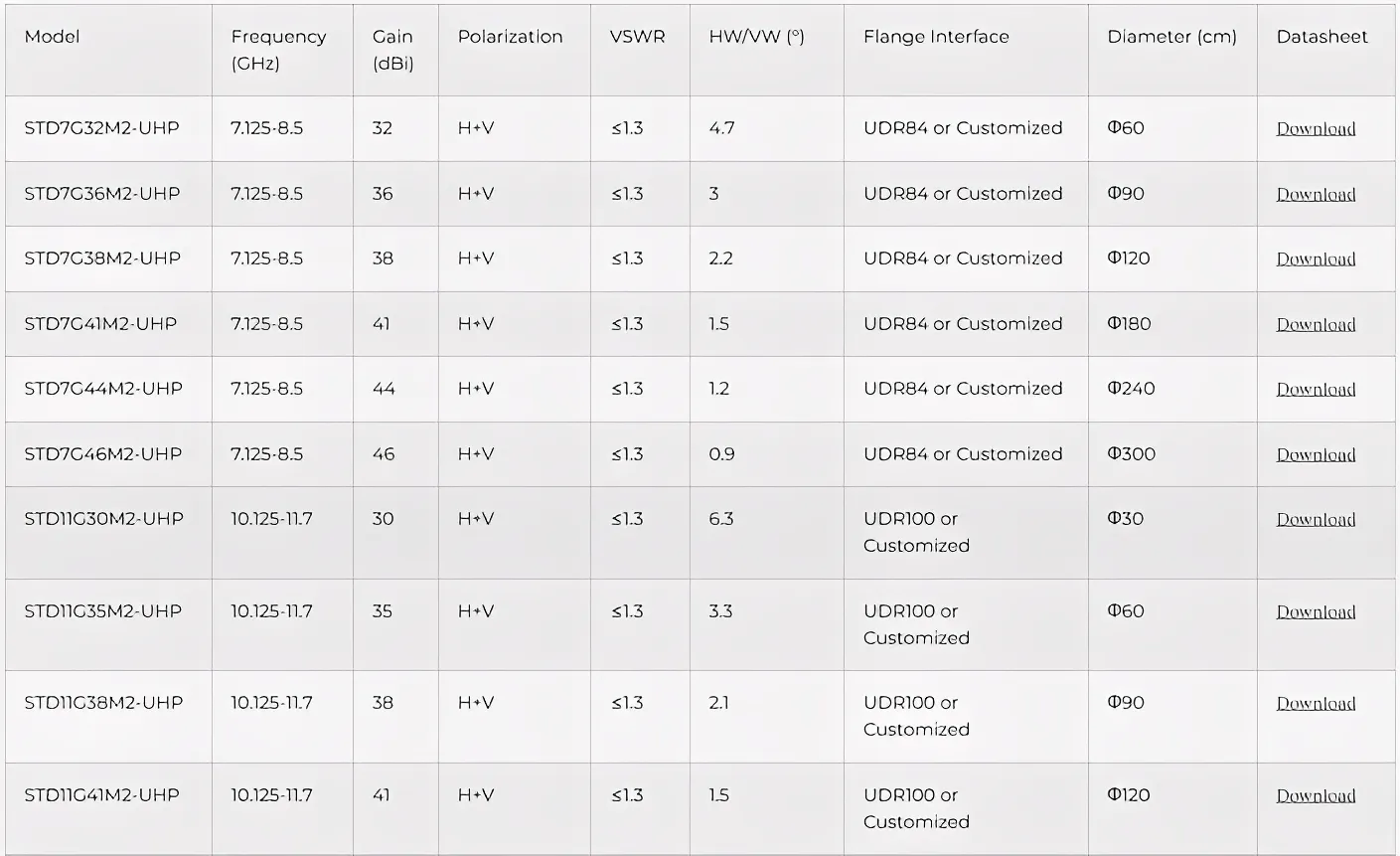
| cURL Too many subrequests by single Worker invocation. To configure this limit, refer to https://developers.cloudflare.com/workers/wrangler/configuration/#limits | Frequency (GHz) | Gain (dBi) | cURL Too many subrequests by single Worker invocation. To configure this limit, refer to https://developers.cloudflare.com/workers/wrangler/configuration/#limits | VSWR | HW/VW (°) | Flange Interface | Diameter (cm) | Datasheet |
| STD7G32M2-UHP | 7.125-8.5 | 32 | H+V | ≤1.3 | 4.7 | UDR84 or Customized | Φ60 | Download |
| STD7G36M2-UHP | 7.125-8.5 | 36 | H+V | ≤1.3 | 3 | UDR84 or Customized | Φ90 | Download |
| cURL Too many subrequests by single Worker invocation. To configure this limit, refer to https://developers.cloudflare.com/workers/wrangler/configuration/#limits | 7.125-8.5 | 38 | H+V | ≤1.3 | 2.2 | UDR84 or Customized | cURL Too many subrequests by single Worker invocation. To configure this limit, refer to https://developers.cloudflare.com/workers/wrangler/configuration/#limits | Download |
| STD7G41M2-UHP | 7.125-8.5 | 41 | H+V | ≤1.3 | 1.5 | UDR84 or Customized | Φ180 | Download |
| STD7G44M2-UHP | 7.125-8.5 | 44 | H+V | ≤1.3 | 1.2 | UDR84 or Customized | Φ240 | Download |
| STD7G46M2-UHP | 7.125-8.5 | 46 | H+V | ≤1.3 | 0.9 | UDR84 or Customized | Φ300 | Download |
| STD11G30M2-UHP | 10.125-11.7 | 30 | H+V | ≤1.3 | 6.3 | UDR100 or Customized | Φ30 | Download |
| STD11G35M2-UHP | 10.125-11.7 | 35 | H+V | ≤1.3 | 3.3 | UDR100 or Customized | Φ60 | Download |
| STD11G38M2-UHP | 10.125-11.7 | 38 | H+V | ≤1.3 | 2.1 | UDR100 or Customized | Φ90 | Download |
| STD11G41M2-UHP | 10.125-11.7 | 41 | H+V | ≤1.3 | 1.5 | UDR100 or Customized | cURL Too many subrequests by single Worker invocation. To configure this limit, refer to https://developers.cloudflare.com/workers/wrangler/configuration/#limits | Download |
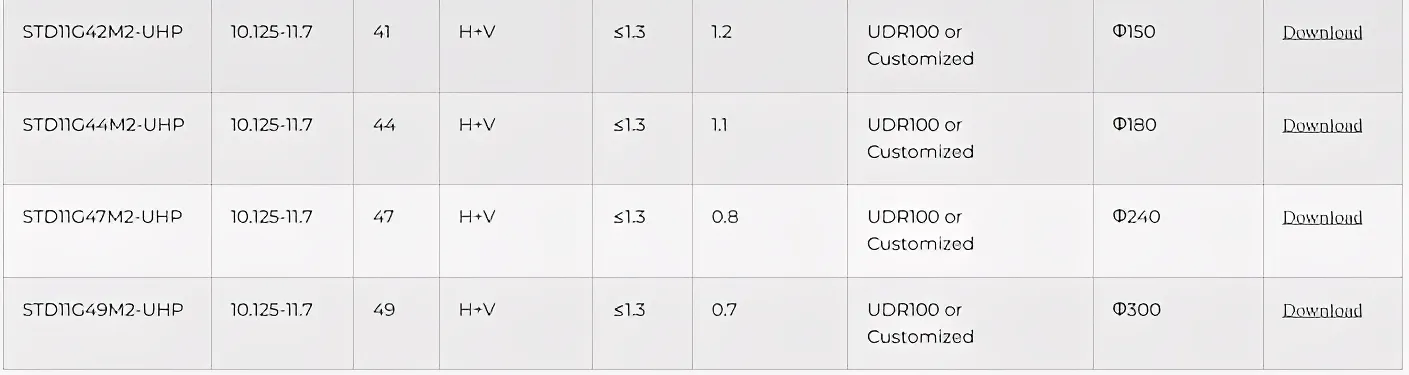
| STD11G42M2-UHP | 10.125-11.7 | 41 | H+V | ≤1.3 | 1.2 | UDR100 or Customized | Φ150 | Download |
| STD11G44M2-UHP | 10.125-11.7 | 44 | H+V | ≤1.3 | 1.1 | UDR100 or Customized | Φ180 | Download |
| STD11G47M2-UHP | 10.125-11.7 | 47 | H+V | ≤1.3 | 0.8 | UDR100 or Customized | Φ240 | Download |
| STD11G49M2-UHP | 10.125-11.7 | 49 | H+V | ≤1.3 | 0.7 | UDR100 or Customized | Φ300 | Download |
Wonderful, you have made the right choice. We will never let you down!
We will contact you within 2 hours of working days, please pay attention to the email with the suffix “@sannytelecom.com”.
Send us a message if you have any questions or request a quote. We will be back to you ASAP!
 BannerText_Seraphinite Accelerator

 Japanese
  English
  Spanish
  German
  French (France)
  Korean
  Russian
  Indonesian
  French (Canada)
  Vietnamese
  Armenian
  Albanian
  Assamese
  Acehnese
  Amharic
  Czech
Czech  Bulgarian
  Cebuano
  Malayalam
  German (Switzerland)
  Dutch
Dutch